 Add to Chrome
 Add to Firefox
 Add to Edge
Failure Ontology: A Lifelong Learning Framework for Blind Spot Detection and Resilience Design
Apr 12, 2026
Personalized learning systems are almost universally designed around a single objective: help people acquire knowledge and skills more efficiently. We argue this framing misses the more consequential problem. The most damaging failures in human life-financial ruin, health collapse, professional obsolescence-are rarely caused by insufficient knowledge acquisition. They arise from the systematic absence of entire conceptual territories from a person's cognitive map: domains they never thought to explore because, from within their existing worldview, those domains did not appear to exist or to matter. We call such absences Ontological Blind Spots and introduce Failure Ontology (F), a formal framework for detecting, classifying, and remediating them across a human lifetime. The framework introduces three original contributions: (1) a four-type taxonomy of blind spots distinguishing domain blindness, structural blindness, weight blindness, and temporal blindness; (2) five convergent failure patterns characterizing how blind spots interact with external disruption to produce catastrophic outcomes; and (3) the Failure Learning Efficiency Theorem, proving that failure-based learning achieves higher sample efficiency than success-based learning under bounded historical data. We illustrate the framework through historical case analysis of the 1997 Asian Financial Crisis and the 2008 subprime mortgage crisis, and through alongitudinal individual case study spanning five life stages.

Demonstration of DB-GPT: Next Generation Data Interaction System Empowered by Large Language Models
Apr 18, 2024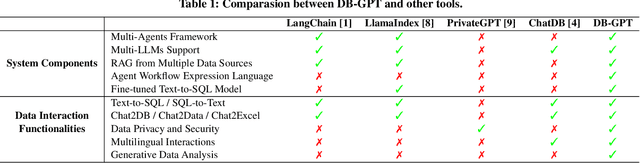
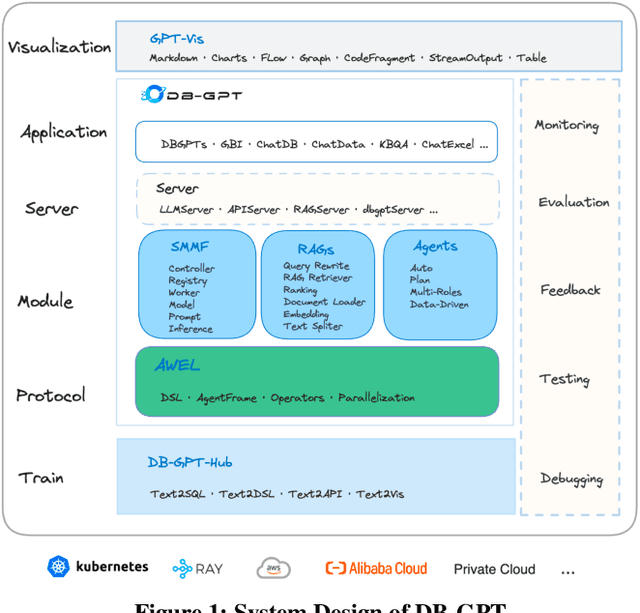

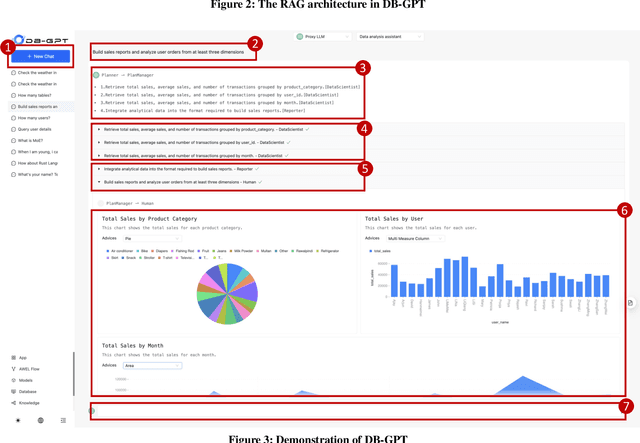
The recent breakthroughs in large language models (LLMs) are positioned to transition many areas of software. The technologies of interacting with data particularly have an important entanglement with LLMs as efficient and intuitive data interactions are paramount. In this paper, we present DB-GPT, a revolutionary and product-ready Python library that integrates LLMs into traditional data interaction tasks to enhance user experience and accessibility. DB-GPT is designed to understand data interaction tasks described by natural language and provide context-aware responses powered by LLMs, making it an indispensable tool for users ranging from novice to expert. Its system design supports deployment across local, distributed, and cloud environments. Beyond handling basic data interaction tasks like Text-to-SQL with LLMs, it can handle complex tasks like generative data analysis through a Multi-Agents framework and the Agentic Workflow Expression Language (AWEL). The Service-oriented Multi-model Management Framework (SMMF) ensures data privacy and security, enabling users to employ DB-GPT with private LLMs. Additionally, DB-GPT offers a series of product-ready features designed to enable users to integrate DB-GPT within their product environments easily. The code of DB-GPT is available at Github(https://github.com/eosphoros-ai/DB-GPT) which already has over 10.7k stars. Please install DB-GPT for your own usage with the instructions(https://github.com/eosphoros-ai/DB-GPT#install) and watch a 5-minute introduction video on Youtube(https://youtu.be/n_8RI1ENyl4) to further investigate DB-GPT.