 Add to Chrome
 Add to Firefox
 Add to Edge
Multiscale Hypersonic Boundary Layer Reconstruction via Spectral Binning and Subdomain-wise Conditional Diffusion
Jun 12, 2026
We propose a multiscale probabilistic reconstruction framework for hypersonic Couette flow, where near-wall states are inferred from limited top-wall observations using conditional diffusion model. The boundary layer is divided into overlapping wall-normal subdomains, and a single height- and Mach-conditioned Elucidating Diffusion Model (EDM) is trained jointly for M=6,7,8 to sample velocity, density, pressure, and temperature fields conditioned on a top-wall boundary slice. A soft overlap inpainting strategy assembles subdomain predictions into full-volume reconstructions while maintaining inter-subdomain continuity and small-scale variability. To improve the spectral fidelity of the generated fields, we introduce a novel bounded binned spectral power (BSP) loss that preserves high-wavenumber content while remaining numerically stable across the diffusion noise schedule. Validation against direct numerical simulation data shows that the model recovers instantaneous structures, spectra, statistical profiles, correlations, and wall quantities across all training Mach numbers, while providing spatially structured uncertainty estimates. The reconstructed Mach-conditioned profiles also collapse under the Trettel-Larsson transformation, indicating consistency with compressibility scaling. These results establish the domain decomposed conditional diffusion model with a bounded binned spectral loss as an effective probabilistic surrogate for near-wall reconstruction in hypersonic wall-bounded turbulence.

Adaptive Diffusion Posterior Sampling for Data and Model Fusion of Complex Nonlinear Dynamical Systems
Mar 13, 2026High-fidelity numerical simulations of chaotic, high dimensional nonlinear dynamical systems are computationally expensive, necessitating the development of efficient surrogate models. Most surrogate models for such systems are deterministic, for example when neural operators are involved. However, deterministic models often fail to capture the intrinsic distributional uncertainty of chaotic systems. This work presents a surrogate modeling formulation that leverages generative machine learning, where a deep learning diffusion model is used to probabilistically forecast turbulent flows over long horizons. We introduce a multi-step autoregressive diffusion objective that significantly enhances long-rollout stability compared to standard single-step training. To handle complex, unstructured geometries, we utilize a multi-scale graph transformer architecture incorporating diffusion preconditioning and voxel-grid pooling. More importantly, our modeling framework provides a unified platform that also predicts spatiotemporally important locations for sensor placement, either via uncertainty estimates or through an error-estimation module. Finally, the observations of the ground truth state at these dynamically varying sensor locations are assimilated using diffusion posterior sampling requiring no retraining of the surrogate model. We present our methodology on two-dimensional homogeneous and isotropic turbulence and for a flow over a backwards-facing step, demonstrating its utility in forecasting, adaptive sensor placement, and data assimilation for high dimensional chaotic systems.
Improving the Accuracy of Community Detection on Signed Networks via Community Refinement and Contrastive Learning
Jan 23, 2026Community detection (CD) on signed networks is crucial for understanding how positive and negative relations jointly shape network structure. However, existing CD methods often yield inconsistent communities due to noisy or conflicting edge signs. In this paper, we propose ReCon, a model-agnostic post-processing framework that progressively refines community structures through four iterative steps: (1) structural refinement, (2) boundary refinement, (3) contrastive learning, and (4) clustering. Extensive experiments on eighteen synthetic and four real-world networks using four CD methods demonstrate that ReCon consistently enhances community detection accuracy, serving as an effective and easily integrable solution for reliable CD across diverse network properties.
Reasoning or Fluency? Dissecting Probabilistic Confidence in Best-of-N Selection
Jan 20, 2026Probabilistic confidence metrics are increasingly adopted as proxies for reasoning quality in Best-of-N selection, under the assumption that higher confidence reflects higher reasoning fidelity. In this work, we challenge this assumption by investigating whether these metrics truly capture inter-step causal dependencies necessary for valid reasoning. We introduce three classes of inter-step causality perturbations that systematically disrupt dependencies between reasoning steps while preserving local fluency. Surprisingly, across diverse model families and reasoning benchmarks, we find that selection accuracy degrades only marginally under these disruptions. Even severe interventions, such as applying hard attention masks that directly prevent the model from attending to prior reasoning steps, do not substantially reduce selection performance. These findings provide strong evidence that current probabilistic metrics are largely insensitive to logical structure, and primarily capture surface-level fluency or in-distribution priors instead. Motivated by this gap, we propose a contrastive causality metric that explicitly isolates inter-step causal dependencies, and demonstrate that it yields more faithful output selection than existing probability-based approaches.
Offline-to-Online Knowledge Distillation for Video Instance Segmentation
Feb 15, 2023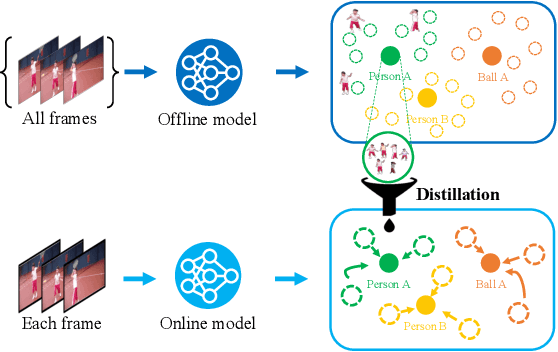
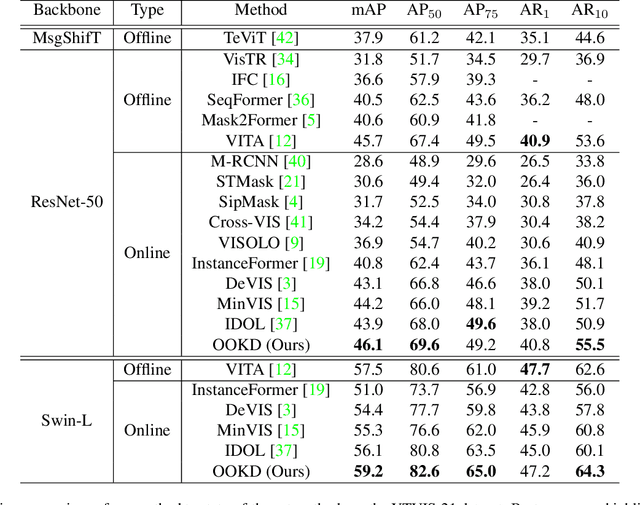
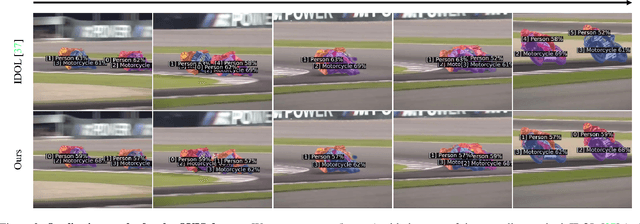
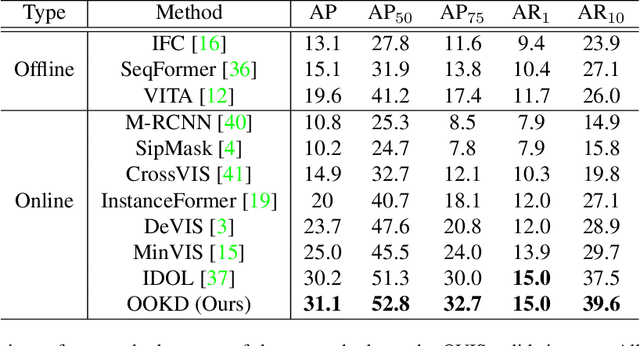
In this paper, we present offline-to-online knowledge distillation (OOKD) for video instance segmentation (VIS), which transfers a wealth of video knowledge from an offline model to an online model for consistent prediction. Unlike previous methods that having adopting either an online or offline model, our single online model takes advantage of both models by distilling offline knowledge. To transfer knowledge correctly, we propose query filtering and association (QFA), which filters irrelevant queries to exact instances. Our KD with QFA increases the robustness of feature matching by encoding object-centric features from a single frame supplemented by long-range global information. We also propose a simple data augmentation scheme for knowledge distillation in the VIS task that fairly transfers the knowledge of all classes into the online model. Extensive experiments show that our method significantly improves the performance in video instance segmentation, especially for challenging datasets including long, dynamic sequences. Our method also achieves state-of-the-art performance on YTVIS-21, YTVIS-22, and OVIS datasets, with mAP scores of 46.1%, 43.6%, and 31.1%, respectively.