 Add to Chrome
 Add to Firefox
 Add to Edge
Improving the Accuracy of Community Detection on Signed Networks via Community Refinement and Contrastive Learning
Jan 23, 2026
Community detection (CD) on signed networks is crucial for understanding how positive and negative relations jointly shape network structure. However, existing CD methods often yield inconsistent communities due to noisy or conflicting edge signs. In this paper, we propose ReCon, a model-agnostic post-processing framework that progressively refines community structures through four iterative steps: (1) structural refinement, (2) boundary refinement, (3) contrastive learning, and (4) clustering. Extensive experiments on eighteen synthetic and four real-world networks using four CD methods demonstrate that ReCon consistently enhances community detection accuracy, serving as an effective and easily integrable solution for reliable CD across diverse network properties.

UD-KSL Treebank v1.3: A semi-automated framework for aligning XPOS-extracted units with UPOS tags
Jun 11, 2025
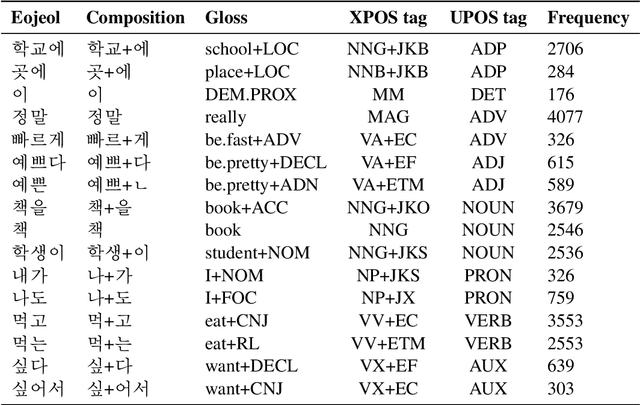


The present study extends recent work on Universal Dependencies annotations for second-language (L2) Korean by introducing a semi-automated framework that identifies morphosyntactic constructions from XPOS sequences and aligns those constructions with corresponding UPOS categories. We also broaden the existing L2-Korean corpus by annotating 2,998 new sentences from argumentative essays. To evaluate the impact of XPOS-UPOS alignments, we fine-tune L2-Korean morphosyntactic analysis models on datasets both with and without these alignments, using two NLP toolkits. Our results indicate that the aligned dataset not only improves consistency across annotation layers but also enhances morphosyntactic tagging and dependency-parsing accuracy, particularly in cases of limited annotated data.