 Add to Chrome
 Add to Firefox
 Add to Edge
3D HAMSTER: Bridging Planning and Control in Hierarchical Vision Language Action Models through 3D Trajectory Guidance
Jul 01, 2026
Hierarchical Vision-Language-Action (VLA) models decouple high-level planning from low-level control to improve generalization in robot manipulation. Recent work in this paradigm uses 2D end-effector trajectories predicted by a Vision-Language Model (VLM) as explicit guidance for a downstream policy. However, state-of-the-art low-level policies operate in 3D metric space on point clouds, and feeding them 2D guidance that lacks depth forces each waypoint to be assigned the depth of whatever scene surface lies beneath it, producing geometrically distorted trajectories. We propose 3D HAMSTER, a hierarchical framework that closes this gap by having the planner directly output metrically reliable 3D trajectories. We augment a VLM with a dedicated depth encoder and a dense depth reconstruction objective to predict 3D waypoint sequences, which are directly integrated into a pointcloudbased low-level policy. Across 3D trajectory prediction, simulation, and real-world manipulation, 3D HAMSTER consistently outperforms proprietary VLMs and 2D-guided baselines, with the largest gains under appearance-altering shifts and unseen language, spatial, and visual conditions. The project page is available at https://davian-robotics.github.io/3D_HAMSTER/.

InsertAnywhere: Bridging 4D Scene Geometry and Diffusion Models for Realistic Video Object Insertion
Dec 19, 2025Recent advances in diffusion-based video generation have opened new possibilities for controllable video editing, yet realistic video object insertion (VOI) remains challenging due to limited 4D scene understanding and inadequate handling of occlusion and lighting effects. We present InsertAnywhere, a new VOI framework that achieves geometrically consistent object placement and appearance-faithful video synthesis. Our method begins with a 4D aware mask generation module that reconstructs the scene geometry and propagates user specified object placement across frames while maintaining temporal coherence and occlusion consistency. Building upon this spatial foundation, we extend a diffusion based video generation model to jointly synthesize the inserted object and its surrounding local variations such as illumination and shading. To enable supervised training, we introduce ROSE++, an illumination aware synthetic dataset constructed by transforming the ROSE object removal dataset into triplets of object removed video, object present video, and a VLM generated reference image. Through extensive experiments, we demonstrate that our framework produces geometrically plausible and visually coherent object insertions across diverse real world scenarios, significantly outperforming existing research and commercial models.
Infinite-Homography as Robust Conditioning for Camera-Controlled Video Generation
Dec 18, 2025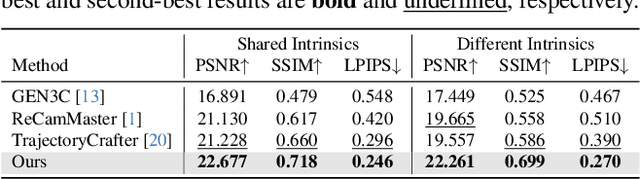
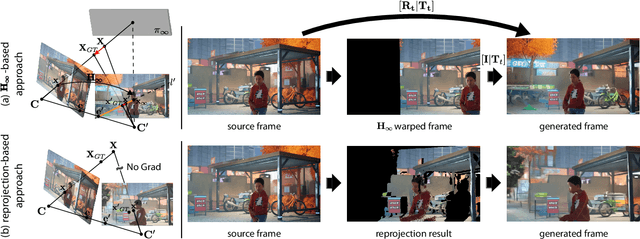
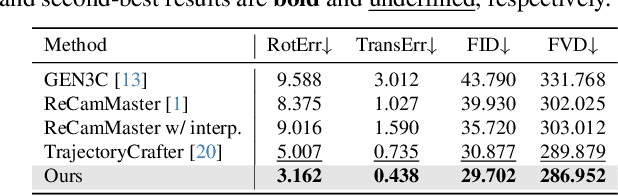
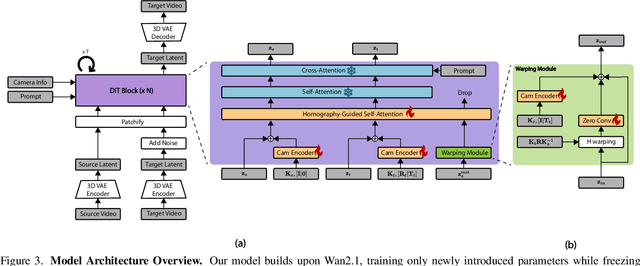
Recent progress in video diffusion models has spurred growing interest in camera-controlled novel-view video generation for dynamic scenes, aiming to provide creators with cinematic camera control capabilities in post-production. A key challenge in camera-controlled video generation is ensuring fidelity to the specified camera pose, while maintaining view consistency and reasoning about occluded geometry from limited observations. To address this, existing methods either train trajectory-conditioned video generation model on trajectory-video pair dataset, or estimate depth from the input video to reproject it along a target trajectory and generate the unprojected regions. Nevertheless, existing methods struggle to generate camera-pose-faithful, high-quality videos for two main reasons: (1) reprojection-based approaches are highly susceptible to errors caused by inaccurate depth estimation; and (2) the limited diversity of camera trajectories in existing datasets restricts learned models. To address these limitations, we present InfCam, a depth-free, camera-controlled video-to-video generation framework with high pose fidelity. The framework integrates two key components: (1) infinite homography warping, which encodes 3D camera rotations directly within the 2D latent space of a video diffusion model. Conditioning on this noise-free rotational information, the residual parallax term is predicted through end-to-end training to achieve high camera-pose fidelity; and (2) a data augmentation pipeline that transforms existing synthetic multiview datasets into sequences with diverse trajectories and focal lengths. Experimental results demonstrate that InfCam outperforms baseline methods in camera-pose accuracy and visual fidelity, generalizing well from synthetic to real-world data. Link to our project page:https://emjay73.github.io/InfCam/
PromptDresser: Improving the Quality and Controllability of Virtual Try-On via Generative Textual Prompt and Prompt-aware Mask
Dec 22, 2024Recent virtual try-on approaches have advanced by fine-tuning the pre-trained text-to-image diffusion models to leverage their powerful generative ability. However, the use of text prompts in virtual try-on is still underexplored. This paper tackles a text-editable virtual try-on task that changes the clothing item based on the provided clothing image while editing the wearing style (e.g., tucking style, fit) according to the text descriptions. In the text-editable virtual try-on, three key aspects exist: (i) designing rich text descriptions for paired person-clothing data to train the model, (ii) addressing the conflicts where textual information of the existing person's clothing interferes the generation of the new clothing, and (iii) adaptively adjust the inpainting mask aligned with the text descriptions, ensuring proper editing areas while preserving the original person's appearance irrelevant to the new clothing. To address these aspects, we propose PromptDresser, a text-editable virtual try-on model that leverages large multimodal model (LMM) assistance to enable high-quality and versatile manipulation based on generative text prompts. Our approach utilizes LMMs via in-context learning to generate detailed text descriptions for person and clothing images independently, including pose details and editing attributes using minimal human cost. Moreover, to ensure the editing areas, we adjust the inpainting mask depending on the text prompts adaptively. We found that our approach, utilizing detailed text prompts, not only enhances text editability but also effectively conveys clothing details that are difficult to capture through images alone, thereby enhancing image quality. Our code is available at https://github.com/rlawjdghek/PromptDresser.