 Add to Chrome
 Add to Firefox
 Add to Edge
K-EXAONE 2.0 Technical Report
Aug 05, 2026
This technical report presents K-EXAONE 2.0, an open-weight multilingual foundation model developed by LG AI Research as a step in our effort toward global frontier-scale foundation models. Rather than training from scratch, we upcycle K-EXAONE and expand its architecture, yielding a Mixture-of-Experts (MoE) model with 750B total parameters and approximately 37B activated per token---more than three times the capacity of its predecessor. K-EXAONE 2.0 supports context lengths of up to 256K tokens and expands multilingual coverage from six to ten languages. Its training pipeline combines continual pre-training, difficulty-focused mid-training, and post-training to strengthen reasoning, agentic coding, multilingual capability, and safety grounded in Korean sociocultural contexts. Across nine evaluation categories selected to reflect the conditions of practical use, K-EXAONE 2.0 improves over K-EXAONE and remains competitive with open-weight models, showing its largest gains in agentic coding and long-context understanding and its clearest strengths in long-context retrieval and safety. Released under the Apache 2.0 license, K-EXAONE 2.0 enables the wider AI ecosystem to evaluate, deploy, adapt, and build upon it, while marking the beginning---rather than the endpoint---of our challenge toward the global frontier.

3D HAMSTER: Bridging Planning and Control in Hierarchical Vision Language Action Models through 3D Trajectory Guidance
Jul 01, 2026Hierarchical Vision-Language-Action (VLA) models decouple high-level planning from low-level control to improve generalization in robot manipulation. Recent work in this paradigm uses 2D end-effector trajectories predicted by a Vision-Language Model (VLM) as explicit guidance for a downstream policy. However, state-of-the-art low-level policies operate in 3D metric space on point clouds, and feeding them 2D guidance that lacks depth forces each waypoint to be assigned the depth of whatever scene surface lies beneath it, producing geometrically distorted trajectories. We propose 3D HAMSTER, a hierarchical framework that closes this gap by having the planner directly output metrically reliable 3D trajectories. We augment a VLM with a dedicated depth encoder and a dense depth reconstruction objective to predict 3D waypoint sequences, which are directly integrated into a pointcloudbased low-level policy. Across 3D trajectory prediction, simulation, and real-world manipulation, 3D HAMSTER consistently outperforms proprietary VLMs and 2D-guided baselines, with the largest gains under appearance-altering shifts and unseen language, spatial, and visual conditions. The project page is available at https://davian-robotics.github.io/3D_HAMSTER/.
EXAONE 4.5 Technical Report
Apr 09, 2026This technical report introduces EXAONE 4.5, the first open-weight vision language model released by LG AI Research. EXAONE 4.5 is architected by integrating a dedicated visual encoder into the existing EXAONE 4.0 framework, enabling native multimodal pretraining over both visual and textual modalities. The model is trained on large-scale data with careful curation, particularly emphasizing document-centric corpora that align with LG's strategic application domains. This targeted data design enables substantial performance gains in document understanding and related tasks, while also delivering broad improvements across general language capabilities. EXAONE 4.5 extends context length up to 256K tokens, facilitating long-context reasoning and enterprise-scale use cases. Comparative evaluations demonstrate that EXAONE 4.5 achieves competitive performance in general benchmarks while outperforming state-of-the-art models of similar scale in document understanding and Korean contextual reasoning. As part of LG's ongoing effort toward practical industrial deployment, EXAONE 4.5 is designed to be continuously extended with additional domains and application scenarios to advance AI for a better life.
An Analysis of Concept Bottleneck Models: Measuring, Understanding, and Mitigating the Impact of Noisy Annotations
May 22, 2025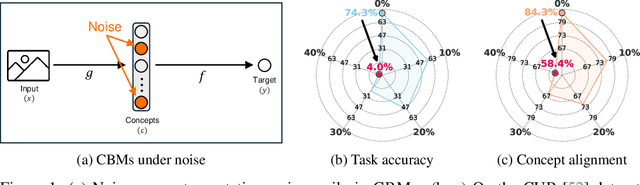
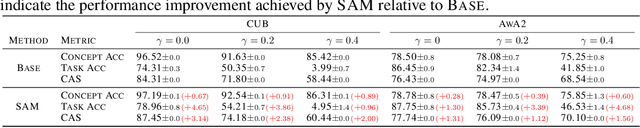
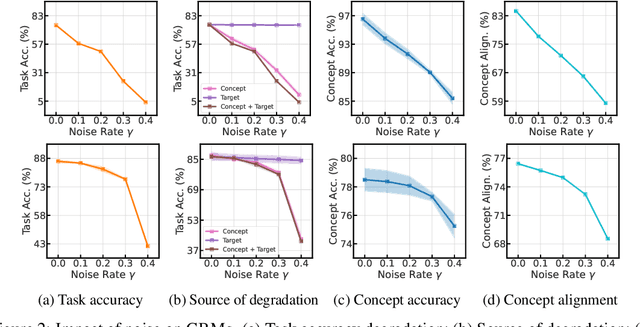

Concept bottleneck models (CBMs) ensure interpretability by decomposing predictions into human interpretable concepts. Yet the annotations used for training CBMs that enable this transparency are often noisy, and the impact of such corruption is not well understood. In this study, we present the first systematic study of noise in CBMs and show that even moderate corruption simultaneously impairs prediction performance, interpretability, and the intervention effectiveness. Our analysis identifies a susceptible subset of concepts whose accuracy declines far more than the average gap between noisy and clean supervision and whose corruption accounts for most performance loss. To mitigate this vulnerability we propose a two-stage framework. During training, sharpness-aware minimization stabilizes the learning of noise-sensitive concepts. During inference, where clean labels are unavailable, we rank concepts by predictive entropy and correct only the most uncertain ones, using uncertainty as a proxy for susceptibility. Theoretical analysis and extensive ablations elucidate why sharpness-aware training confers robustness and why uncertainty reliably identifies susceptible concepts, providing a principled basis that preserves both interpretability and resilience in the presence of noise.