 Add to Chrome
 Add to Firefox
 Add to Edge
From Top-1 to Top-K: A Reproducibility Study and Benchmarking of Counterfactual Explanations for Recommender Systems
Apr 21, 2026
Counterfactual explanations (CEs) provide an intuitive way to understand recommender systems by identifying minimal modifications to user-item interactions that alter recommendation outcomes. Existing CE methods for recommender systems, however, have been evaluated under heterogeneous protocols, using different datasets, recommenders, metrics, and even explanation formats, which hampers reproducibility and fair comparison. Our paper systematically reproduces, re-implement, and re-evaluate eleven state-of-the-art CE methods for recommender systems, covering both native explainers (e.g., LIME-RS, SHAP, PRINCE, ACCENT, LXR, GREASE) and specific graph-based explainers originally proposed for GNNs. Here, a unified benchmarking framework is proposed to assess explainers along three dimensions: explanation format (implicit vs. explicit), evaluation level (item-level vs. list-level), and perturbation scope (user interaction vectors vs. user-item interaction graphs). Our evaluation protocol includes effectiveness, sparsity, and computational complexity metrics, and extends existing item-level assessments to top-K list-level explanations. Through extensive experiments on three real-world datasets and six representative recommender models, we analyze how well previously reported strengths of CE methods generalize across diverse setups. We observe that the trade-off between effectiveness and sparsity depends strongly on the specific method and evaluation setting, particularly under the explicit format; in addition, explainer performance remains largely consistent across item level and list level evaluations, and several graph-based explainers exhibit notable scalability limitations on large recommender graphs. Our results refine and challenge earlier conclusions about the robustness and practicality of CE generation methods in recommender systems: https://github.com/L2R-UET/CFExpRec.

Counterfactual Understanding via Retrieval-aware Multimodal Modeling for Time-to-Event Survival Prediction
Feb 23, 2026This paper tackles the problem of time-to-event counterfactual survival prediction, aiming to optimize individualized survival outcomes in the presence of heterogeneity and censored data. We propose CURE, a framework that advances counterfactual survival modeling via comprehensive multimodal embedding and latent subgroup retrieval. CURE integrates clinical, paraclinical, demographic, and multi-omics information, which are aligned and fused through cross-attention mechanisms. Complex multi-omics signals can be adaptively refined using a mixture-of-experts architecture, emphasizing the most informative omics components. Building upon this representation, CURE implicitly retrieves patient-specific latent subgroups that capture both baseline survival dynamics and treatment-dependent variations. Experimental results on METABRIC and TCGA-LUAD datasets demonstrate that proposed CURE model consistently outperforms strong baselines in survival analysis, evaluated using the Time-dependent Concordance Index ($C^{td}$) and Integrated Brier Score (IBS). These findings highlight the potential of CURE to enhance multimodal understanding and serve as a foundation for future treatment recommendation models. All code and related resources are publicly available to facilitate the reproducibility https://github.com/L2R-UET/CURE.
Multi-modal Adaptive Mixture of Experts for Cold-start Recommendation
Aug 11, 2025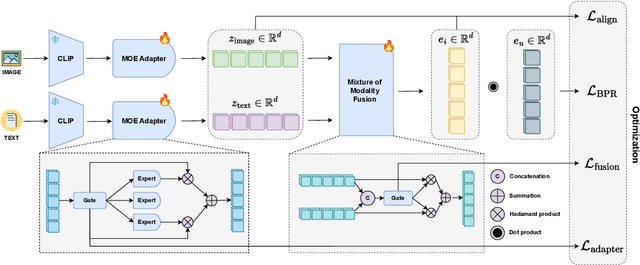
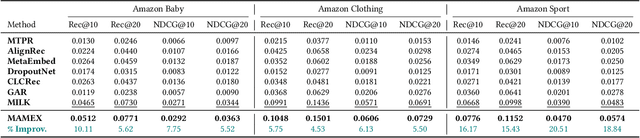
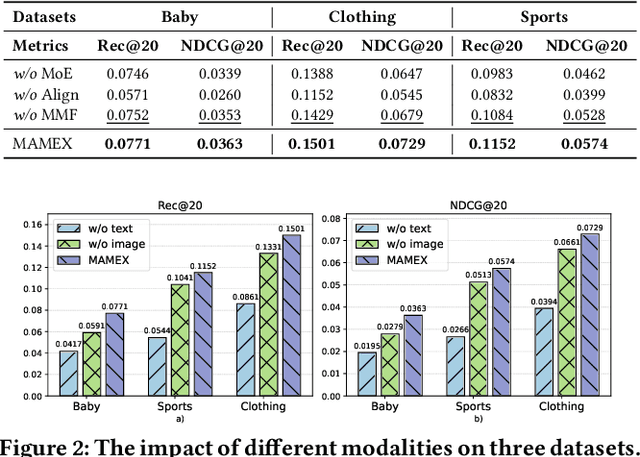
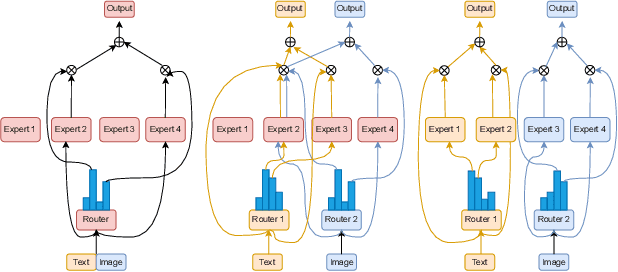
Recommendation systems have faced significant challenges in cold-start scenarios, where new items with a limited history of interaction need to be effectively recommended to users. Though multimodal data (e.g., images, text, audio, etc.) offer rich information to address this issue, existing approaches often employ simplistic integration methods such as concatenation, average pooling, or fixed weighting schemes, which fail to capture the complex relationships between modalities. Our study proposes a novel Mixture of Experts (MoE) framework for multimodal cold-start recommendation, named MAMEX, which dynamically leverages latent representation from different modalities. MAMEX utilizes modality-specific expert networks and introduces a learnable gating mechanism that adaptively weights the contribution of each modality based on its content characteristics. This approach enables MAMEX to emphasize the most informative modalities for each item while maintaining robustness when certain modalities are less relevant or missing. Extensive experiments on benchmark datasets show that MAMEX outperforms state-of-the-art methods in cold-start scenarios, with superior accuracy and adaptability. For reproducibility, the code has been made available on Github https://github.com/L2R-UET/MAMEX.