 Add to Chrome
 Add to Firefox
 Add to Edge
LaMoGen: Language to Motion Generation Through LLM-Guided Symbolic Inference
Mar 12, 2026
Human motion is highly expressive and naturally aligned with language, yet prevailing methods relying heavily on joint text-motion embeddings struggle to synthesize temporally accurate, detailed motions and often lack explainability. To address these limitations, we introduce LabanLite, a motion representation developed by adapting and extending the Labanotation system. Unlike black-box text-motion embeddings, LabanLite encodes each atomic body-part action (e.g., a single left-foot step) as a discrete Laban symbol paired with a textual template. This abstraction decomposes complex motions into interpretable symbol sequences and body-part instructions, establishing a symbolic link between high-level language and low-level motion trajectories. Building on LabanLite, we present LaMoGen, a Text-to-LabanLite-to-Motion Generation framework that enables large language models (LLMs) to compose motion sequences through symbolic reasoning. The LLM interprets motion patterns, relates them to textual descriptions, and recombines symbols into executable plans, producing motions that are both interpretable and linguistically grounded. To support rigorous evaluation, we introduce a Labanotation-based benchmark with structured description-motion pairs and three metrics that jointly measure text-motion alignment across symbolic, temporal, and harmony dimensions. Experiments demonstrate that LaMoGen establishes a new baseline for both interpretability and controllability, outperforming prior methods on our benchmark and two public datasets. These results highlight the advantages of symbolic reasoning and agent-based design for language-driven motion synthesis.

Learning Context-Adaptive Motion Priors for Masked Motion Diffusion Models with Efficient Kinematic Attention Aggregation
Mar 08, 2026Vision-based motion capture solutions often struggle with occlusions, which result in the loss of critical joint information and hinder accurate 3D motion reconstruction. Other wearable alternatives also suffer from noisy or unstable data, often requiring extensive manual cleaning and correction to achieve reliable results. To address these challenges, we introduce the Masked Motion Diffusion Model (MMDM), a diffusion-based generative reconstruction framework that enhances incomplete or low-confidence motion data using partially available high-quality reconstructions within a Masked Autoencoder architecture. Central to our design is the Kinematic Attention Aggregation (KAA) mechanism, which enables efficient, deep, and iterative encoding of both joint-level and pose-level features, capturing structural and temporal motion patterns essential for task-specific reconstruction. We focus on learning context-adaptive motion priors, specialized structural and temporal features extracted by the same reusable architecture, where each learned prior emphasizes different aspects of motion dynamics and is specifically efficient for its corresponding task. This enables the architecture to adaptively specialize without altering its structure. Such versatility allows MMDM to efficiently learn motion priors tailored to scenarios such as motion refinement, completion, and in-betweening. Extensive evaluations on public benchmarks demonstrate that MMDM achieves strong performance across diverse masking strategies and task settings. The source code is available at https://github.com/jjkislele/MMDM.
Deep Compositional Phase Diffusion for Long Motion Sequence Generation
Oct 16, 2025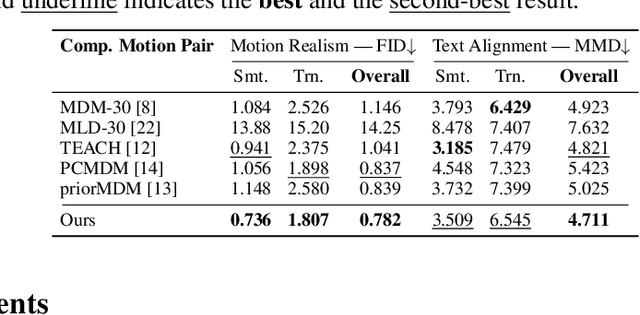
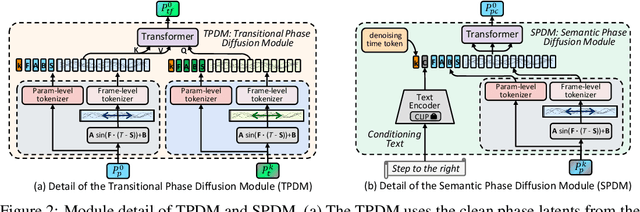
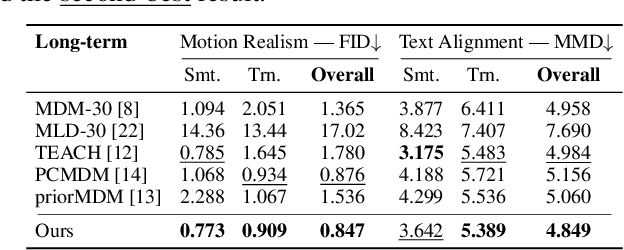
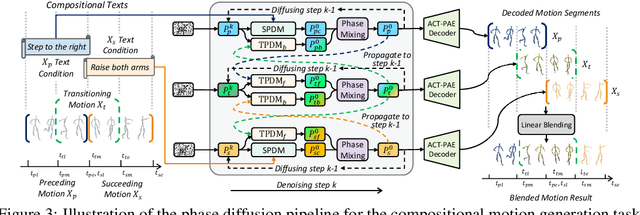
Recent research on motion generation has shown significant progress in generating semantically aligned motion with singular semantics. However, when employing these models to create composite sequences containing multiple semantically generated motion clips, they often struggle to preserve the continuity of motion dynamics at the transition boundaries between clips, resulting in awkward transitions and abrupt artifacts. To address these challenges, we present Compositional Phase Diffusion, which leverages the Semantic Phase Diffusion Module (SPDM) and Transitional Phase Diffusion Module (TPDM) to progressively incorporate semantic guidance and phase details from adjacent motion clips into the diffusion process. Specifically, SPDM and TPDM operate within the latent motion frequency domain established by the pre-trained Action-Centric Motion Phase Autoencoder (ACT-PAE). This allows them to learn semantically important and transition-aware phase information from variable-length motion clips during training. Experimental results demonstrate the competitive performance of our proposed framework in generating compositional motion sequences that align semantically with the input conditions, while preserving phase transitional continuity between preceding and succeeding motion clips. Additionally, motion inbetweening task is made possible by keeping the phase parameter of the input motion sequences fixed throughout the diffusion process, showcasing the potential for extending the proposed framework to accommodate various application scenarios. Codes are available at https://github.com/asdryau/TransPhase.
Every Angle Is Worth A Second Glance: Mining Kinematic Skeletal Structures from Multi-view Joint Cloud
Feb 05, 2025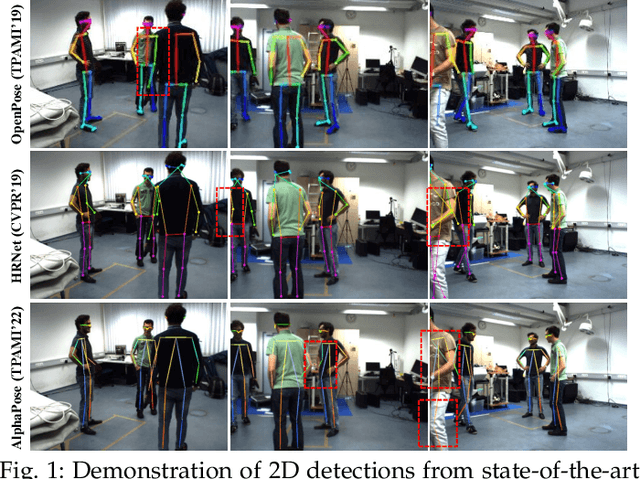
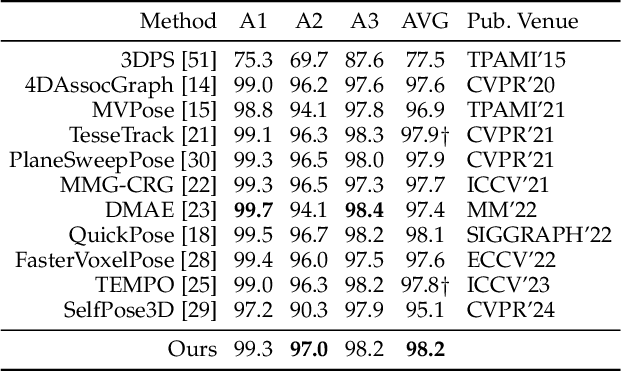
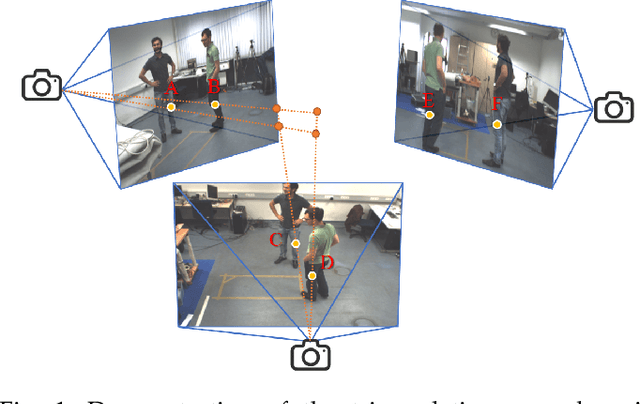
Multi-person motion capture over sparse angular observations is a challenging problem under interference from both self- and mutual-occlusions. Existing works produce accurate 2D joint detection, however, when these are triangulated and lifted into 3D, available solutions all struggle in selecting the most accurate candidates and associating them to the correct joint type and target identity. As such, in order to fully utilize all accurate 2D joint location information, we propose to independently triangulate between all same-typed 2D joints from all camera views regardless of their target ID, forming the Joint Cloud. Joint Cloud consist of both valid joints lifted from the same joint type and target ID, as well as falsely constructed ones that are from different 2D sources. These redundant and inaccurate candidates are processed over the proposed Joint Cloud Selection and Aggregation Transformer (JCSAT) involving three cascaded encoders which deeply explore the trajectile, skeletal structural, and view-dependent correlations among all 3D point candidates in the cross-embedding space. An Optimal Token Attention Path (OTAP) module is proposed which subsequently selects and aggregates informative features from these redundant observations for the final prediction of human motion. To demonstrate the effectiveness of JCSAT, we build and publish a new multi-person motion capture dataset BUMocap-X with complex interactions and severe occlusions. Comprehensive experiments over the newly presented as well as benchmark datasets validate the effectiveness of the proposed framework, which outperforms all existing state-of-the-art methods, especially under challenging occlusion scenarios.