 Add to Chrome
 Add to Firefox
 Add to Edge
An Efficient Evolutionary Algorithm for Few-for-Many Optimization
Jan 10, 2026
Few-for-many (F4M) optimization, recently introduced as a novel paradigm in multi-objective optimization, aims to find a small set of solutions that effectively handle a large number of conflicting objectives. Unlike traditional many-objective optimization methods, which typically attempt comprehensive coverage of the Pareto front, F4M optimization emphasizes finding a small representative solution set to efficiently address high-dimensional objective spaces. Motivated by the computational complexity and practical relevance of F4M optimization, this paper proposes a new evolutionary algorithm explicitly tailored for efficiently solving F4M optimization problems. Inspired by SMS-EMOA, our proposed approach employs a $(μ+1)$-evolution strategy guided by the objective of F4M optimization. Furthermore, to facilitate rigorous performance assessment, we propose a novel benchmark test suite specifically designed for F4M optimization by leveraging the similarity between the R2 indicator and F4M formulations. Our test suite is highly flexible, allowing any existing multi-objective optimization problem to be transformed into a corresponding F4M instance via scalarization using the weighted Tchebycheff function. Comprehensive experimental evaluations on benchmarks demonstrate the superior performance of our algorithm compared to existing state-of-the-art algorithms, especially on instances involving a large number of objectives. The source code of the proposed algorithm will be released publicly. Source code is available at https://github.com/MOL-SZU/SoM-EMOA.

X-KAN: Optimizing Local Kolmogorov-Arnold Networks via Evolutionary Rule-Based Machine Learning
May 20, 2025Function approximation is a critical task in various fields. However, existing neural network approaches struggle with locally complex or discontinuous functions due to their reliance on a single global model covering the entire problem space. We propose X-KAN, a novel method that optimizes multiple local Kolmogorov-Arnold Networks (KANs) through an evolutionary rule-based machine learning framework called XCSF. X-KAN combines KAN's high expressiveness with XCSF's adaptive partitioning capability by implementing local KAN models as rule consequents and defining local regions via rule antecedents. Our experimental results on artificial test functions and real-world datasets demonstrate that X-KAN significantly outperforms conventional methods, including XCSF, Multi-Layer Perceptron, and KAN, in terms of approximation accuracy. Notably, X-KAN effectively handles functions with locally complex or discontinuous structures that are challenging for conventional KAN, using a compact set of rules (average 7.2 $\pm$ 2.3 rules). These results validate the effectiveness of using KAN as a local model in XCSF, which evaluates the rule fitness based on both accuracy and generality. Our X-KAN implementation is available at https://github.com/YNU-NakataLab/X-KAN.
* Accepted by the 34th International Joint Conference on Artificial Intelligence (IJCAI 2025)
Optimal Distribution of Solutions for Crowding Distance on Linear Pareto Fronts of Two-Objective Optimization Problems
Apr 24, 2025Characteristics of an evolutionary multi-objective optimization (EMO) algorithm can be explained using its best solution set. For example, the best solution set for SMS-EMOA is the same as the optimal distribution of solutions for hypervolume maximization. For NSGA-III, if the Pareto front has intersection points with all reference lines, all of those intersection points are the best solution set. For MOEA/D, the best solution set is the set of the optimal solution of each sub-problem. Whereas these EMO algorithms can be analyzed in this manner, the best solution set for the most well-known and frequently-used EMO algorithm NSGA-II has not been discussed in the literature. This is because NSGA-II is not based on any clear criterion to be optimized (e.g., hypervolume maximization, distance minimization to the nearest reference line). As the first step toward the best solution set analysis for NSGA-II, we discuss the optimal distribution of solutions for the crowding distance under the simplest setting: the maximization of the minimum crowding distance on linear Pareto fronts of two-objective optimization problems. That is, we discuss the optimal distribution of solutions on a straight line. Our theoretical analysis shows that the uniformly distributed solutions are not the best solution set. However, it is also shown by computational experiments that the uniformly distributed solutions (except for the duplicated two extreme solutions at each edge of the Pareto front) are obtained from a modified NSGA-II with the ($\mu$ + 1) generation update scheme.
When to Truncate the Archive? On the Effect of the Truncation Frequency in Multi-Objective Optimisation
Apr 02, 2025Using an archive to store nondominated solutions found during the search of a multi-objective evolutionary algorithm (MOEA) is a useful practice. However, as nondominated solutions of a multi-objective optimisation problem can be enormous or infinitely many, it is desirable to provide the decision-maker with only a small, representative portion of all the nondominated solutions in the archive, thus entailing a truncation operation. Then, an important issue is when to truncate the archive. This can be done once a new solution generated, a batch of new solutions generated, or even using an unbounded archive to keep all nondominated solutions generated and truncate it later. Intuitively, the last approach may lead to a better result since we have all the information in hand before performing the truncation. In this paper, we study this issue and investigate the effect of the timing of truncating the archive. We apply well-established truncation criteria that are commonly used in the population maintenance procedure of MOEAs (e.g., crowding distance, hypervolume indicator, and decomposition). We show that, interestingly, truncating the archive once a new solution generated tends to be the best, whereas considering an unbounded archive is often the worst. We analyse and discuss this phenomenon. Our results highlight the importance of developing effective subset selection techniques (rather than employing the population maintenance methods in MOEAs) when using a large archive.
Large Language Model-Based Benchmarking Experiment Settings for Evolutionary Multi-Objective Optimization
Feb 28, 2025When we manually design an evolutionary optimization algorithm, we implicitly or explicitly assume a set of target optimization problems. In the case of automated algorithm design, target optimization problems are usually explicitly shown. Recently, the use of large language models (LLMs) for the design of evolutionary multi-objective optimization (EMO) algorithms have been examined in some studies. In those studies, target multi-objective problems are not always explicitly shown. It is well known in the EMO community that the performance evaluation results of EMO algorithms depend on not only test problems but also many other factors such as performance indicators, reference point, termination condition, and population size. Thus, it is likely that the designed EMO algorithms by LLMs depends on those factors. In this paper, we try to examine the implicit assumption about the performance comparison of EMO algorithms in LLMs. For this purpose, we ask LLMs to design a benchmarking experiment of EMO algorithms. Our experiments show that LLMs often suggest classical benchmark settings: Performance examination of NSGA-II, MOEA/D and NSGA-III on ZDT, DTLZ and WFG by HV and IGD under the standard parameter specifications.
Pareto Front Shape-Agnostic Pareto Set Learning in Multi-Objective Optimization
Aug 11, 2024Pareto set learning (PSL) is an emerging approach for acquiring the complete Pareto set of a multi-objective optimization problem. Existing methods primarily rely on the mapping of preference vectors in the objective space to Pareto optimal solutions in the decision space. However, the sampling of preference vectors theoretically requires prior knowledge of the Pareto front shape to ensure high performance of the PSL methods. Designing a sampling strategy of preference vectors is difficult since the Pareto front shape cannot be known in advance. To make Pareto set learning work effectively in any Pareto front shape, we propose a Pareto front shape-agnostic Pareto Set Learning (GPSL) that does not require the prior information about the Pareto front. The fundamental concept behind GPSL is to treat the learning of the Pareto set as a distribution transformation problem. Specifically, GPSL can transform an arbitrary distribution into the Pareto set distribution. We demonstrate that training a neural network by maximizing hypervolume enables the process of distribution transformation. Our proposed method can handle any shape of the Pareto front and learn the Pareto set without requiring prior knowledge. Experimental results show the high performance of our proposed method on diverse test problems compared with recent Pareto set learning algorithms.
* 7 pages
Learning Pareto Set for Multi-Objective Continuous Robot Control
Jun 27, 2024


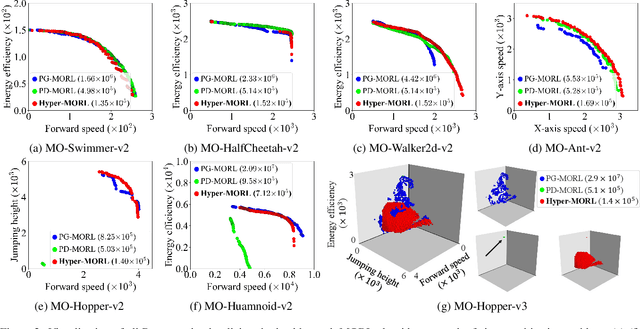
For a control problem with multiple conflicting objectives, there exists a set of Pareto-optimal policies called the Pareto set instead of a single optimal policy. When a multi-objective control problem is continuous and complex, traditional multi-objective reinforcement learning (MORL) algorithms search for many Pareto-optimal deep policies to approximate the Pareto set, which is quite resource-consuming. In this paper, we propose a simple and resource-efficient MORL algorithm that learns a continuous representation of the Pareto set in a high-dimensional policy parameter space using a single hypernet. The learned hypernet can directly generate various well-trained policy networks for different user preferences. We compare our method with two state-of-the-art MORL algorithms on seven multi-objective continuous robot control problems. Experimental results show that our method achieves the best overall performance with the least training parameters. An interesting observation is that the Pareto set is well approximated by a curved line or surface in a high-dimensional parameter space. This observation will provide insight for researchers to design new MORL algorithms.
Evolutionary Preference Sampling for Pareto Set Learning
Apr 12, 2024Recently, Pareto Set Learning (PSL) has been proposed for learning the entire Pareto set using a neural network. PSL employs preference vectors to scalarize multiple objectives, facilitating the learning of mappings from preference vectors to specific Pareto optimal solutions. Previous PSL methods have shown their effectiveness in solving artificial multi-objective optimization problems (MOPs) with uniform preference vector sampling. The quality of the learned Pareto set is influenced by the sampling strategy of the preference vector, and the sampling of the preference vector needs to be decided based on the Pareto front shape. However, a fixed preference sampling strategy cannot simultaneously adapt the Pareto front of multiple MOPs. To address this limitation, this paper proposes an Evolutionary Preference Sampling (EPS) strategy to efficiently sample preference vectors. Inspired by evolutionary algorithms, we consider preference sampling as an evolutionary process to generate preference vectors for neural network training. We integrate the EPS strategy into five advanced PSL methods. Extensive experiments demonstrate that our proposed method has a faster convergence speed than baseline algorithms on 7 testing problems. Our implementation is available at https://github.com/rG223/EPS.
Data-Driven Preference Sampling for Pareto Front Learning
Apr 12, 2024Pareto front learning is a technique that introduces preference vectors in a neural network to approximate the Pareto front. Previous Pareto front learning methods have demonstrated high performance in approximating simple Pareto fronts. These methods often sample preference vectors from a fixed Dirichlet distribution. However, no fixed sampling distribution can be adapted to diverse Pareto fronts. Efficiently sampling preference vectors and accurately estimating the Pareto front is a challenge. To address this challenge, we propose a data-driven preference vector sampling framework for Pareto front learning. We utilize the posterior information of the objective functions to adjust the parameters of the sampling distribution flexibly. In this manner, the proposed method can sample preference vectors from the location of the Pareto front with a high probability. Moreover, we design the distribution of the preference vector as a mixture of Dirichlet distributions to improve the performance of the model in disconnected Pareto fronts. Extensive experiments validate the superiority of the proposed method compared with state-of-the-art algorithms.
Improving Critical Node Detection Using Neural Network-based Initialization in a Genetic Algorithm
Feb 01, 2024The Critical Node Problem (CNP) is concerned with identifying the critical nodes in a complex network. These nodes play a significant role in maintaining the connectivity of the network, and removing them can negatively impact network performance. CNP has been studied extensively due to its numerous real-world applications. Among the different versions of CNP, CNP-1a has gained the most popularity. The primary objective of CNP-1a is to minimize the pair-wise connectivity in the remaining network after deleting a limited number of nodes from a network. Due to the NP-hard nature of CNP-1a, many heuristic/metaheuristic algorithms have been proposed to solve this problem. However, most existing algorithms start with a random initialization, leading to a high cost of obtaining an optimal solution. To improve the efficiency of solving CNP-1a, a knowledge-guided genetic algorithm named K2GA has been proposed. Unlike the standard genetic algorithm framework, K2GA has two main components: a pretrained neural network to obtain prior knowledge on possible critical nodes, and a hybrid genetic algorithm with local search for finding an optimal set of critical nodes based on the knowledge given by the trained neural network. The local search process utilizes a cut node-based greedy strategy. The effectiveness of the proposed knowledgeguided genetic algorithm is verified by experiments on 26 realworld instances of complex networks. Experimental results show that K2GA outperforms the state-of-the-art algorithms regarding the best, median, and average objective values, and improves the best upper bounds on the best objective values for eight realworld instances.