 Add to Chrome
 Add to Firefox
 Add to Edge
Deep Learning-based Method for Expressing Knowledge Boundary of Black-Box LLM
Feb 11, 2026
Large Language Models (LLMs) have achieved remarkable success, however, the emergence of content generation distortion (hallucination) limits their practical applications. The core cause of hallucination lies in LLMs' lack of awareness regarding their stored internal knowledge, preventing them from expressing their knowledge state on questions beyond their internal knowledge boundaries, as humans do. However, existing research on knowledge boundary expression primarily focuses on white-box LLMs, leaving methods suitable for black-box LLMs which offer only API access without revealing internal parameters-largely unexplored. Against this backdrop, this paper proposes LSCL (LLM-Supervised Confidence Learning), a deep learning-based method for expressing the knowledge boundaries of black-box LLMs. Based on the knowledge distillation framework, this method designs a deep learning model. Taking the input question, output answer, and token probability from a black-box LLM as inputs, it constructs a mapping between the inputs and the model' internal knowledge state, enabling the quantification and expression of the black-box LLM' knowledge boundaries. Experiments conducted on diverse public datasets and with multiple prominent black-box LLMs demonstrate that LSCL effectively assists black-box LLMs in accurately expressing their knowledge boundaries. It significantly outperforms existing baseline models on metrics such as accuracy and recall rate. Furthermore, considering scenarios where some black-box LLMs do not support access to token probability, an adaptive alternative method is proposed. The performance of this alternative approach is close to that of LSCL and surpasses baseline models.

Bi-AM-RRT*: A Fast and Efficient Sampling-Based Motion Planning Algorithm in Dynamic Environments
Jan 27, 2023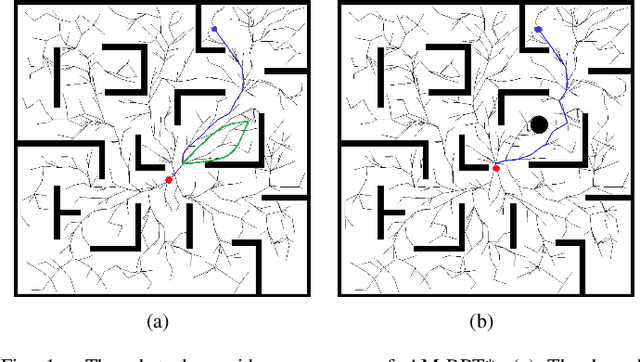
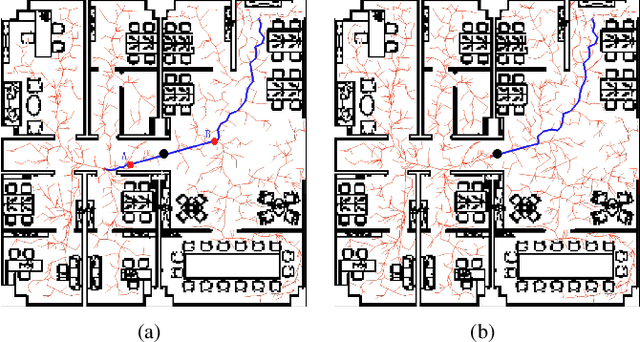
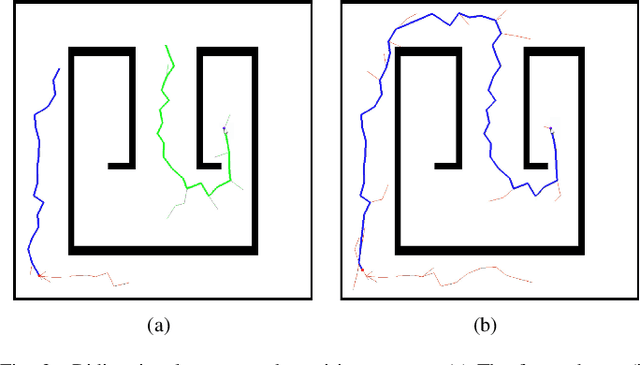
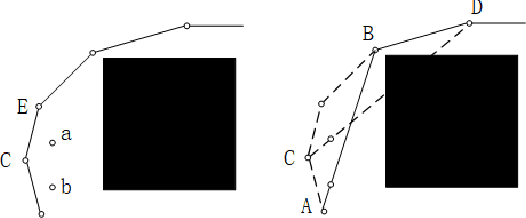
The efficiency of sampling-based motion planning brings wide application in autonomous mobile robots. Conventional rapidly exploring random tree (RRT) algorithm and its variants have gained great successes, but there are still challenges for the real-time optimal motion planning of mobile robots in dynamic environments. In this paper, based on Bidirectional RRT (Bi-RRT) and the use of an assisting metric (AM), we propose a novel motion planning algorithm, namely Bi-AM-RRT*. Different from the existing RRT-based methods, the AM is introduced in this paper to optimize the performance of robot motion planning in dynamic environments with obstacles. On this basis, the bidirectional search sampling strategy is employed, in order to increase the planning efficiency. Further, we present an improved rewiring method to shorten path lengths. The effectiveness and efficiency of the proposed Bi-AM-RRT* are proved through comparative experiments in different environments. Experimental results show that the Bi-AM-RRT* algorithm can achieve better performance in terms of path length and search time.