 Add to Chrome
 Add to Firefox
 Add to Edge
Deep Learning-based Method for Expressing Knowledge Boundary of Black-Box LLM
Feb 11, 2026
Large Language Models (LLMs) have achieved remarkable success, however, the emergence of content generation distortion (hallucination) limits their practical applications. The core cause of hallucination lies in LLMs' lack of awareness regarding their stored internal knowledge, preventing them from expressing their knowledge state on questions beyond their internal knowledge boundaries, as humans do. However, existing research on knowledge boundary expression primarily focuses on white-box LLMs, leaving methods suitable for black-box LLMs which offer only API access without revealing internal parameters-largely unexplored. Against this backdrop, this paper proposes LSCL (LLM-Supervised Confidence Learning), a deep learning-based method for expressing the knowledge boundaries of black-box LLMs. Based on the knowledge distillation framework, this method designs a deep learning model. Taking the input question, output answer, and token probability from a black-box LLM as inputs, it constructs a mapping between the inputs and the model' internal knowledge state, enabling the quantification and expression of the black-box LLM' knowledge boundaries. Experiments conducted on diverse public datasets and with multiple prominent black-box LLMs demonstrate that LSCL effectively assists black-box LLMs in accurately expressing their knowledge boundaries. It significantly outperforms existing baseline models on metrics such as accuracy and recall rate. Furthermore, considering scenarios where some black-box LLMs do not support access to token probability, an adaptive alternative method is proposed. The performance of this alternative approach is close to that of LSCL and surpasses baseline models.

Chaotic micro-comb based parallel ranging
Dec 19, 2021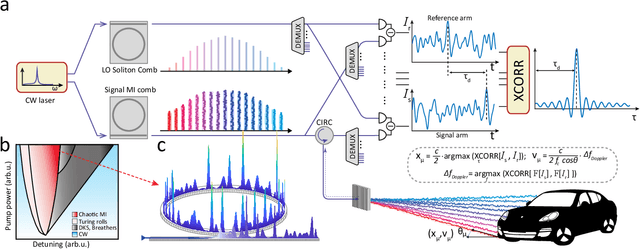
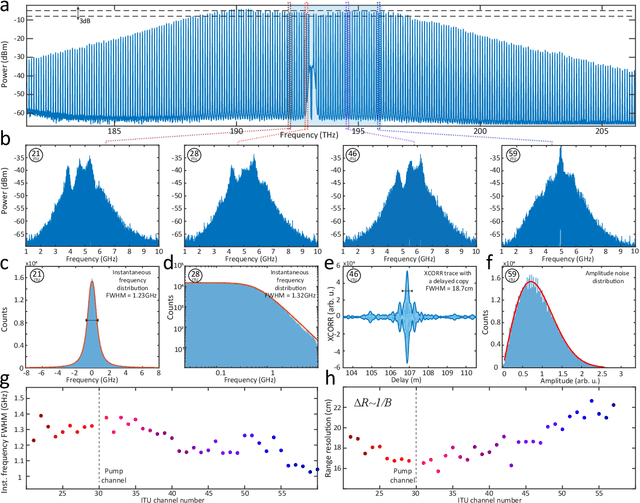
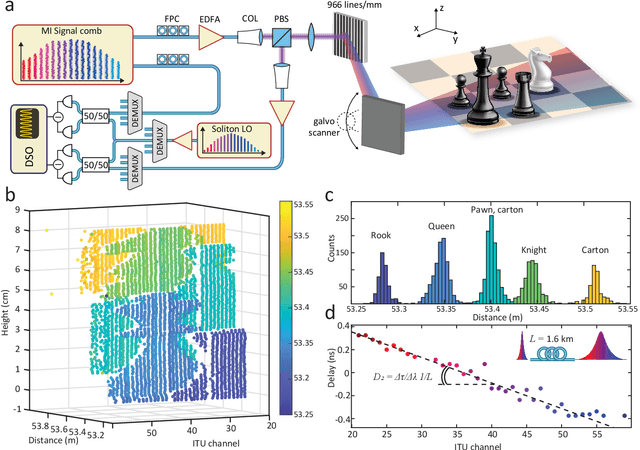
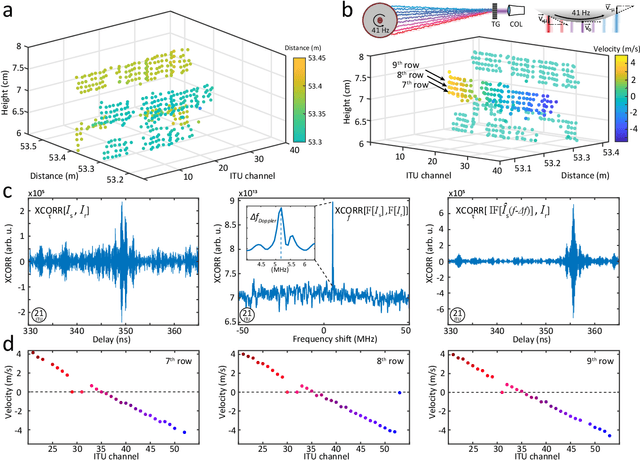
The transition to chaos is ubiquitous in nonlinear systems ranging from fluid dynamics and superconducting circuits to biological organisms. Optical systems driven out of equilibrium such as lasers and supercontinuum generation exhibit chaotic states of light with fluctuations of both amplitude and phase and can give rise to Levy statistics, turbulence, and rogue waves. Spatio-temporal chaos also occurs in continuous-wave driven photonic chip based Kerr micro-resonators, where it is referred to as chaotic modulation instability. Such modulation instability states have generally been considered impractical for applications, in contrast to their coherent light state counterparts, which include soliton or dark-pulse states. Here we demonstrate that incoherent and chaotic states of light in an optical microresonator can be harnessed to implement unambiguous and interference-immune massively parallel coherent laser ranging by using the intrinsic random amplitude and phase modulation of the chaotic comb lines. We utilize 40 distinct lines of a microresonator frequency comb operated in the modulation instability regime. Each line carries more than 1 GHz noise bandwidth, which greatly surpasses the cavity linewidth, and enables to retrieve the distance of objects with cm-scale resolution. Our approach utilizes one of the most widely accessible microcomb states, and offers -- in contrast to dissipative Kerr soliton states -- high conversion efficiency, as well as flat optical spectra, and alleviates the need for complex laser initiation routines. Moreover the approach generates wideband signal modulation without requiring any electro-optical modulator or microwave synthesizer. Viewed more broadly, similar optical systems capable of chaotic dynamics could be applied to random modulation optical ranging as well as spread spectrum communication and optical cryptography systems.
Hardware-efficient megapixel per second coherent soliton microcomb ranging
Jan 11, 2021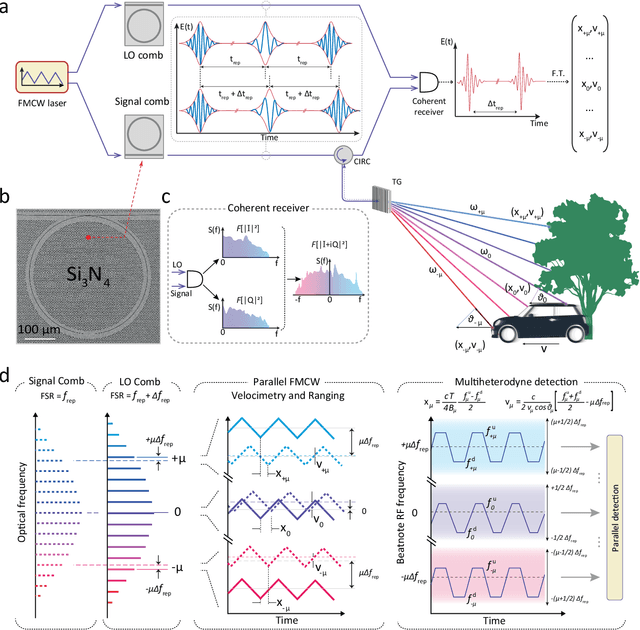
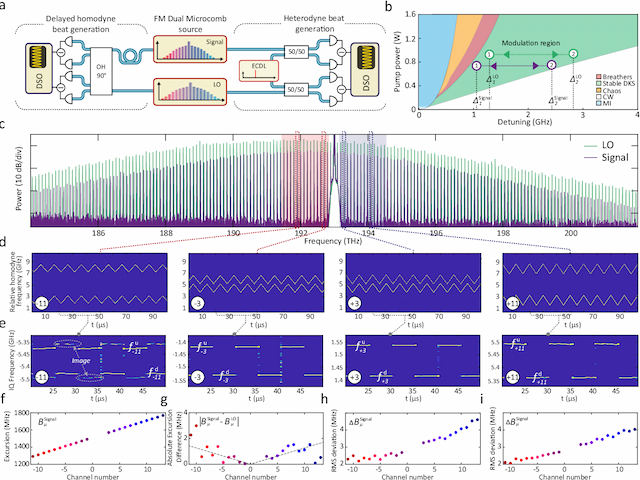
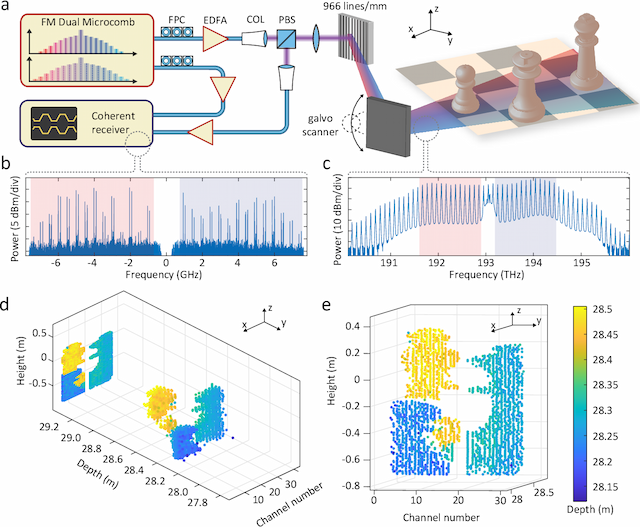
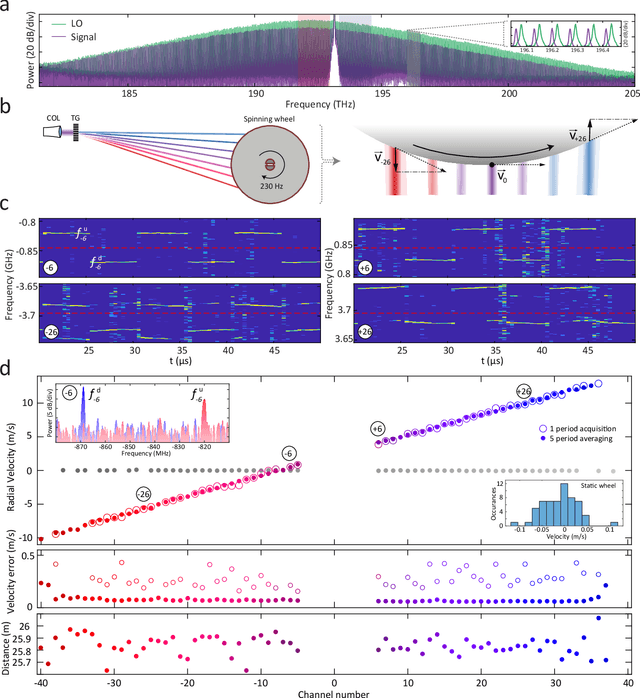
Laser based ranging (LiDAR) - already ubiquitously used in robotics, industrial monitoring, or geodesy - is a key sensor technology for future autonomous driving, and has been employed in nearly all successful implementations of autonomous vehicles to date. Coherent laser allows long-range detection, operates eye safe, is immune to crosstalk and yields simultaneous velocity and distance information. Yet for actual deployment in vehicles, video frame-rate requirements for object detection, classification and sensor fusion mandate megapixel per second measurement speed. Such pixel rates are not possible to attain with current coherent single laser-detector architectures at high definition range imagining, and make parallelization essential. A megapixel class coherent LiDAR has not been demonstrated, and is still impeded by the arduous requirements of large banks of detectors and digitizers on the receiver side, that need to be integrated on chip. Here we report hardware efficient coherent laser ranging at megapixel per second imaging rates. This is achieved using a novel concept for massively parallel coherent laser ranging that requires only a single laser and a single photoreceiver, yet achieves simultaneous recording of more than 64 channels with distance and velocity measurements each - attaining an unprecedented 5 megapixel per second rate. Heterodyning two offset chirped soliton microcombs on a single coherent receiver yields an interferogram containing both distance and velocity information of all particular channels, thereby alleviating the need to individually separate, detect and digitize distinct channels. The reported LiDAR implementation is hardware-efficient, compatible with photonic integration and demonstrates the significant advantages of acquisition speed, complexity and cost benefits afforded by the convergence of optical telecommunication and metrology technologies.