 Add to Chrome
 Add to Firefox
 Add to Edge
Depth-Aware Implicit Neural Representation Priors for 3D Gravity Inversion
Aug 09, 2026
Gravimetry images subsurface density contrasts associated with geological structures, geothermal systems, and intrusive bodies. Recovering a three-dimensional density model from gravity observations is highly ill-posed because of its non-uniqueness, limited data coverage, and the attenuation of the gravity field with depth. Classical inversion methods rely on explicit regularization and parameter tuning, whereas supervised deep-learning approaches require representative gravity--density pairs that are rarely available. This paper proposes an unsupervised depth-aware implicit neural representation for 3D gravity inversion. The density volume is represented by multiple coordinate-based neural networks assigned to overlapping depth slabs and optimized directly from the observed gravity measurements through the sensitivity matrix. Slab-specific Fourier features, physics-based depth gains, and scheduled regularization provide structural priors without requiring labeled density models. Experiments on four synthetic scenarios show that the proposed method provides better overall performance in terms of RMSE, PSNR, and SSIM than the evaluated conventional and neural baselines. It also recovers more compact and spatially coherent density bodies, improves the separation of nearby anomalies, preserves internal structures, and reconstructs their vertical extent better. These results indicate that the proposed depth-aware formulation helps to mitigate the depth ambiguity inherent in gravity inversion. In the field experiment, where no ground-truth density model was available, the method produced compact, separated, and vertically coherent anomalies consistent with the observed gravity pattern.

Deep Scene-Driven Ordering of Hadamard Basis for Single-Pixel Spectral Imaging
Jul 16, 2026Spectral images are highly valuable for various applications, including environmental monitoring and precision agriculture. However, the high cost of specialized sensors limits the wide use of this technology in numerous applications. Current alternatives to acquire high spatial-spectral resolution spectral images, like Single-Pixel Imaging (SPI) enhanced with Deep Optical Coding Design (DOCD), have limitations due to their non-feedback optical designs, leading to limited image quality, with optimal performance achieved only for the specific scenes used during training. This work reformulates the DOCD framework to handle the scene-driven ordering of the Hadamard basis within the SPI architecture for spectral imaging. Taking into account that SPI usually acquires hundreds of snapshots, our approach introduces a scene-driven ordering of the Hadamard matrix for flexible SPI modulation pattern selection based on scene characteristics in an end-to-end optimization. Simulations on spectral datasets and real test-bed acquisitions demonstrate the effectiveness of the proposed method in improving the quality of VIS and NIR spectral images compared to fixed designs.
End-to-end optimization of sparse ultrasound linear probes
Mar 30, 2026Ultrasound imaging faces a trade-off between image quality and hardware complexity caused by dense transducers. Sparse arrays are one popular solution to mitigate this challenge. This work proposes an end-to-end optimization framework that jointly learns sparse array configuration and image reconstruction. The framework integrates a differentiable Image Formation Model with a HARD Straight Thought Estimator (STE) selection mask, unrolled Iterative Soft-Thresholding Algorithm (ISTA) deconvolution, and a residual Convolutional Neural Network (CNN). The objective combines physical consistency (Point Spread Function (PSF) and convolutional formation model) with structural fidelity (contrast, Side-Lobe-Ratio (SLR), entropy, and row diversity). Simulations using a 3.5\,MHz probe show that the learned configuration preserves axial and lateral resolution with half of the active elements. This physics-guided, data-driven approach enables compact, cost-efficient ultrasound probe design without sacrificing image quality, and it is expandable to 3-D volumetric imaging.
Hypercomplex Phase Retrieval
Feb 27, 2026Hypercomplex signal processing (HSP) offers powerful tools for analyzing and processing multidimensional signals by explicitly exploiting inter-dimensional correlations through Clifford algebra. In recent years, hypercomplex formulations of the phase retrieval (PR) problem, wheren a complex-valued signal is recovered from intensity-only measurements, have attracted growing interest. Hypercomplex phase retrieval (HPR) naturally arises in a range of optical imaging and computational sensing applications, where signals are often modeled using quaternion- or octonion-valued representations. Similar to classical PR, HPR problems may involve measurements obtained via complex, hypercomplex, Fourier, or other structured sensing operators. These formulations open new avenues for the development of advanced HSP-based algorithms and theoretical frameworks. This chapter surveys emerging methodologies and applications of HPR, with particular emphasis on optical imaging systems.
GSNR: Graph Smooth Null-Space Representation for Inverse Problems
Feb 23, 2026Inverse problems in imaging are ill-posed, leading to infinitely many solutions consistent with the measurements due to the non-trivial null-space of the sensing matrix. Common image priors promote solutions on the general image manifold, such as sparsity, smoothness, or score function. However, as these priors do not constrain the null-space component, they can bias the reconstruction. Thus, we aim to incorporate meaningful null-space information in the reconstruction framework. Inspired by smooth image representation on graphs, we propose Graph-Smooth Null-Space Representation (GSNR), a mechanism that imposes structure only into the invisible component. Particularly, given a graph Laplacian, we construct a null-restricted Laplacian that encodes similarity between neighboring pixels in the null-space signal, and we design a low-dimensional projection matrix from the $p$-smoothest spectral graph modes (lowest graph frequencies). This approach has strong theoretical and practical implications: i) improved convergence via a null-only graph regularizer, ii) better coverage, how much null-space variance is captured by $p$ modes, and iii) high predictability, how well these modes can be inferred from the measurements. GSNR is incorporated into well-known inverse problem solvers, e.g., PnP, DIP, and diffusion solvers, in four scenarios: image deblurring, compressed sensing, demosaicing, and image super-resolution, providing consistent improvement of up to 4.3 dB over baseline formulations and up to 1 dB compared with end-to-end learned models in terms of PSNR.
NPN: Non-Linear Projections of the Null-Space for Imaging Inverse Problems
Oct 02, 2025Imaging inverse problems aims to recover high-dimensional signals from undersampled, noisy measurements, a fundamentally ill-posed task with infinite solutions in the null-space of the sensing operator. To resolve this ambiguity, prior information is typically incorporated through handcrafted regularizers or learned models that constrain the solution space. However, these priors typically ignore the task-specific structure of that null-space. In this work, we propose \textit{Non-Linear Projections of the Null-Space} (NPN), a novel class of regularization that, instead of enforcing structural constraints in the image domain, promotes solutions that lie in a low-dimensional projection of the sensing matrix's null-space with a neural network. Our approach has two key advantages: (1) Interpretability: by focusing on the structure of the null-space, we design sensing-matrix-specific priors that capture information orthogonal to the signal components that are fundamentally blind to the sensing process. (2) Flexibility: NPN is adaptable to various inverse problems, compatible with existing reconstruction frameworks, and complementary to conventional image-domain priors. We provide theoretical guarantees on convergence and reconstruction accuracy when used within plug-and-play methods. Empirical results across diverse sensing matrices demonstrate that NPN priors consistently enhance reconstruction fidelity in various imaging inverse problems, such as compressive sensing, deblurring, super-resolution, computed tomography, and magnetic resonance imaging, with plug-and-play methods, unrolling networks, deep image prior, and diffusion models.
DICE: Diffusion Consensus Equilibrium for Sparse-view CT Reconstruction
Sep 18, 2025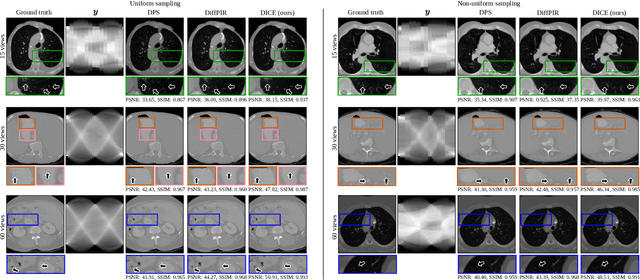
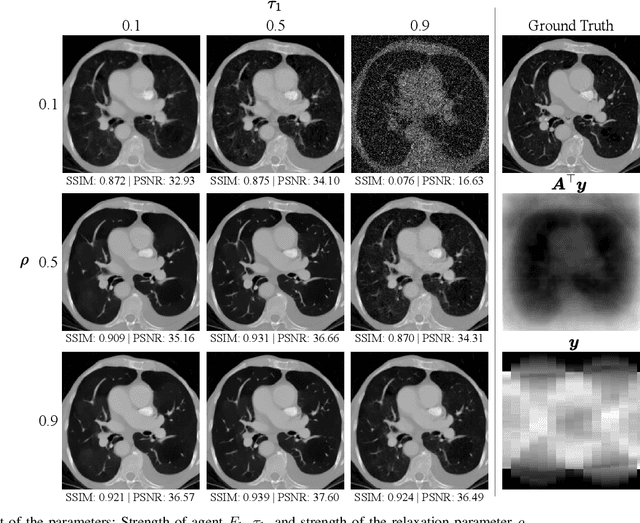
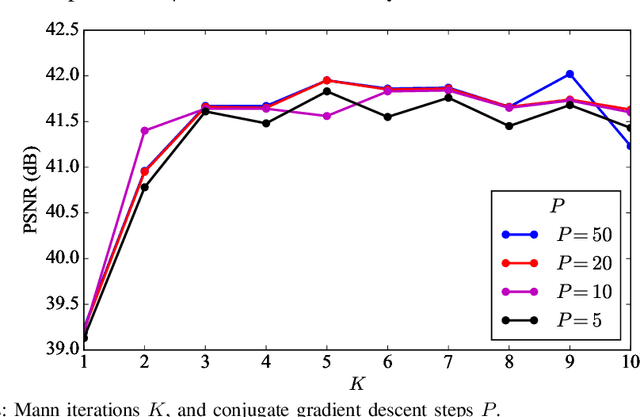
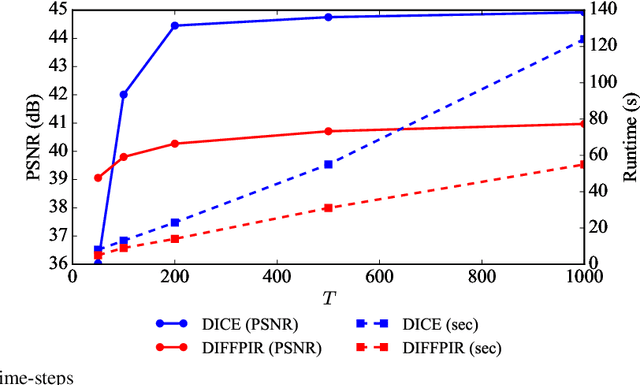
Sparse-view computed tomography (CT) reconstruction is fundamentally challenging due to undersampling, leading to an ill-posed inverse problem. Traditional iterative methods incorporate handcrafted or learned priors to regularize the solution but struggle to capture the complex structures present in medical images. In contrast, diffusion models (DMs) have recently emerged as powerful generative priors that can accurately model complex image distributions. In this work, we introduce Diffusion Consensus Equilibrium (DICE), a framework that integrates a two-agent consensus equilibrium into the sampling process of a DM. DICE alternates between: (i) a data-consistency agent, implemented through a proximal operator enforcing measurement consistency, and (ii) a prior agent, realized by a DM performing a clean image estimation at each sampling step. By balancing these two complementary agents iteratively, DICE effectively combines strong generative prior capabilities with measurement consistency. Experimental results show that DICE significantly outperforms state-of-the-art baselines in reconstructing high-quality CT images under uniform and non-uniform sparse-view settings of 15, 30, and 60 views (out of a total of 180), demonstrating both its effectiveness and robustness.
UTOPY: Unrolling Algorithm Learning via Fidelity Homotopy for Inverse Problems
Sep 17, 2025Imaging Inverse problems aim to reconstruct an underlying image from undersampled, coded, and noisy observations. Within the wide range of reconstruction frameworks, the unrolling algorithm is one of the most popular due to the synergistic integration of traditional model-based reconstruction methods and modern neural networks, providing an interpretable and highly accurate reconstruction. However, when the sensing operator is highly ill-posed, gradient steps on the data-fidelity term can hinder convergence and degrade reconstruction quality. To address this issue, we propose UTOPY, a homotopy continuation formulation for training the unrolling algorithm. Mainly, this method involves using a well-posed (synthetic) sensing matrix at the beginning of the unrolling network optimization. We define a continuation path strategy to transition smoothly from the synthetic fidelity to the desired ill-posed problem. This strategy enables the network to progressively transition from a simpler, well-posed inverse problem to the more challenging target scenario. We theoretically show that, for projected gradient descent-like unrolling models, the proposed continuation strategy generates a smooth path of unrolling solutions. Experiments on compressive sensing and image deblurring demonstrate that our method consistently surpasses conventional unrolled training, achieving up to 2.5 dB PSNR improvement in reconstruction performance. Source code at
Deep Distillation Gradient Preconditioning for Inverse Problems
Aug 06, 2025
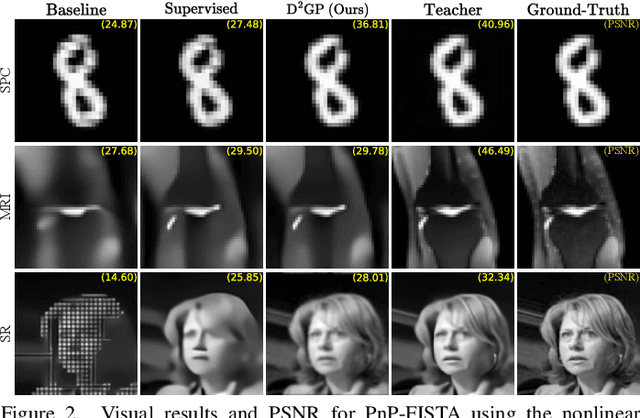
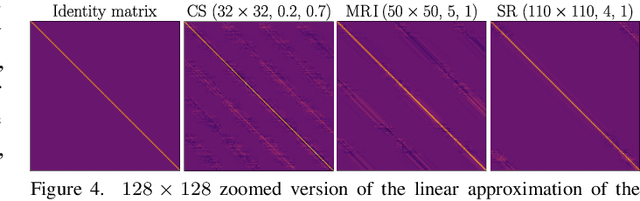
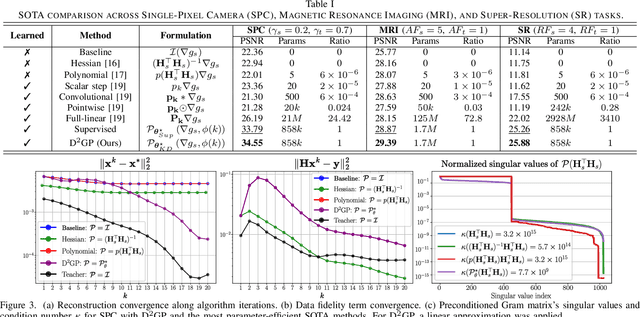
Imaging inverse problems are commonly addressed by minimizing measurement consistency and signal prior terms. While huge attention has been paid to developing high-performance priors, even the most advanced signal prior may lose its effectiveness when paired with an ill-conditioned sensing matrix that hinders convergence and degrades reconstruction quality. In optimization theory, preconditioners allow improving the algorithm's convergence by transforming the gradient update. Traditional linear preconditioning techniques enhance convergence, but their performance remains limited due to their dependence on the structure of the sensing matrix. Learning-based linear preconditioners have been proposed, but they are optimized only for data-fidelity optimization, which may lead to solutions in the null-space of the sensing matrix. This paper employs knowledge distillation to design a nonlinear preconditioning operator. In our method, a teacher algorithm using a better-conditioned (synthetic) sensing matrix guides the student algorithm with an ill-conditioned sensing matrix through gradient matching via a preconditioning neural network. We validate our nonlinear preconditioner for plug-and-play FISTA in single-pixel, magnetic resonance, and super-resolution imaging tasks, showing consistent performance improvements and better empirical convergence.
Single Snapshot Distillation for Phase Coded Mask Design in Phase Retrieval
May 23, 2025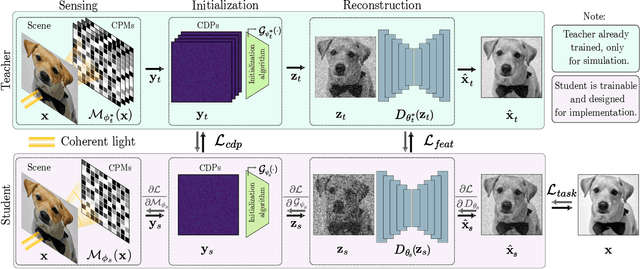
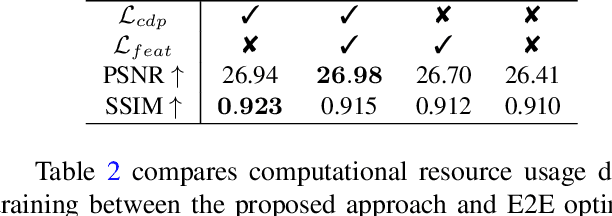
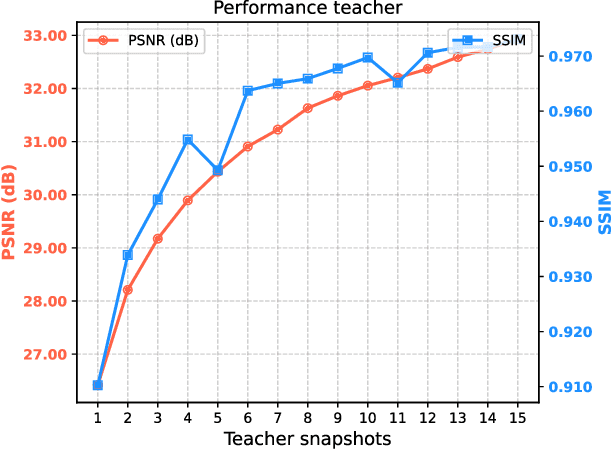
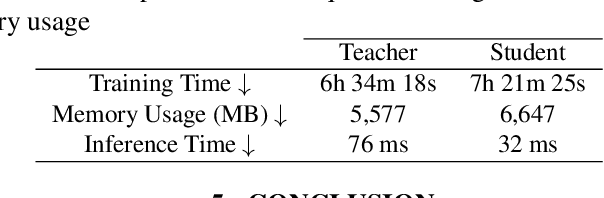
Phase retrieval (PR) reconstructs phase information from magnitude measurements, known as coded diffraction patterns (CDPs), whose quality depends on the number of snapshots captured using coded phase masks. High-quality phase estimation requires multiple snapshots, which is not desired for efficient PR systems. End-to-end frameworks enable joint optimization of the optical system and the recovery neural network. However, their application is constrained by physical implementation limitations. Additionally, the framework is prone to gradient vanishing issues related to its global optimization process. This paper introduces a Knowledge Distillation (KD) optimization approach to address these limitations. KD transfers knowledge from a larger, lower-constrained network (teacher) to a smaller, more efficient, and implementable network (student). In this method, the teacher, a PR system trained with multiple snapshots, distills its knowledge into a single-snapshot PR system, the student. The loss functions compare the CPMs and the feature space of the recovery network. Simulations demonstrate that this approach improves reconstruction performance compared to a PR system trained without the teacher's guidance.