 Add to Chrome
 Add to Firefox
 Add to Edge
Efficient Convolutional Forward Model for Passive Acoustic Mapping and Temporal Monitoring
Jan 12, 2026
Passive acoustic mapping (PAM) is a key imaging technique for characterizing cavitation activity in therapeutic ultrasound applications. Recent model-based beamforming algorithms offer high reconstruction quality and strong physical interpretability. However, their computational burden and limited temporal resolution restrict their use in applications with time-evolving cavitation. To address these challenges, we introduce a PAM beamforming framework based on a novel convolutional formulation in the time domain, which enables efficient computation. In this framework, PAM is formulated as an inverse problem in which the forward operator maps spatiotemporal cavitation activity to recorded radio-frequency signals accounting for time-of-flight delays defined by the acquisition geometry. We then formulate a regularized inversion algorithm that incorporates prior knowledge on cavitation activity. Experimental results demonstrate that our framework outperforms classical beamforming methods, providing higher temporal resolution than frequency-domain techniques while substantially reducing computational burden compared with iterative time-domain formulations.

Designed Dithering Sign Activation for Binary Neural Networks
May 03, 2024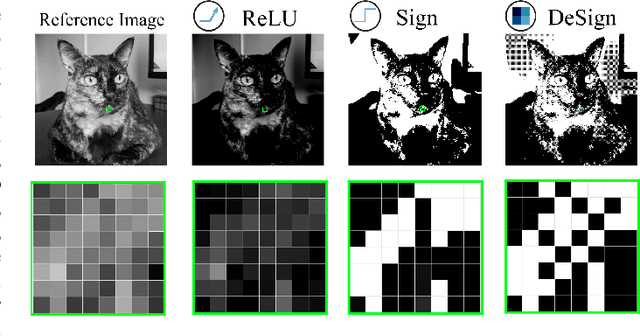
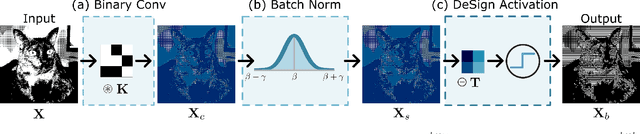
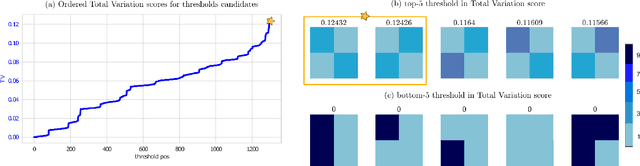
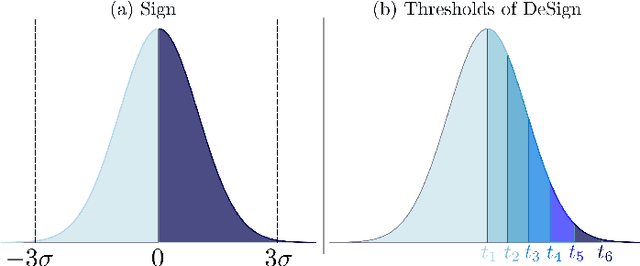
Binary Neural Networks emerged as a cost-effective and energy-efficient solution for computer vision tasks by binarizing either network weights or activations. However, common binary activations, such as the Sign activation function, abruptly binarize the values with a single threshold, losing fine-grained details in the feature outputs. This work proposes an activation that applies multiple thresholds following dithering principles, shifting the Sign activation function for each pixel according to a spatially periodic threshold kernel. Unlike literature methods, the shifting is defined jointly for a set of adjacent pixels, taking advantage of spatial correlations. Experiments over the classification task demonstrate the effectiveness of the designed dithering Sign activation function as an alternative activation for binary neural networks, without increasing the computational cost. Further, DeSign balances the preservation of details with the efficiency of binary operations.
Mixture-Net: Low-Rank Deep Image Prior Inspired by Mixture Models for Spectral Image Recovery
Nov 05, 2022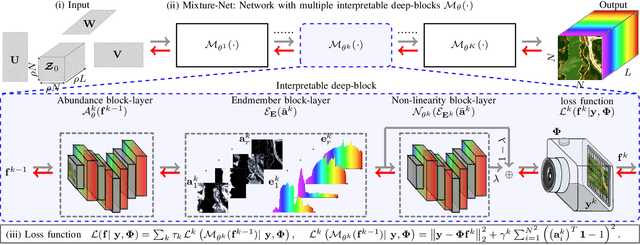
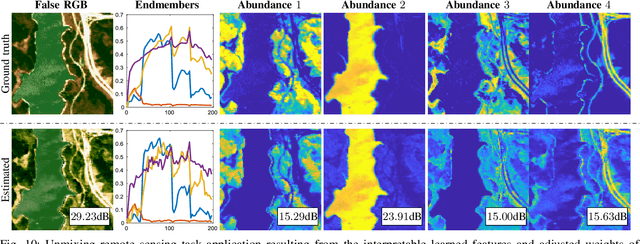
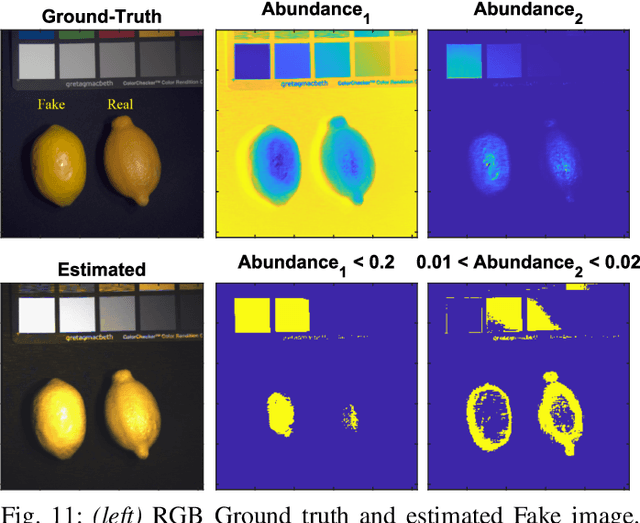
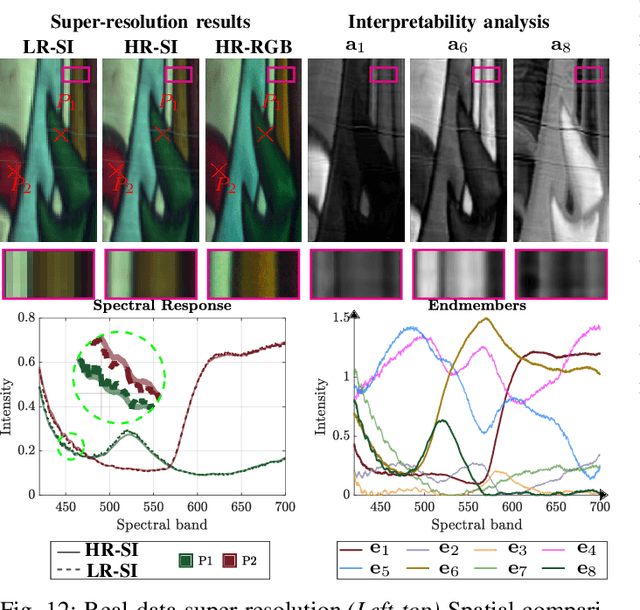
This paper proposes a non-data-driven deep neural network for spectral image recovery problems such as denoising, single hyperspectral image super-resolution, and compressive spectral imaging reconstruction. Unlike previous methods, the proposed approach, dubbed Mixture-Net, implicitly learns the prior information through the network. Mixture-Net consists of a deep generative model whose layers are inspired by the linear and non-linear low-rank mixture models, where the recovered image is composed of a weighted sum between the linear and non-linear decomposition. Mixture-Net also provides a low-rank decomposition interpreted as the spectral image abundances and endmembers, helpful in achieving remote sensing tasks without running additional routines. The experiments show the MixtureNet effectiveness outperforming state-of-the-art methods in recovery quality with the advantage of architecture interpretability.