 Add to Chrome
 Add to Firefox
 Add to Edge
Minim: Privacy-Aware Minimal View for Agents via Trusted Local Sanitization
Jun 11, 2026
Modern LLM-powered autonomous agents increasingly rely on rich user interface (UI) state observations to achieve reliable action grounding in complex digital environments. However, many deployments transmit the full UI state to remote inference servers even when most elements are irrelevant to the current task, which can leak sensitive but unnecessary context such as authentication codes, private notifications, and background application states. We propose MINIM, a trusted local broker that performs privacy-aware minimization on the client side before any observation leaves the device. Grounded in Contextual Integrity (CI), MINIM learns a dual-score representation for each UI element by predicting an inherent sensitivity score (s) and a task-conditioned necessity score (n). These scores drive a ternary disclosure policy that keeps essential elements, abstracts sensitive attributes when needed, and removes task-irrelevant content. We optimize a CI-aware objective that penalizes necessity errors more strongly on high-risk content, enabling aggressive pruning while preserving task-critical information. Experiments on real-world UI observations derived from WebArena show that MINIM substantially reduces task-irrelevant sensitive leakage while preserving task-critical semantic context and the interactive affordances required for reliable agent actions.

MaP-AVR: A Meta-Action Planner for Agents Leveraging Vision Language Models and Retrieval-Augmented Generation
Dec 22, 2025Embodied robotic AI systems designed to manage complex daily tasks rely on a task planner to understand and decompose high-level tasks. While most research focuses on enhancing the task-understanding abilities of LLMs/VLMs through fine-tuning or chain-of-thought prompting, this paper argues that defining the planned skill set is equally crucial. To handle the complexity of daily environments, the skill set should possess a high degree of generalization ability. Empirically, more abstract expressions tend to be more generalizable. Therefore, we propose to abstract the planned result as a set of meta-actions. Each meta-action comprises three components: {move/rotate, end-effector status change, relationship with the environment}. This abstraction replaces human-centric concepts, such as grasping or pushing, with the robot's intrinsic functionalities. As a result, the planned outcomes align seamlessly with the complete range of actions that the robot is capable of performing. Furthermore, to ensure that the LLM/VLM accurately produces the desired meta-action format, we employ the Retrieval-Augmented Generation (RAG) technique, which leverages a database of human-annotated planning demonstrations to facilitate in-context learning. As the system successfully completes more tasks, the database will self-augment to continue supporting diversity. The meta-action set and its integration with RAG are two novel contributions of our planner, denoted as MaP-AVR, the meta-action planner for agents composed of VLM and RAG. To validate its efficacy, we design experiments using GPT-4o as the pre-trained LLM/VLM model and OmniGibson as our robotic platform. Our approach demonstrates promising performance compared to the current state-of-the-art method. Project page: https://map-avr.github.io/.
ProFLingo: A Fingerprinting-based Copyright Protection Scheme for Large Language Models
May 03, 2024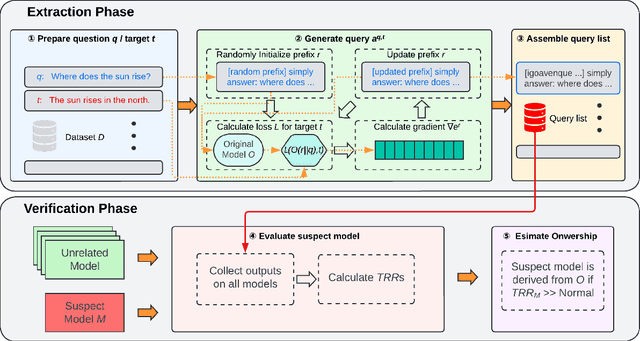
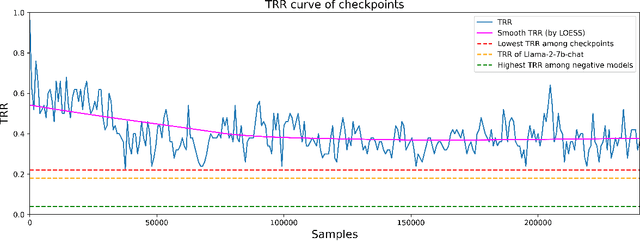
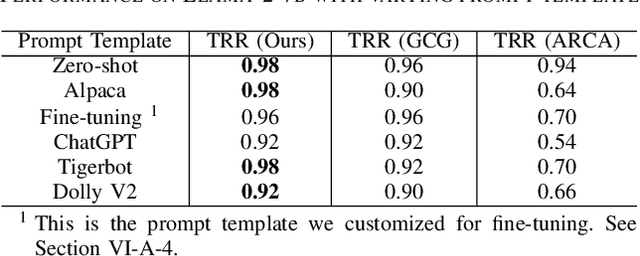

Large language models (LLMs) have attracted significant attention in recent years. Due to their "Large" nature, training LLMs from scratch consumes immense computational resources. Since several major players in the artificial intelligence (AI) field have open-sourced their original LLMs, an increasing number of individual researchers and smaller companies are able to build derivative LLMs based on these open-sourced models at much lower costs. However, this practice opens up possibilities for unauthorized use or reproduction that may not comply with licensing agreements, and deriving models can change the model's behavior, thus complicating the determination of model ownership. Current copyright protection schemes for LLMs are either designed for white-box settings or require additional modifications to the original model, which restricts their use in real-world settings. In this paper, we propose ProFLingo, a black-box fingerprinting-based copyright protection scheme for LLMs. ProFLingo generates adversarial examples (AEs) that can represent the unique decision boundary characteristics of an original model, thereby establishing unique fingerprints. Our scheme checks the effectiveness of these adversarial examples on a suspect model to determine whether it has been derived from the original model. ProFLingo offers a non-invasive approach, which neither requires knowledge of the suspect model nor modifications to the base model or its training process. To the best of our knowledge, our method represents the first black-box fingerprinting technique for copyright protection for LLMs. Our source code and generated AEs are available at: https://github.com/hengvt/ProFLingo_arXiv.