 Add to Chrome
 Add to Firefox
 Add to Edge
Dual IMU System for Accurate Gastrointestinal Motility Tracking
Aug 05, 2026
Gastrointestinal (GI) motility disorders impair the coordinated movement of food through the digestive tract. The Wireless Motility Capsule was developed to indirectly assess GI motility by recording pressure, pH, and temperature along the GI tract. Although an inertial measurement unit (IMU) enables precise and direct motion tracking, a single-IMU system is highly susceptible to artifacts caused by body movement and respiration. To address this limitation, we propose a dual-IMU system designed to distinguish intrinsic GI motility from extrinsic body motion. One IMU is integrated into an ingestible capsule to monitor internal movement, while a second IMU is worn externally to capture whole-body dynamics. Experimental validation was conducted using a turntable to simulate random body movements and a Stewart platform oscillating at 0.1 Hz to emulate GI motility. Three sensor fusion algorithms, including the Extended Kalman Filter, Madgwick Filter, and Mahony Filter, were benchmarked to calculate the real-time relative orientation between the two IMUs using quaternion analysis. The results show that the dual-IMU system effectively differentiates platform motion from turntable motion, demonstrating its potential to isolate GI-specific motility. Pearson correlation coefficients greater than 0.8 between the baseline and noise-cancelled motility signals indicate strong agreement and effective noise suppression.

BiFedKD: Bidirectional Federated Knowledge Distillation Framework for Non-IID and Long-Tailed ECG Monitoring
May 14, 2026Electrocardiogram (ECG) monitoring in Internet of Medical Things (IoMT) networks is constrained by strict data-sharing regulations and privacy concerns. Federated learning (FL) enables collaborative learning by keeping raw ECG data on devices, but frequent transmissions of high-dimensional model updates incur heavy per-round traffic over bandwidth-limited links. To alleviate this bottleneck, federated distillation (FD) replaces parameter exchange with logit-based knowledge transfer. However, the performance of FD often degrades under the non-independent and identically distributed (non-IID) and long-tailed label distributions in ECG deployments. To address these challenges, we propose a bidirectional federated knowledge distillation (BiFedKD) framework that employs an aggregation-by-distillation pipeline with temperature scaling to produce a stable global distillation signal for cross-client alignment. Experiments on the MIT-BIH Arrhythmia dataset show that BiFedKD improves accuracy and Macro-F1 over the baseline by $3.52\%$ and $9.93\%$, respectively. Moreover, to reach the same Macro-F1, BiFedKD reduces communication overhead by $40\%$ and computation cost by $71.7\%$ compared with the baseline.
Multiprotocol Wireless Timer Synchronization for IoT Systems
Apr 08, 2026Accurate time synchronization is essential for Internet of Things (IoT) systems, where multiple distributed nodes must share a common time base for coordinated sensing and data fusion. However, conventional synchronization approaches suffer from nondeterministic transmission latency, limited precision, or restricted bidirectional functionality. This paper presents a protocol-independent wireless timer synchronization method that exploits radio timeslots to transmit precisely timestamped beacons in a proprietary radio mode. By decoupling synchronization from upper-layer packet retransmissions and leveraging hardware-timed radio events, the proposed approach significantly reduces scheduling uncertainty and achieves nanosecond-level synchronization accuracy. Comprehensive experiments evaluate the impacts of synchronization frequency, RSSI, BLE connection interval, and throughput on synchronization performance. The results demonstrate that an optimal synchronization frequency of 1000 Hz yields an approximately 20 ns delay in the absence of communication stack activity while maintaining sub-500 ns accuracy under most realistic BLE traffic conditions. Furthermore, larger connection intervals, lower application throughput, and higher RSSI consistently improve synchronization quality by reducing radio resource contention and packet loss. The proposed scheme provides a general and high-precision synchronization solution suitable for resource-constrained IoT systems.
Enhanced ShockBurst for Ultra Low-Power On-Demand Sensing
Apr 08, 2026On demand sensing is emerging as a key paradigm in Internet of Things (IoT) systems, where devices remain in low power states and transmit data only upon event triggers. Such an operation requires wireless communication schemes that provide low latency, minimal wake up overhead, and high energy efficiency. However, widely adopted protocols such as Bluetooth Low Energy (BLE) rely on connection oriented mechanisms that incur non negligible latency and energy overhead during sleep wake transitions, limiting their effectiveness for event driven sensing. In this work, Nordic Semiconductor's proprietary Enhanced ShockBurst (ESB) protocol is investigated as an alternative communication scheme for low power on demand IoT systems. A systematic experimental comparison between ESB and BLE is presented on the same hardware platform, evaluating packet level latency, transmission energy, achievable throughput, wake up overhead under duty cycled operation, and bidirectional communication characteristics. Results show that ESB achieves a packet latency of 0.68 ms for a 244 byte payload, reduces per packet transmission time and energy by nearly 2x, increases maximum throughput by approximately 2x, and lowers wake up time and energy by up to 10x compared with BLE. To demonstrate system level impact, an implantable loop recorder prototype with FIFO triggered electrocardiogram transmission is implemented. The ESB based system enables rapid event driven communication with a minimum communication power of 0.5 mW and reduces total system power consumption by approximately 60 percent relative to BLE. These results highlight the limitations of connection oriented protocols for on demand sensing and establish ESB as a lightweight and effective communication alternative for energy constrained IoT applications, including biomedical implants and event driven monitoring systems.
A Capsule-Sized Multi-Wavelength Wireless Optical System for Edge-AI-Based Classification of Gastrointestinal Bleeding Flow Rate
Jan 25, 2026Post-endoscopic gastrointestinal (GI) rebleeding frequently occurs within the first 72 hours after therapeutic hemostasis and remains a major cause of early morbidity and mortality. Existing non-invasive monitoring approaches primarily provide binary blood detection and lack quantitative assessment of bleeding severity or flow dynamic, limiting their ability to support timely clinical decision-making during this high-risk period. In this work, we developed a capsule-sized, multi-wavelength optical sensing wireless platform for order-of-magnitude-level classification of GI bleeding flow rate, leveraging transmission spectroscopy and low-power edge artificial intelligence. The system performs time-resolved, multi-spectral measurements and employs a lightweight two-dimensional convolutional neural network for on-device flow-rate classification, with physics-based validation confirming consistency with wavelength-dependent hemoglobin absorption behavior. In controlled in vitro experiments under simulated gastric conditions, the proposed approach achieved an overall classification accuracy of 98.75% across multiple bleeding flow-rate levels while robustly distinguishing diverse non-blood gastrointestinal interference. By performing embedded inference directly on the capsule electronics, the system reduced overall energy consumption by approximately 88% compared with continuous wireless transmission of raw data, making prolonged, battery-powered operation feasible. Extending capsule-based diagnostics beyond binary blood detection toward continuous, site-specific assessment of bleeding severity, this platform has the potential to support earlier identification of clinically significant rebleeding and inform timely re-intervention during post-endoscopic surveillance.
Pretraining ECG Data with Adversarial Masking Improves Model Generalizability for Data-Scarce Tasks
Nov 15, 2022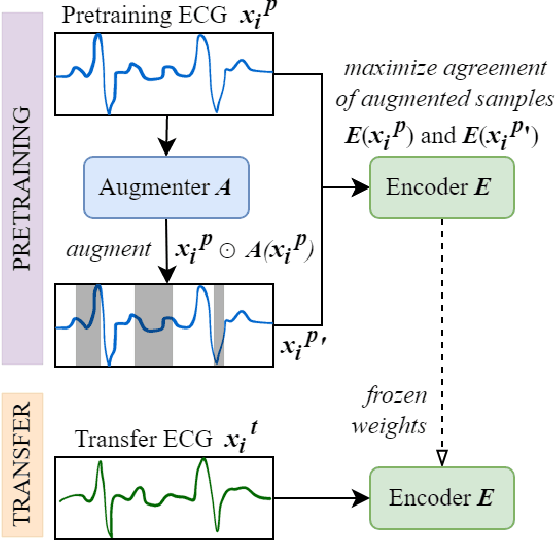
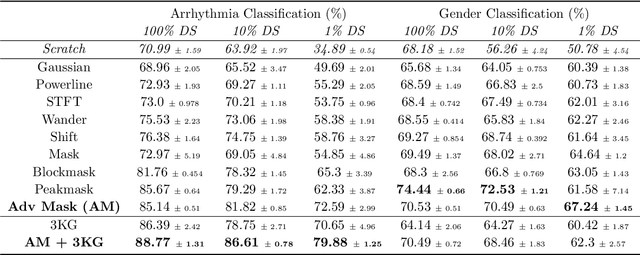
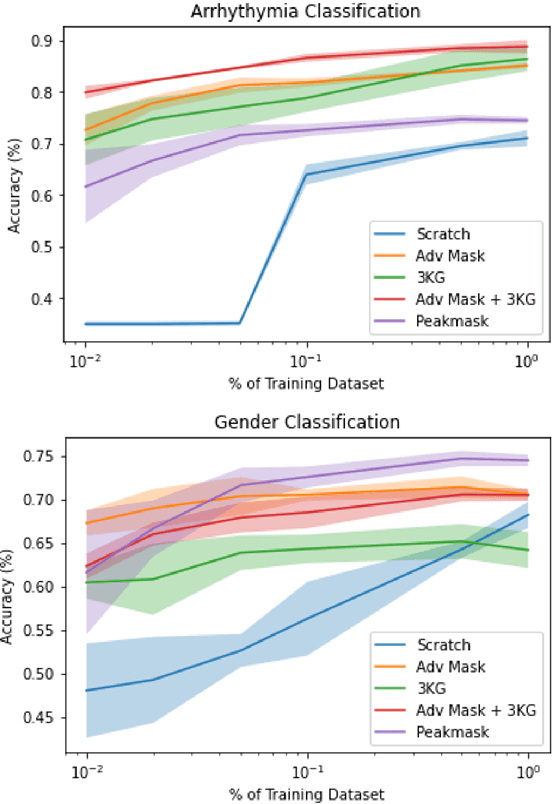
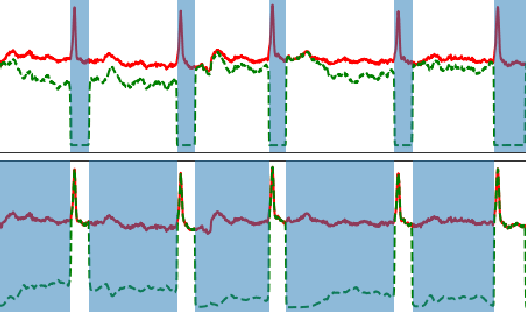
Medical datasets often face the problem of data scarcity, as ground truth labels must be generated by medical professionals. One mitigation strategy is to pretrain deep learning models on large, unlabelled datasets with self-supervised learning (SSL). Data augmentations are essential for improving the generalizability of SSL-trained models, but they are typically handcrafted and tuned manually. We use an adversarial model to generate masks as augmentations for 12-lead electrocardiogram (ECG) data, where masks learn to occlude diagnostically-relevant regions of the ECGs. Compared to random augmentations, adversarial masking reaches better accuracy when transferring to to two diverse downstream objectives: arrhythmia classification and gender classification. Compared to a state-of-art ECG augmentation method 3KG, adversarial masking performs better in data-scarce regimes, demonstrating the generalizability of our model.