 Add to Chrome
 Add to Firefox
 Add to Edge
Object-IR: Leveraging Object Consistency and Mesh Deformation for Self-Supervised Image Retargeting
Oct 31, 2025
Eliminating geometric distortion in semantically important regions remains an intractable challenge in image retargeting. This paper presents Object-IR, a self-supervised architecture that reformulates image retargeting as a learning-based mesh warping optimization problem, where the mesh deformation is guided by object appearance consistency and geometric-preserving constraints. Given an input image and a target aspect ratio, we initialize a uniform rigid mesh at the output resolution and use a convolutional neural network to predict the motion of each mesh grid and obtain the deformed mesh. The retargeted result is generated by warping the input image according to the rigid mesh in the input image and the deformed mesh in the output resolution. To mitigate geometric distortion, we design a comprehensive objective function incorporating a) object-consistent loss to ensure that the important semantic objects retain their appearance, b) geometric-preserving loss to constrain simple scale transform of the important meshes, and c) boundary loss to enforce a clean rectangular output. Notably, our self-supervised paradigm eliminates the need for manually annotated retargeting datasets by deriving supervision directly from the input's geometric and semantic properties. Extensive evaluations on the RetargetMe benchmark demonstrate that our Object-IR achieves state-of-the-art performance, outperforming existing methods in quantitative metrics and subjective visual quality assessments. The framework efficiently processes arbitrary input resolutions (average inference time: 0.009s for 1024x683 resolution) while maintaining real-time performance on consumer-grade GPUs. The source code will soon be available at https://github.com/tlliao/Object-IR.

Seam-guided local alignment and stitching for large parallax images
Nov 30, 2023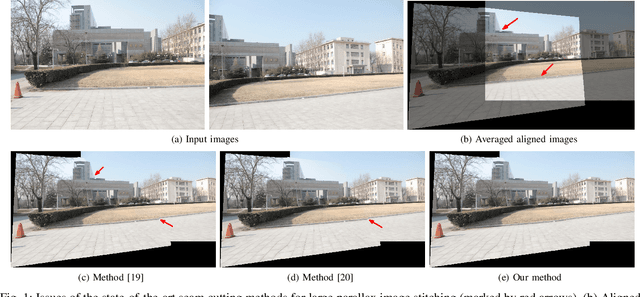
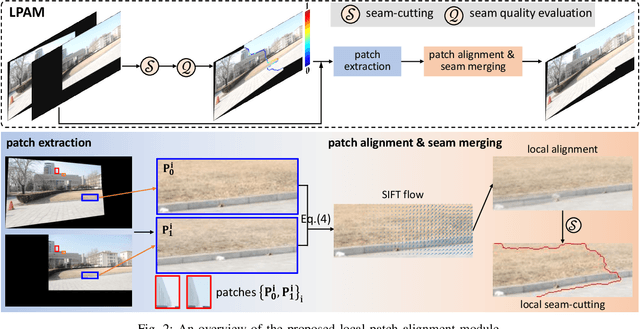

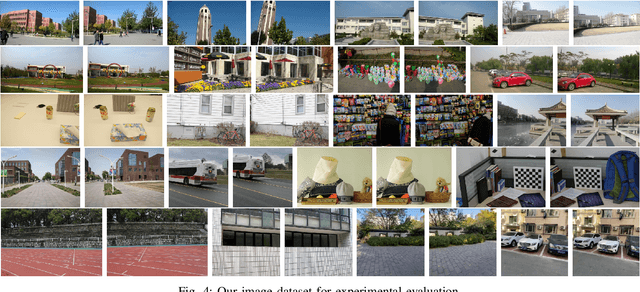
Seam-cutting methods have been proven effective in the composition step of image stitching, especially for images with parallax. However, the effectiveness of seam-cutting usually depends on that images can be roughly aligned such that there exists a local region where a plausible seam can be found. For images with large parallax, current alignment methods often fall short of expectations. In this paper, we propose a local alignment and stitching method guided by seam quality evaluation. First, we use existing image alignment and seam-cutting methods to calculate an initial seam and evaluate the quality of pixels along the seam. Then, for pixels with low qualities, we separate their enclosing patches in the aligned images and locally align them by extracting modified dense correspondences via SIFT flow. Finally, we composite the aligned patches via seam-cutting and merge them into the original aligned result to generate the final mosaic. Experiments show that compared with the state-of-the-art seam-cutting methods, our result is more plausible and with fewer artifacts. The code will be available at https://github.com/tlliao/Seam-guided-local-alignment.