 Add to Chrome
 Add to Firefox
 Add to Edge
Learning to Forecast Crop Growth from Earth Observation Data
Aug 14, 2026
Forecasting crop growth across agricultural landscapes is important for improving the productivity, resilience, and operational management of farming systems. In this work, we investigate whether Earth observation time series and meteorological drivers can be used to predict future canopy development at country scale. We focus on winter wheat and formulate crop growth prediction as forecasting future leaf area index (LAI) trajectories beyond the last available Sentinel-2 observation. We evaluate this task on a multi-year dataset which spans the entire country of Switzerland, containing over 20 million pixel-level Sentinel-2-derived LAI time series paired with meteorological variables. Because cloud cover and revisit gaps leave LAI supervision sparse, models fit the few valid (cloud-free) LAI observations yet oscillate implausibly between them, producing trajectories no real canopy could follow. We introduce a lightweight unimodal shape regulariser which improves trajectory plausibility with negligible loss in accuracy. We compare deep learning sequence-to-sequence (Seq2Seq) models with classic machine learning baselines and show that Seq2Seq models generalise well across years, achieving $\mathrm{R}^2$ above 0.8 and consistently outperforming conventional approaches. Together, these results demonstrate that remote sensing and weather-driven sequence modelling can learn crop growth dynamics at landscape scale. S

SwissCrop25: A National Multi-Year Benchmark for Operational Crop Mapping
Aug 10, 2026Operational crop mapping requires models that generalise across years, resolve fine-grained crop taxonomies, and distinguish cropland from surrounding landscapes. However, existing crop mapping datasets enable evaluation of these requirements only in isolation. We therefore introduce SwissCrop25, a national-scale crop mapping benchmark dataset spanning seven growing seasons (2019-2025). SwissCrop25 combines Sentinel-2 time series, daily temperature observations, a fine-grained 73 crop taxonomy including grassland management types, and 5 explicit non-crop land cover classes. To evaluate realistic deployment conditions, we define a leave-one-year-out protocol with joint cropland delineation and crop classification for benchmarking representative crop mapping architectures. Evaluating U-TAE (convolutional temporal-attention model), TSViT (transformer-based spatio-temporal model), and Galileo (EO foundation model) reveals differences between architectures hidden by conventional benchmarks. In this setting, domain-specific models outperform Galileo, with TSViT achieving the best overall performance and a 12 pp macro-mIoU advantage over U-TAE. SwissCrop25 also exposes substantial interannual distribution shifts and shows that incorporating temperature-derived phenological information improves robustness. Finally, in-season evaluation reveals a trade-off between models, with U-TAE performing better early in the season and TSViT gaining an advantage later through improved rare-class discrimination. SwissCrop25 provides a challenging testbed for evaluating crop mapping systems under realistic operational conditions and is publicly released at https://huggingface.co/datasets/EOA-team/SwissCrop25 .
Making Foundation Models Probabilistic via Singular Value Ensembles
Jan 29, 2026Foundation models have become a dominant paradigm in machine learning, achieving remarkable performance across diverse tasks through large-scale pretraining. However, these models often yield overconfident, uncalibrated predictions. The standard approach to quantifying epistemic uncertainty, training an ensemble of independent models, incurs prohibitive computational costs that scale linearly with ensemble size, making it impractical for large foundation models. We propose Singular Value Ensemble (SVE), a parameter-efficient implicit ensemble method that builds on a simple, but powerful core assumption: namely, that the singular vectors of the weight matrices constitute meaningful subspaces of the model's knowledge. Pretrained foundation models encode rich, transferable information in their weight matrices. If the singular vectors are indeed meaningful (orthogonal) "knowledge directions". To obtain a model ensemble, we modulate only how strongly each direction contributes to the output. Rather than learning entirely new parameters, we freeze the singular vectors and only train per-member singular values that rescale the contribution of each direction in that shared knowledge basis. Ensemble diversity emerges naturally as stochastic initialization and random sampling of mini-batches during joint training cause different members to converge to different combinations of the same underlying knowledge. SVE achieves uncertainty quantification comparable to explicit deep ensembles while increasing the parameter count of the base model by less than 1%, making principled uncertainty estimation accessible in resource-constrained settings. We validate SVE on NLP and vision tasks with various different backbones and show that it improves calibration while maintaining predictive accuracy.
Model-Agnostic, Temperature-Informed Sampling Enhances Cross-Year Crop Mapping with Deep Learning
Jun 15, 2025Conventional benchmarks for crop type classification from optical satellite time series typically assume access to labeled data from the same year and rely on fixed calendar-day sampling. This limits generalization across seasons, where crop phenology shifts due to interannual climate variability, and precludes real-time application when current-year labels are unavailable. Furthermore, uncertainty quantification is often neglected, making such approaches unreliable for crop monitoring applications. Inspired by ecophysiological principles of plant growth, we propose a simple, model-agnostic sampling strategy that leverages growing degree days (GDD), based on daily average temperature, to replace calendar time with thermal time. By uniformly subsampling time series in this biologically meaningful domain, the method emphasizes phenologically active growth stages while reducing temporal redundancy and noise. We evaluate the method on a multi-year Sentinel-2 dataset spanning all of Switzerland, training on one growing season and testing on other seasons. Compared to state-of-the-art baselines, our method delivers substantial gains in classification accuracy and, critically, produces more calibrated uncertainty estimates. Notably, our method excels in low-data regimes and enables significantly more accurate early-season classification. With only 10 percent of the training data, our method surpasses the state-of-the-art baseline in both predictive accuracy and uncertainty estimation, and by the end of June, it achieves performance similar to a baseline trained on the full season. These results demonstrate that leveraging temperature data not only improves predictive performance across seasons but also enhances the robustness and trustworthiness of crop-type mapping in real-world applications.
LoRA-Ensemble: Efficient Uncertainty Modelling for Self-attention Networks
May 23, 2024Numerous crucial tasks in real-world decision-making rely on machine learning algorithms with calibrated uncertainty estimates. However, modern methods often yield overconfident and uncalibrated predictions. Various approaches involve training an ensemble of separate models to quantify the uncertainty related to the model itself, known as epistemic uncertainty. In an explicit implementation, the ensemble approach has high computational cost and high memory requirements. This particular challenge is evident in state-of-the-art neural networks such as transformers, where even a single network is already demanding in terms of compute and memory. Consequently, efforts are made to emulate the ensemble model without actually instantiating separate ensemble members, referred to as implicit ensembling. We introduce LoRA-Ensemble, a parameter-efficient deep ensemble method for self-attention networks, which is based on Low-Rank Adaptation (LoRA). Initially developed for efficient LLM fine-tuning, we extend LoRA to an implicit ensembling approach. By employing a single pre-trained self-attention network with weights shared across all members, we train member-specific low-rank matrices for the attention projections. Our method exhibits superior calibration compared to explicit ensembles and achieves similar or better accuracy across various prediction tasks and datasets.
Global Wheat Head Dataset 2021: more diversity to improve the benchmarking of wheat head localization methods
Jun 03, 2021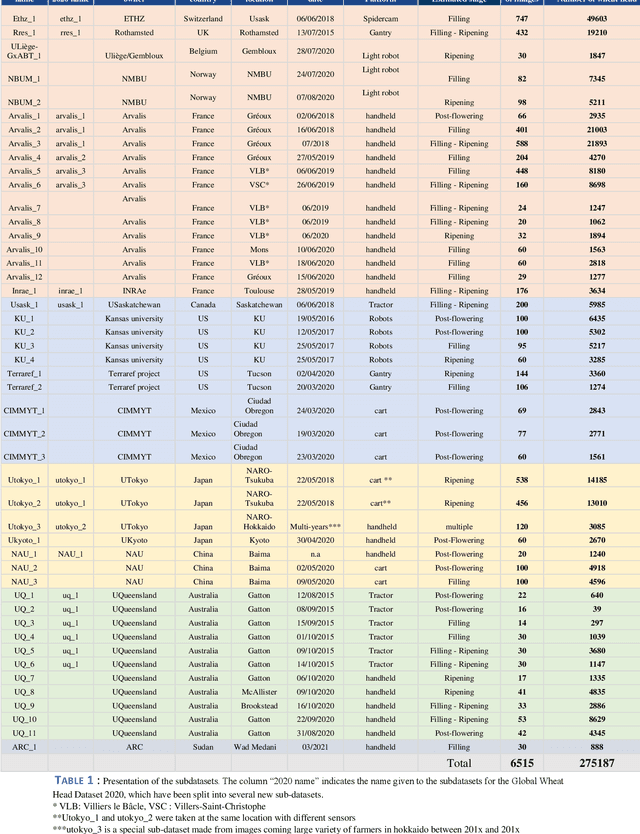
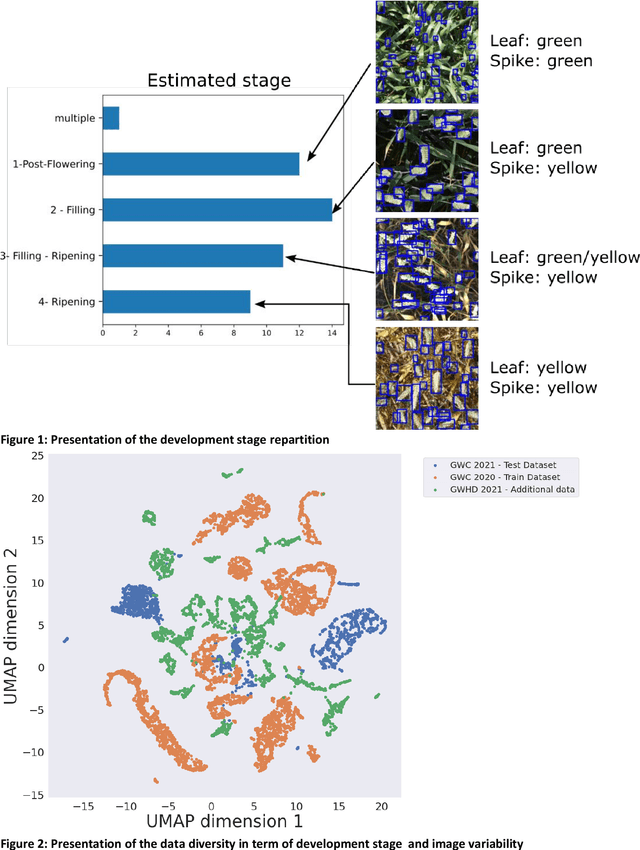
The Global Wheat Head Detection (GWHD) dataset was created in 2020 and has assembled 193,634 labelled wheat heads from 4,700 RGB images acquired from various acquisition platforms and 7 countries/institutions. With an associated competition hosted in Kaggle, GWHD has successfully attracted attention from both the computer vision and agricultural science communities. From this first experience in 2020, a few avenues for improvements have been identified, especially from the perspective of data size, head diversity and label reliability. To address these issues, the 2020 dataset has been reexamined, relabeled, and augmented by adding 1,722 images from 5 additional countries, allowing for 81,553 additional wheat heads to be added. We now release a new version of the Global Wheat Head Detection (GWHD) dataset in 2021, which is bigger, more diverse, and less noisy than the 2020 version. The GWHD 2021 is now publicly available at http://www.global-wheat.com/ and a new data challenge has been organized on AIcrowd to make use of this updated dataset.