 Add to Chrome
 Add to Firefox
 Add to Edge
Adaptation-Free Heterogeneous Collaborative Perception with Unseen Agent Configurations
May 26, 2026
Collaborative perception improves 3D object detection by enabling agents to share complementary observations, but most existing methods assume fixed or known collaborator encoder configurations, limiting deployment in practice. In this work, we consider an open-world setting in which auxiliary agents with unseen configurations may appear after deployment, such as different LiDAR beam counts or encoder architectures. To address this challenge, we propose ALF, a collaborative perception framework that enables zero-adaptation collaboration with unseen agent configurations by lifting lightweight box-level messages into ego-compatible auxiliary features. ALF converts auxiliary box-level messages into pseudo-BEV maps and synthesizes ego-compatible latent features by combining object-centric cues with scene context from the ego feature. On V2X-Real, under a zero-shot evaluation across 64 case studies, ALF outperforms the strongest prior baseline by 35.91% in relative mAP@0.7 while requiring only 120 bytes per agent per frame (approximately 9.6 Kbps bandwidth at 10 Hz).

Probabilistic Recursively Feasible Motion Planning Under Uncertain Environments
May 18, 2026Safe motion planning in uncertain, time-varying environments is challenging because the safe region can change unpredictably across planning steps, often causing a loss of recursive feasibility. In this work, we present a Probabilistic Recursively Feasible Model Predictive Control (PRF-MPC) framework that guarantees recursive feasibility with a specified probability. We introduce properties that an ideal predictor should satisfy to ensure distributional consistency, and use these properties to derive closed-form expressions for the means and covariances of trajectories predicted at future time steps. Building on this analysis, we construct safety constraints that ensure, with high probability, that the current safe set is contained within the safe sets at future time steps, thereby probabilistically guaranteeing recursive feasibility. Simulation results on a lane-change scenario demonstrate that the proposed method significantly improves recursive feasibility.
Uncertainty Estimation via Hyperspherical Confidence Mapping
May 07, 2026Quantifying uncertainty in neural network predictions is essential for high-stakes domains such as autonomous driving, healthcare, and manufacturing. While existing approaches often depend on costly sampling or restrictive distributional assumptions, we propose Hyperspherical Confidence Mapping (HCM), a simple yet principled framework for sampling-free and distribution-free uncertainty estimation. HCM decomposes outputs into a magnitude and a normalized direction vector constrained to lie on the unit hypersphere, enabling a novel interpretation of uncertainty as the degree of violation of this geometric constraint. This yields deterministic and interpretable estimates applicable to both regression and classification. Experiments across diverse benchmarks and real-world industrial tasks demonstrate that HCM matches or surpasses ensemble and evidential approaches, with far lower inference cost and stronger confidence-error alignment. Our results highlight the power of geometric structure in uncertainty estimation and position HCM as a versatile alternative to conventional techniques.
HyDRA: Hybrid Domain-Aware Robust Architecture for Heterogeneous Collaborative Perception
Mar 25, 2026In collaborative perception, an agent's performance can be degraded by heterogeneity arising from differences in model architecture or training data distributions. To address this challenge, we propose HyDRA (Hybrid Domain-Aware Robust Architecture), a unified pipeline that integrates intermediate and late fusion within a domain-aware framework. We introduce a lightweight domain classifier that dynamically identifies heterogeneous agents and assigns them to the late-fusion branch. Furthermore, we propose anchor-guided pose graph optimization to mitigate localization errors inherent in late fusion, leveraging reliable detections from intermediate fusion as fixed spatial anchors. Extensive experiments demonstrate that, despite requiring no additional training, HyDRA achieves performance comparable to state-of-the-art heterogeneity-aware CP methods. Importantly, this performance is maintained as the number of collaborating agents increases, enabling zero-cost scaling without retraining.
High-Density Automated Valet Parking with Relocation-Free Sequential Operations
Mar 25, 2026In this paper, we present DROP, high-Density Relocation-free sequential OPerations in automated valet parking. DROP addresses the challenges in high-density parking & vehicle retrieval without relocations. Each challenge is handled by jointly providing area-efficient layouts and relocation-free parking & exit sequences, considering accessibility with relocation-free sequential operations. To generate such sequences, relocation-free constraints are formulated as explicit logical conditions expressed in boolean variables. Recursive search strategies are employed to derive the logical conditions and enumerate relocation-free sequences under sequential constraints. We demonstrate the effectiveness of our framework through extensive simulations, showing its potential to significantly improve area utilization with relocation-free constraints. We also examine its viability on an application problem with prescribed operational order. The results from all experiments are available at: https://drop-park.github.io.
Miniature Testbed for Validating Multi-Agent Cooperative Autonomous Driving
Nov 14, 2025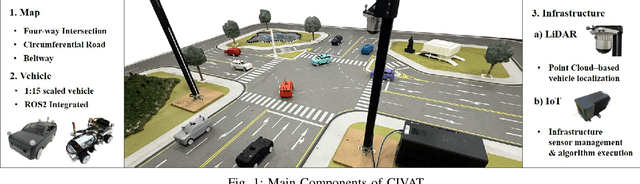
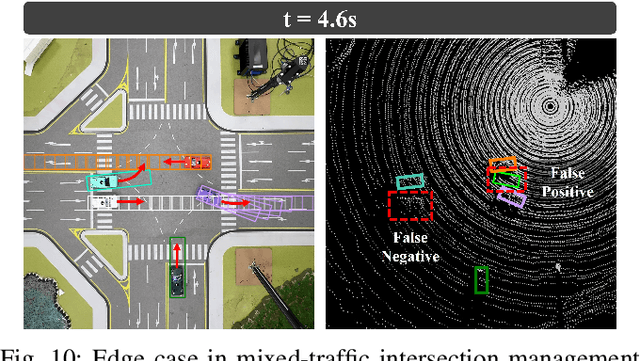
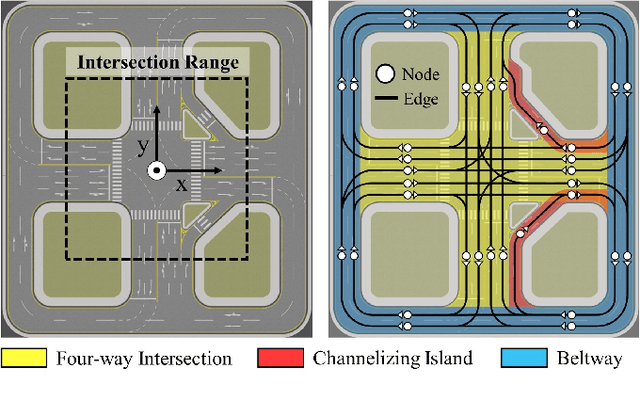
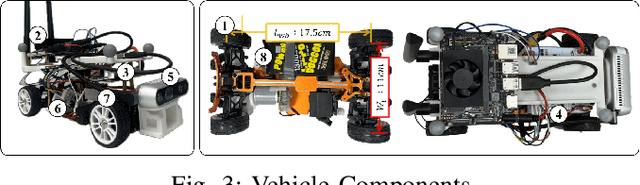
Cooperative autonomous driving, which extends vehicle autonomy by enabling real-time collaboration between vehicles and smart roadside infrastructure, remains a challenging yet essential problem. However, none of the existing testbeds employ smart infrastructure equipped with sensing, edge computing, and communication capabilities. To address this gap, we design and implement a 1:15-scale miniature testbed, CIVAT, for validating cooperative autonomous driving, consisting of a scaled urban map, autonomous vehicles with onboard sensors, and smart infrastructure. The proposed testbed integrates V2V and V2I communication with the publish-subscribe pattern through a shared Wi-Fi and ROS2 framework, enabling information exchange between vehicles and infrastructure to realize cooperative driving functionality. As a case study, we validate the system through infrastructure-based perception and intersection management experiments.
A Domain-Agnostic Scalable AI Safety Ensuring Framework
Apr 30, 2025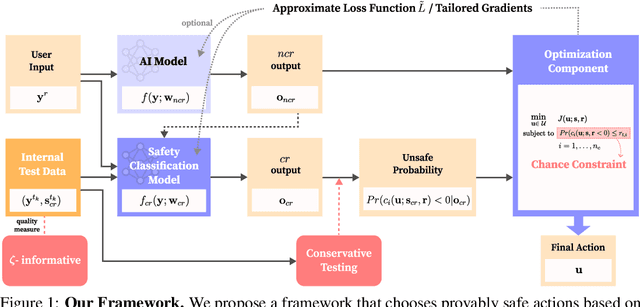
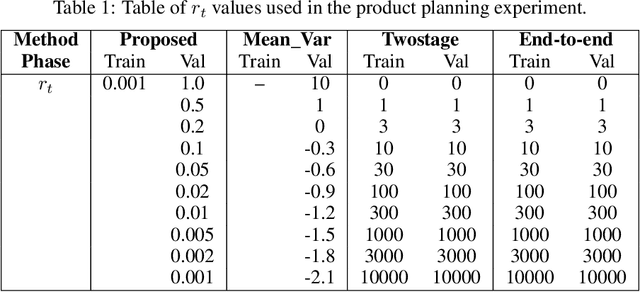
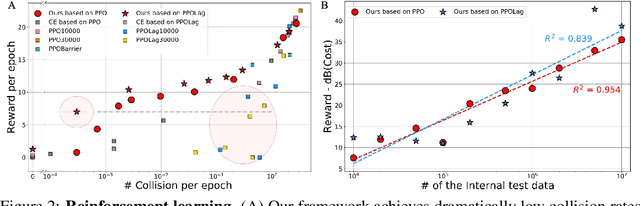
Ensuring the safety of AI systems has recently emerged as a critical priority for real-world deployment, particularly in physical AI applications. Current approaches to AI safety typically address predefined domain-specific safety conditions, limiting their ability to generalize across contexts. We propose a novel AI safety framework that ensures AI systems comply with any user-defined constraint, with any desired probability, and across various domains. In this framework, we combine an AI component (e.g., neural network) with an optimization problem to produce responses that minimize objectives while satisfying user-defined constraints with probabilities exceeding user-defined thresholds. For credibility assessment of the AI component, we propose internal test data, a supplementary set of safety-labeled data, and a conservative testing methodology that provides statistical validity of using internal test data. We also present an approximation method of a loss function and how to compute its gradient for training. We mathematically prove that probabilistic constraint satisfaction is guaranteed under specific, mild conditions and prove a scaling law between safety and the number of internal test data. We demonstrate our framework's effectiveness through experiments in diverse domains: demand prediction for production decision, safe reinforcement learning within the SafetyGym simulator, and guarding AI chatbot outputs. Through these experiments, we demonstrate that our method guarantees safety for user-specified constraints, outperforms for up to several order of magnitudes existing methods in low safety threshold regions, and scales effectively with respect to the size of internal test data.
Chance-Constrained Trajectory Planning with Multimodal Environmental Uncertainty
Mar 09, 2025We tackle safe trajectory planning under Gaussian mixture model (GMM) uncertainty. Specifically, we use a GMM to model the multimodal behaviors of obstacles' uncertain states. Then, we develop a mixed-integer conic approximation to the chance-constrained trajectory planning problem with deterministic linear systems and polyhedral obstacles. When the GMM moments are estimated via finite samples, we develop a tight concentration bound to ensure the chance constraint with a desired confidence. Moreover, to limit the amount of constraint violation, we develop a Conditional Value-at-Risk (CVaR) approach corresponding to the chance constraints and derive a tractable approximation for known and estimated GMM moments. We verify our methods with state-of-the-art trajectory prediction algorithms and autonomous driving datasets.
* Published in IEEE Control Systems Letters
Rethinking the Role of Infrastructure in Collaborative Perception
Oct 15, 2024Collaborative Perception (CP) is a process in which an ego agent receives and fuses sensor information from surrounding vehicles and infrastructure to enhance its perception capability. To evaluate the need for infrastructure equipped with sensors, extensive and quantitative analysis of the role of infrastructure data in CP is crucial, yet remains underexplored. To address this gap, we first quantitatively assess the importance of infrastructure data in existing vehicle-centric CP, where the ego agent is a vehicle. Furthermore, we compare vehicle-centric CP with infra-centric CP, where the ego agent is now the infrastructure, to evaluate the effectiveness of each approach. Our results demonstrate that incorporating infrastructure data improves 3D detection accuracy by up to 10.87%, and infra-centric CP shows enhanced noise robustness and increases accuracy by up to 42.53% compared with vehicle-centric CP.
A GPT-based Decision Transformer for Multi-Vehicle Coordination at Unsignalized Intersections
Oct 08, 2024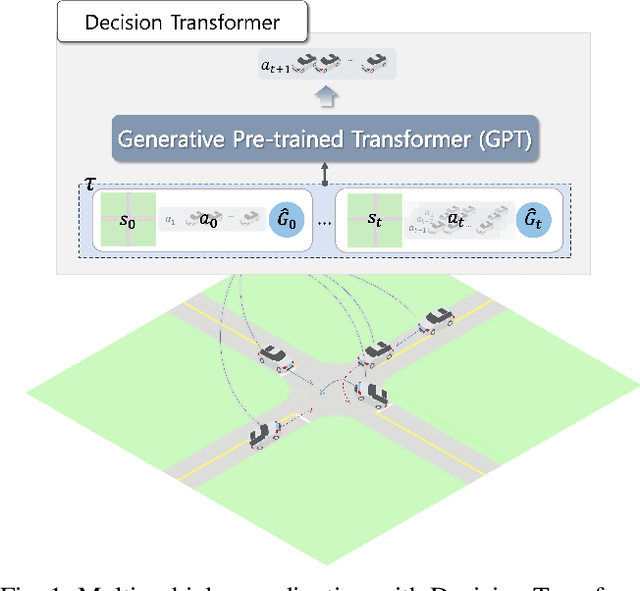
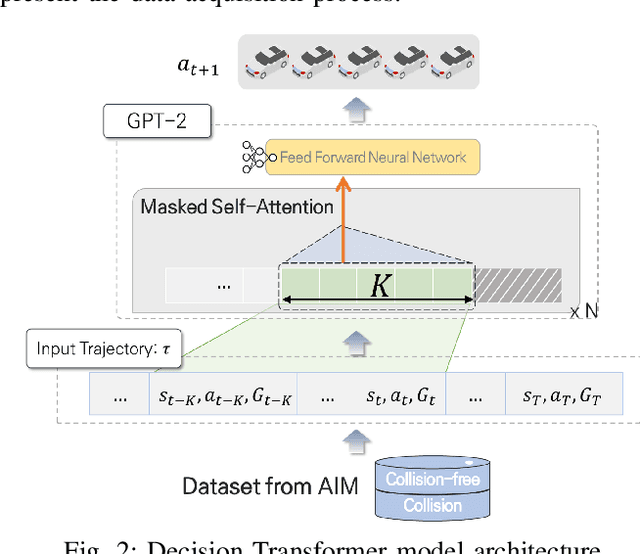
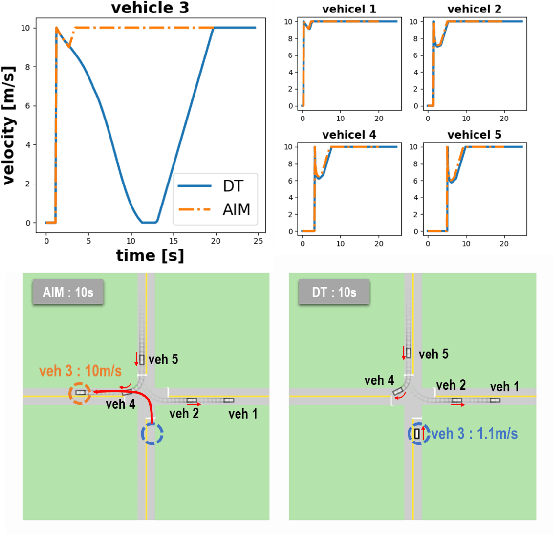
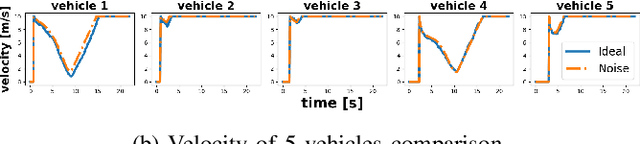
In this paper, we explore the application of the Decision Transformer, a decision-making algorithm based on the Generative Pre-trained Transformer (GPT) architecture, to multi-vehicle coordination at unsignalized intersections. We formulate the coordination problem so as to find the optimal trajectories for multiple vehicles at intersections, modeling it as a sequence prediction task to fully leverage the power of GPTs as a sequence model. Through extensive experiments, we compare our approach to a reservation-based intersection management system. Our results show that the Decision Transformer can outperform the training data in terms of total travel time and can be generalized effectively to various scenarios, including noise-induced velocity variations, continuous interaction environments, and different vehicle numbers and road configurations.