 Add to Chrome
 Add to Firefox
 Add to Edge
Agents' Last Exam
Jun 03, 2026
Recent AI systems have achieved strong results on a wide range of benchmarks, yet these gains have not translated into economically meaningful deployment across many professional domains. We argue that this gap is largely an evaluation problem: widely used benchmarks lack sustained performance measurement on real and economically valuable workflows. This paper introduces Agents' Last Exam (ALE), a benchmark designed to evaluate AI agents on long-horizon, economically valuable, real-world tasks with verifiable outcomes. Developed in collaboration with 250+ industry experts, ALE covers non-physical industries defined with reference to O*NET / SOC 2018 (the U.S. federal occupational taxonomy). It is organized around a task taxonomy with 55 subfields grouped into 13 industry clusters covering 1K+ tasks. Current results show that the hardest tier remains far from saturated: across mainstream harness and backbone configurations, the average full pass rate is 2.6%. ALE is designed as a living benchmark: its task pool grows continuously as new workflows and industries are onboarded. More broadly, ALE is intended not merely as another leaderboard, but as an instrument for closing the gap between benchmark success and GDP-relevant impact.

AeroJEPA: Learning Semantic Latent Representations for Scalable 3D Aerodynamic Field Modeling
May 07, 2026Aerodynamic surrogate models are increasingly used to replace repeated high-fidelity CFD evaluations in many-query design settings, but current approaches still face two important limitations: they often scale poorly to the very large fields arising in realistic 3D aerodynamics, and they rarely produce latent representations that are directly useful for analysis and design. We introduce AeroJEPA, a Joint-Embedding Predictive Architecture for aerodynamic field modeling that addresses both issues. Rather than predicting the full flow field directly from geometry, AeroJEPA predicts a target latent representation of the flow from a context latent representation of the geometry and operating conditions, and optionally reconstructs the field through a continuous implicit decoder. This formulation decouples latent prediction from field resolution while encouraging the latent space to organize semantically. We evaluate AeroJEPA on two complementary datasets: HiLiftAeroML, which stresses the method in a high-fidelity regime with extremely large boundary-layer fields, and SuperWing, which tests large-scale generalization and latent-space optimization over a broad family of transonic wings. Across these benchmarks, AeroJEPA is competitive as a continuous surrogate for aerodynamic fields, scales naturally to high-resolution outputs, and learns context and predicted latents that encode geometry and aerodynamic quantities not used directly as supervision. We further show that the resulting latent space supports controlled interpolation, linear probing, concept-vector arithmetic, and a constrained design latent-optimization experiment. These results suggest that predictive latent learning is a promising direction for scalable and design-meaningful aerodynamic surrogate modeling.
Patient-specific, mechanistic models of tumor growth incorporating artificial intelligence and big data
Aug 28, 2023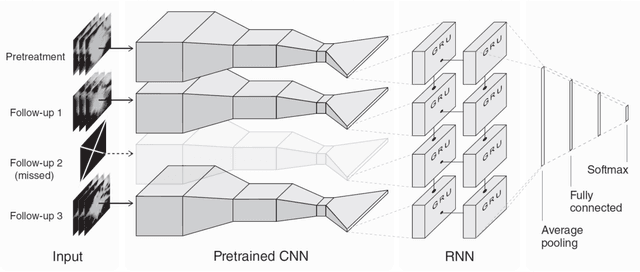
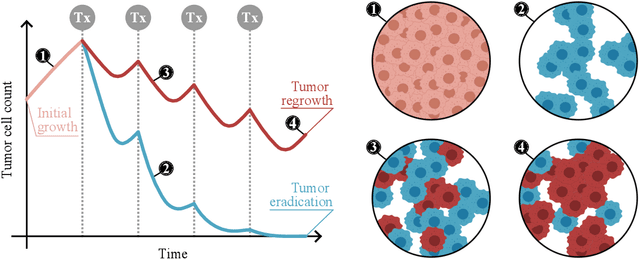
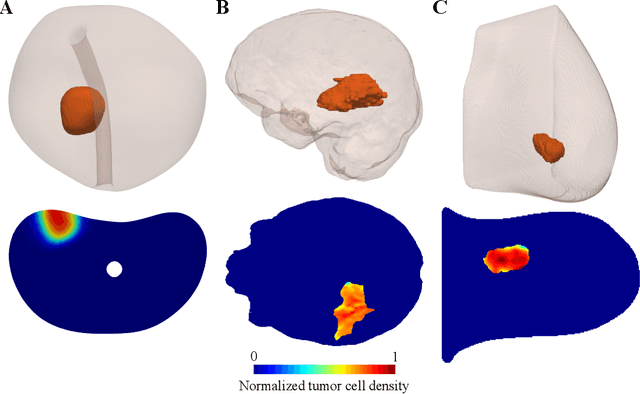
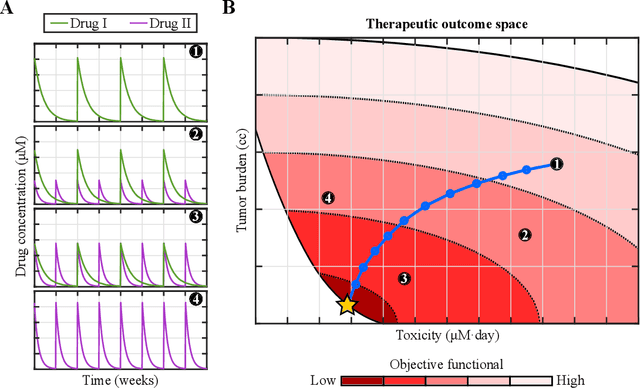
Despite the remarkable advances in cancer diagnosis, treatment, and management that have occurred over the past decade, malignant tumors remain a major public health problem. Further progress in combating cancer may be enabled by personalizing the delivery of therapies according to the predicted response for each individual patient. The design of personalized therapies requires patient-specific information integrated into an appropriate mathematical model of tumor response. A fundamental barrier to realizing this paradigm is the current lack of a rigorous, yet practical, mathematical theory of tumor initiation, development, invasion, and response to therapy. In this review, we begin by providing an overview of different approaches to modeling tumor growth and treatment, including mechanistic as well as data-driven models based on ``big data" and artificial intelligence. Next, we present illustrative examples of mathematical models manifesting their utility and discussing the limitations of stand-alone mechanistic and data-driven models. We further discuss the potential of mechanistic models for not only predicting, but also optimizing response to therapy on a patient-specific basis. We then discuss current efforts and future possibilities to integrate mechanistic and data-driven models. We conclude by proposing five fundamental challenges that must be addressed to fully realize personalized care for cancer patients driven by computational models.
A deep learning framework for solution and discovery in solid mechanics: linear elasticity
Feb 14, 2020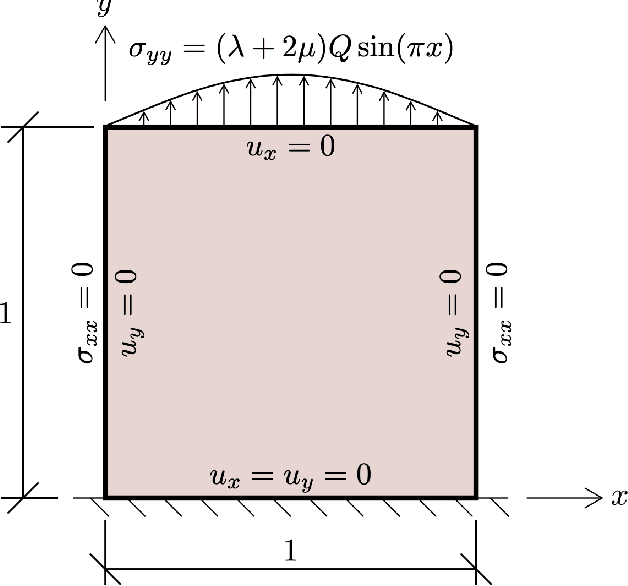
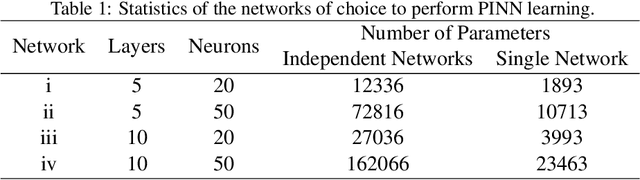
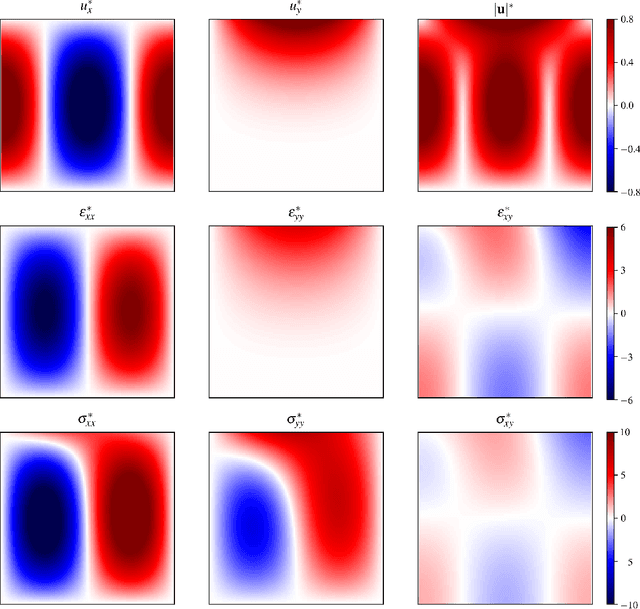
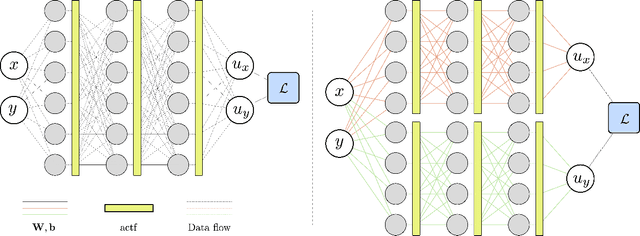
We present the application of a class of deep learning, known as Physics Informed Neural Networks (PINN), to learning and discovery in solid mechanics. We explain how to incorporate the momentum balance and constitutive relations into PINN, and explore in detail the application to linear elasticity, although the framework is rather general and can be extended to other solid-mechanics problems. While common PINN algorithms are based on training one deep neural network (DNN), we propose a multi-network model that results in more accurate representation of the field variables. To validate the model, we test the framework on synthetic data generated from analytical and numerical reference solutions. We study convergence of the PINN model, and show that Isogeometric Analysis (IGA) results in superior accuracy and convergence characteristics compared with classic low-order Finite Element Method (FEM). We also show the applicability of the framework for transfer learning, and find vastly accelerated convergence during network re-training. Finally, we find that honoring the physics leads to improved robustness: when trained only on a few parameters, we find that the PINN model can accurately predict the solution for a wide range of parameters new to the network---thus pointing to an important application of this framework to sensitivity analysis and surrogate modeling.