 Add to Chrome
 Add to Firefox
 Add to Edge
Explainable deep reinforcement learning reveals energy-efficient control strategies for turbulent drag reduction
May 31, 2026
We propose a method combining Multi-Agent Deep Reinforcement Learning (MARL) and eXplainable Deep Learning (XDL) to reduce drag in wall-bounded turbulent flows. Taking as a baseline the results of training agents directly targeting wall-shear stress and opposition control, three SHAP-guided approaches are compared. In the first, the reward is computed from SHAP attributions of a U-net predicting the future velocity field; in the second, from SHAP attributions of a U-net predicting the skin-friction coefficient; in the third, from a combination of SHAP attributions of two U-nets predicting the skin-friction coefficient and the wall pressure fluctuations, respectively. The combined SHAP strategy based on skin-friction coefficient and wall-pressure fluctuations achieves the best overall performance, achieving a DR of 34.44% and a NES of 34.01% with only 0.43% normalized input power. Relative to opposition control, drag reduction and net energy saving increase by 49.41% and 48.52%, respectively. Compared with the direct wall-shear-stress baseline, the proposed strategy simultaneously improves performance while reducing the normalized actuation cost from 5.90% to 0.43%. Analysis of the results reveals that the energetically efficient policy is consistent with pressure-gated actuation, activating predominantly at near-zero wall pressure, and operates on a temporal timescale comparable to the lifetime of the near-wall turbulent structures.

AeroJEPA: Learning Semantic Latent Representations for Scalable 3D Aerodynamic Field Modeling
May 07, 2026Aerodynamic surrogate models are increasingly used to replace repeated high-fidelity CFD evaluations in many-query design settings, but current approaches still face two important limitations: they often scale poorly to the very large fields arising in realistic 3D aerodynamics, and they rarely produce latent representations that are directly useful for analysis and design. We introduce AeroJEPA, a Joint-Embedding Predictive Architecture for aerodynamic field modeling that addresses both issues. Rather than predicting the full flow field directly from geometry, AeroJEPA predicts a target latent representation of the flow from a context latent representation of the geometry and operating conditions, and optionally reconstructs the field through a continuous implicit decoder. This formulation decouples latent prediction from field resolution while encouraging the latent space to organize semantically. We evaluate AeroJEPA on two complementary datasets: HiLiftAeroML, which stresses the method in a high-fidelity regime with extremely large boundary-layer fields, and SuperWing, which tests large-scale generalization and latent-space optimization over a broad family of transonic wings. Across these benchmarks, AeroJEPA is competitive as a continuous surrogate for aerodynamic fields, scales naturally to high-resolution outputs, and learns context and predicted latents that encode geometry and aerodynamic quantities not used directly as supervision. We further show that the resulting latent space supports controlled interpolation, linear probing, concept-vector arithmetic, and a constrained design latent-optimization experiment. These results suggest that predictive latent learning is a promising direction for scalable and design-meaningful aerodynamic surrogate modeling.
Navigation in a simplified Urban Flow through Deep Reinforcement Learning
Sep 26, 2024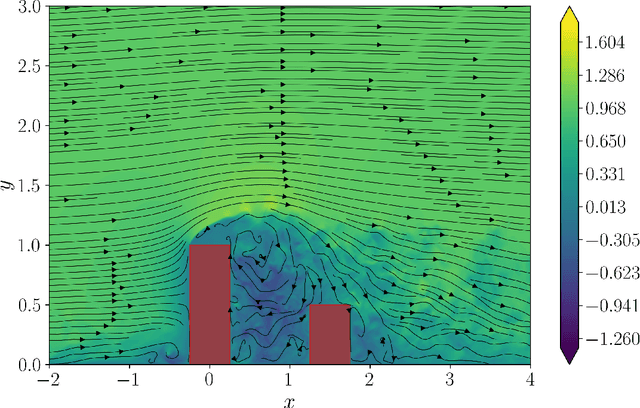
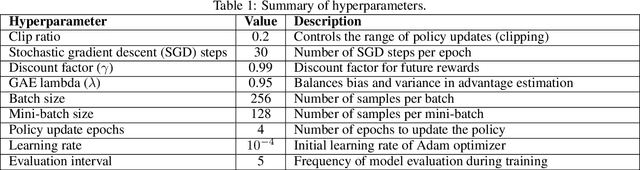
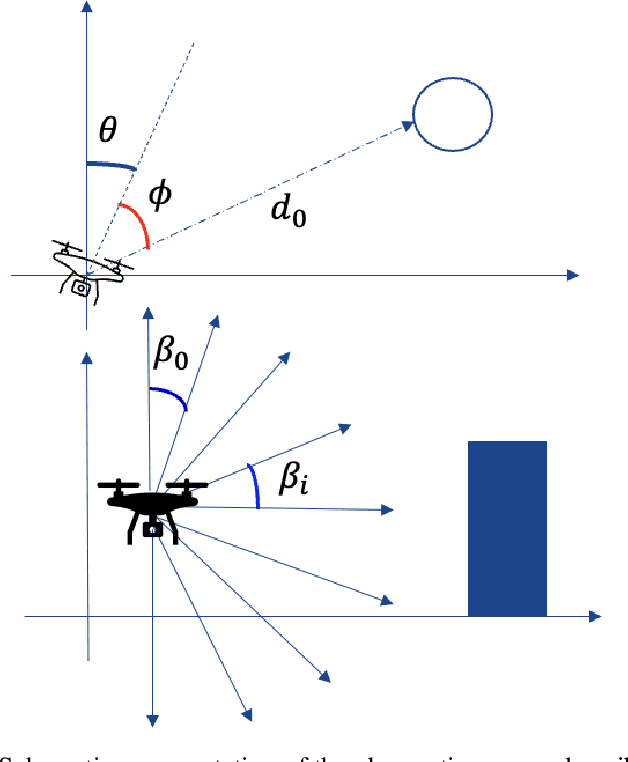
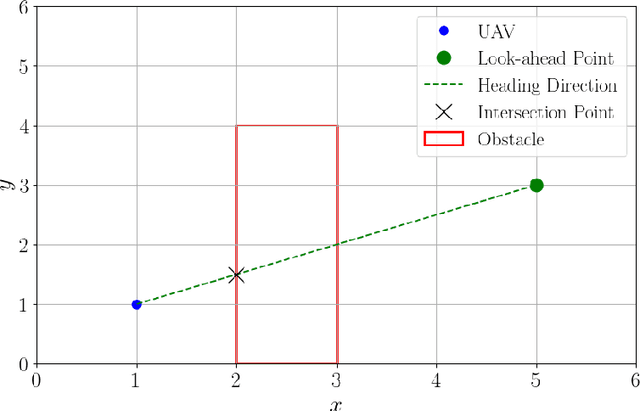
The increasing number of unmanned aerial vehicles (UAVs) in urban environments requires a strategy to minimize their environmental impact, both in terms of energy efficiency and noise reduction. In order to reduce these concerns, novel strategies for developing prediction models and optimization of flight planning, for instance through deep reinforcement learning (DRL), are needed. Our goal is to develop DRL algorithms capable of enabling the autonomous navigation of UAVs in urban environments, taking into account the presence of buildings and other UAVs, optimizing the trajectories in order to reduce both energetic consumption and noise. This is achieved using fluid-flow simulations which represent the environment in which UAVs navigate and training the UAV as an agent interacting with an urban environment. In this work, we consider a domain domain represented by a two-dimensional flow field with obstacles, ideally representing buildings, extracted from a three-dimensional high-fidelity numerical simulation. The presented methodology, using PPO+LSTM cells, was validated by reproducing a simple but fundamental problem in navigation, namely the Zermelo's problem, which deals with a vessel navigating in a turbulent flow, travelling from a starting point to a target location, optimizing the trajectory. The current method shows a significant improvement with respect to both a simple PPO and a TD3 algorithm, with a success rate (SR) of the PPO+LSTM trained policy of 98.7%, and a crash rate (CR) of 0.1%, outperforming both PPO (SR = 75.6%, CR=18.6%) and TD3 (SR=77.4% and CR=14.5%). This is the first step towards DRL strategies which will guide UAVs in a three-dimensional flow field using real-time signals, making the navigation efficient in terms of flight time and avoiding damages to the vehicle.