 Add to Chrome
 Add to Firefox
 Add to Edge
Inertial Human Motion Capture: From Biomechanics to Recent Sensor Fusion Methods and Back
Jul 17, 2026
Inertial measurement units (IMUs) are a promising means to capture human motion, yet obtaining meaningful biomechanical quantities from IMU measurements remains non-trivial. This tutorial-style review focuses on kinematics and introduces four key aspects (inertial human motion capture objective, environmental conditions, subject & attributes, and motion characteristics) to determine how to translate biomechanical problems into adequate formulations for the fusion of inertial sensor measurements. We identify three fundamental challenges for kinematics estimation from IMUs: IMUs do not provide direct information about the joint angle, IMUs do not measure their own orientation, and real-world environments and dynamics compromise sensor reliability. Though there exist widely-used methods to overcome these challenges, they suffer from severe limitations in real-life applications, e.g., the need for sensor-to-segment calibration, and the fact that magnetic field disturbances degrade joint angle accuracy. The full potential for many use-cases hence remains untapped in terms of accuracy and reliability. We share insights into recently proposed methods, e.g. exploiting the human body's kinematic chain constraints, having the potential to overcome these limitations. We also present guiding questions related to the four key aspects and illustrate their use for navigating the methodological landscape for the use-case of lower-extremity joint angle estimation, for which we share open-access code and compare the traditional workflow with three alternatives. Our aim is to bridge the gap between the sensor fusion community developing methods for human motion capture and the biomechanics community in need of accurate, easy-to-use, and reliable methods to study human motion outside of the laboratory.

A Tightly Coupled IMU-Based Motion Capture Approach for Estimating Multibody Kinematics and Kinetics
May 13, 2025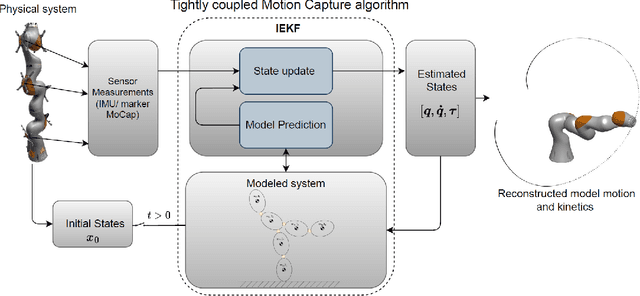
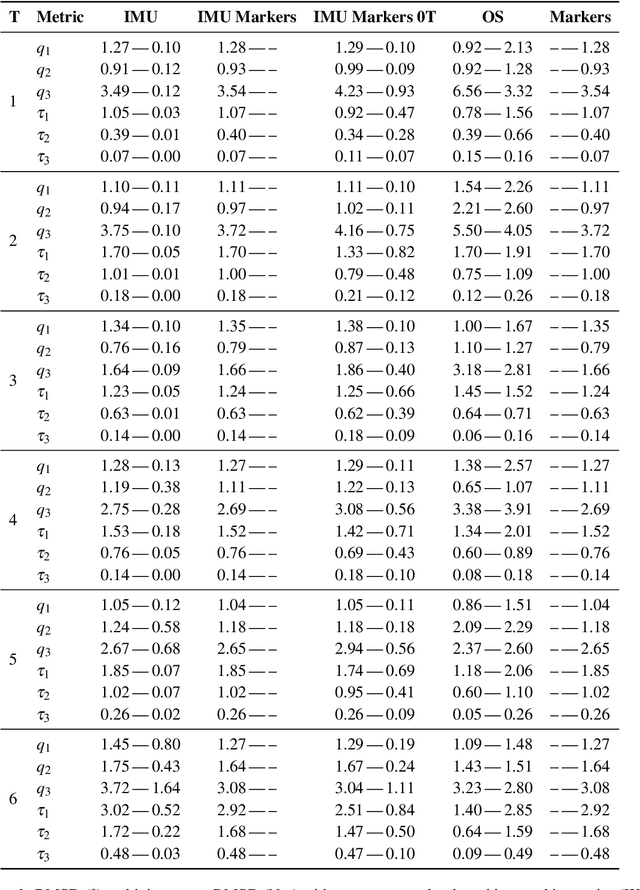
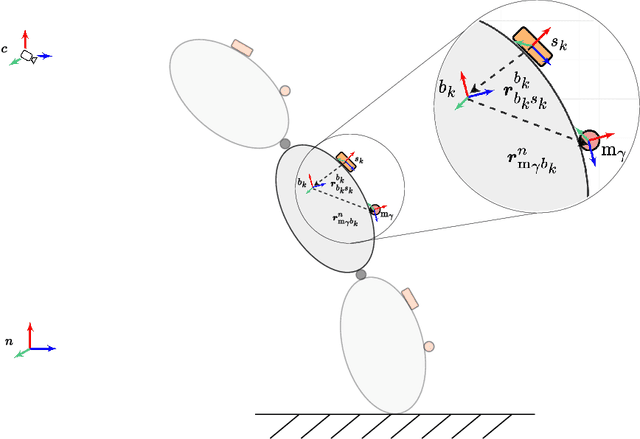
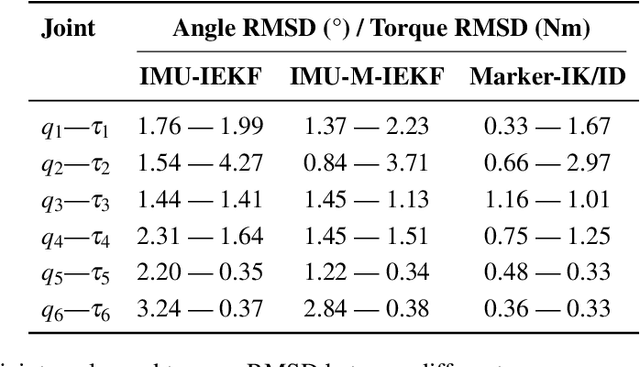
Inertial Measurement Units (IMUs) enable portable, multibody motion capture (MoCap) in diverse environments beyond the laboratory, making them a practical choice for diagnosing mobility disorders and supporting rehabilitation in clinical or home settings. However, challenges associated with IMU measurements, including magnetic distortions and drift errors, complicate their broader use for MoCap. In this work, we propose a tightly coupled motion capture approach that directly integrates IMU measurements with multibody dynamic models via an Iterated Extended Kalman Filter (IEKF) to simultaneously estimate the system's kinematics and kinetics. By enforcing kinematic and kinetic properties and utilizing only accelerometer and gyroscope data, our method improves IMU-based state estimation accuracy. Our approach is designed to allow for incorporating additional sensor data, such as optical MoCap measurements and joint torque readings, to further enhance estimation accuracy. We validated our approach using highly accurate ground truth data from a 3 Degree of Freedom (DoF) pendulum and a 6 DoF Kuka robot. We demonstrate a maximum Root Mean Square Difference (RMSD) in the pendulum's computed joint angles of 3.75 degrees compared to optical MoCap Inverse Kinematics (IK), which serves as the gold standard in the absence of internal encoders. For the Kuka robot, we observe a maximum joint angle RMSD of 3.24 degrees compared to the Kuka's internal encoders, while the maximum joint angle RMSD of the optical MoCap IK compared to the encoders was 1.16 degrees. Additionally, we report a maximum joint torque RMSD of 2 Nm in the pendulum compared to optical MoCap Inverse Dynamics (ID), and 3.73 Nm in the Kuka robot relative to its internal torque sensors.