 Add to Chrome
 Add to Firefox
 Add to Edge
Simple Features and Honest Calibration for Ambivalence and Hesitancy Recognition in Video
Jul 13, 2026
We address ambivalence and hesitancy (A/H) recognition in the ABAW 2026 BAH Challenge: given a short interview video, predict whether the person shows signs of A/H. Our system combines affect-specialised text, audio, and visual representations with a small set of readable linguistic hesitation cues, fused by a reliability gate we call Affective Marker Fusion (AMF), and finished with a simple AP-weighted ensemble at a fixed decision threshold. We also introduce \emph{ASR-erased time}: speech recognisers delete fillers and hesitation pauses from the transcript, but the chunk timestamps keep the time those events took, and sixteen features built from these gaps form the strongest and most independent non-verbal channel we measured (AP $0.718$, correlation $0.11$--$0.36$ with all other members). Across controlled experiments we find three things: cross-modal conflict design does not reliably help on BAH; language is by far the strongest channel while affect-specialised audio is a useful second; and calibration matters more than architecture. Fitting ensemble weights and a threshold on the small validation split overfits: it scores $0.741$ macro-F1 on validation but only $0.690$ on the untouched test set. AP-weighting at a fixed threshold instead reaches $\mathbf{0.731}$ on test.

CA-AFP: Cluster-Aware Adaptive Federated Pruning
Mar 02, 2026Federated Learning (FL) faces major challenges in real-world deployments due to statistical heterogeneity across clients and system heterogeneity arising from resource-constrained devices. While clustering-based approaches mitigate statistical heterogeneity and pruning techniques improve memory and communication efficiency, these strategies are typically studied in isolation. We propose CA-AFP, a unified framework that jointly addresses both challenges by performing cluster-specific model pruning. In CA-AFP, clients are first grouped into clusters, and a separate model for each cluster is adaptively pruned during training. The framework introduces two key innovations: (1) a cluster-aware importance scoring mechanism that combines weight magnitude, intra-cluster coherence, and gradient consistency to identify parameters for pruning, and (2) an iterative pruning schedule that progressively removes parameters while enabling model self-healing through weight regrowth. We evaluate CA-AFP on two widely used human activity recognition benchmarks, UCI HAR and WISDM, under natural user-based federated partitions. Experimental results demonstrate that CA-AFP achieves a favorable balance between predictive accuracy, inter-client fairness, and communication efficiency. Compared to pruning-based baselines, CA-AFP consistently improves accuracy and lower performance disparity across clients with limited fine-tuning, while requiring substantially less communication than dense clustering-based methods. It also shows robustness to different Non-IID levels of data. Finally, ablation studies analyze the impact of clustering, pruning schedules and scoring mechanism offering practical insights into the design of efficient and adaptive FL systems.
Evaluating Federated Learning for Cross-Country Mood Inference from Smartphone Sensing Data
Feb 17, 2026Mood instability is a key behavioral indicator of mental health, yet traditional assessments rely on infrequent and retrospective reports that fail to capture its continuous nature. Smartphone-based mobile sensing enables passive, in-the-wild mood inference from everyday behaviors; however, deploying such systems at scale remains challenging due to privacy constraints, uneven sensing availability, and substantial variability in behavioral patterns. In this work, we study mood inference using smartphone sensing data in a cross-country federated learning setting, where each country participates as an independent client while retaining local data. We introduce FedFAP, a feature-aware personalized federated framework designed to accommodate heterogeneous sensing modalities across regions. Evaluations across geographically and culturally diverse populations show that FedFAP achieves an AUROC of 0.744, outperforming both centralized approaches and existing personalized federated baselines. Beyond inference, our results offer design insights for mood-aware systems, demonstrating how population-aware personalization and privacy-preserving learning can enable scalable and mood-aware mobile sensing technologies.
Fairness-Aware Few-Shot Learning for Audio-Visual Stress Detection
Nov 12, 2025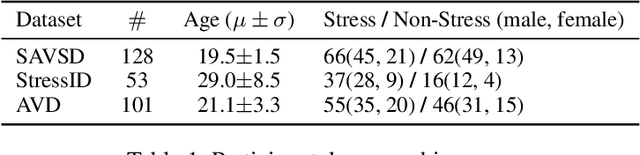
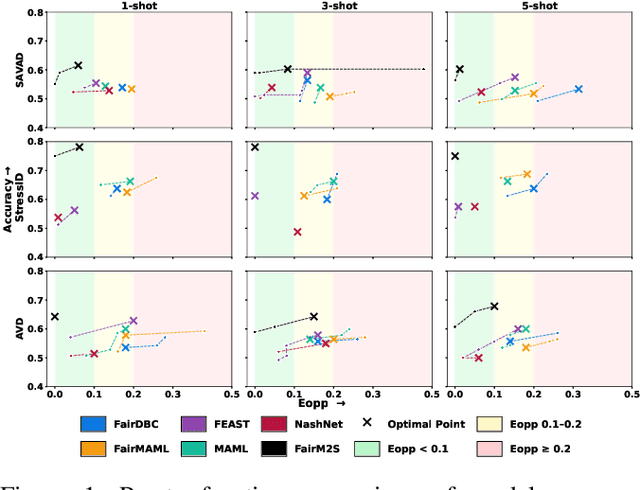
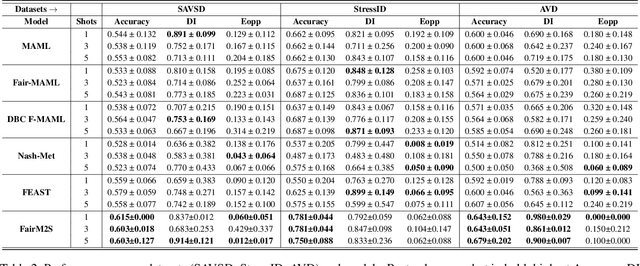

Fairness in AI-driven stress detection is critical for equitable mental healthcare, yet existing models frequently exhibit gender bias, particularly in data-scarce scenarios. To address this, we propose FairM2S, a fairness-aware meta-learning framework for stress detection leveraging audio-visual data. FairM2S integrates Equalized Odds constraints during both meta-training and adaptation phases, employing adversarial gradient masking and fairness-constrained meta-updates to effectively mitigate bias. Evaluated against five state-of-the-art baselines, FairM2S achieves 78.1% accuracy while reducing the Equal Opportunity to 0.06, demonstrating substantial fairness gains. We also release SAVSD, a smartphone-captured dataset with gender annotations, designed to support fairness research in low-resource, real-world contexts. Together, these contributions position FairM2S as a state-of-the-art approach for equitable and scalable few-shot stress detection in mental health AI. We release our dataset and FairM2S publicly with this paper.
HCFSLN: Adaptive Hyperbolic Few-Shot Learning for Multimodal Anxiety Detection
Nov 10, 2025Anxiety disorders impact millions globally, yet traditional diagnosis relies on clinical interviews, while machine learning models struggle with overfitting due to limited data. Large-scale data collection remains costly and time-consuming, restricting accessibility. To address this, we introduce the Hyperbolic Curvature Few-Shot Learning Network (HCFSLN), a novel Few-Shot Learning (FSL) framework for multimodal anxiety detection, integrating speech, physiological signals, and video data. HCFSLN enhances feature separability through hyperbolic embeddings, cross-modal attention, and an adaptive gating network, enabling robust classification with minimal data. We collected a multimodal anxiety dataset from 108 participants and benchmarked HCFSLN against six FSL baselines, achieving 88% accuracy, outperforming the best baseline by 14%. These results highlight the effectiveness of hyperbolic space for modeling anxiety-related speech patterns and demonstrate FSL's potential for anxiety classification.
Harnessing Smartwatch Microphone Sensors for Cough Detection and Classification
Jan 31, 2024This study investigates the potential of using smartwatches with built-in microphone sensors for monitoring coughs and detecting various cough types. We conducted a study involving 32 participants and collected 9 hours of audio data in a controlled manner. Afterward, we processed this data using a structured approach, resulting in 223 positive cough samples. We further improved the dataset through augmentation techniques and employed a specialized 1D CNN model. This model achieved an impressive accuracy rate of 98.49% while non-walking and 98.2% while walking, showing smartwatches can detect cough. Moreover, our research successfully identified four distinct types of coughs using clustering techniques.
DECODE: Data-driven Energy Consumption Prediction leveraging Historical Data and Environmental Factors in Buildings
Sep 06, 2023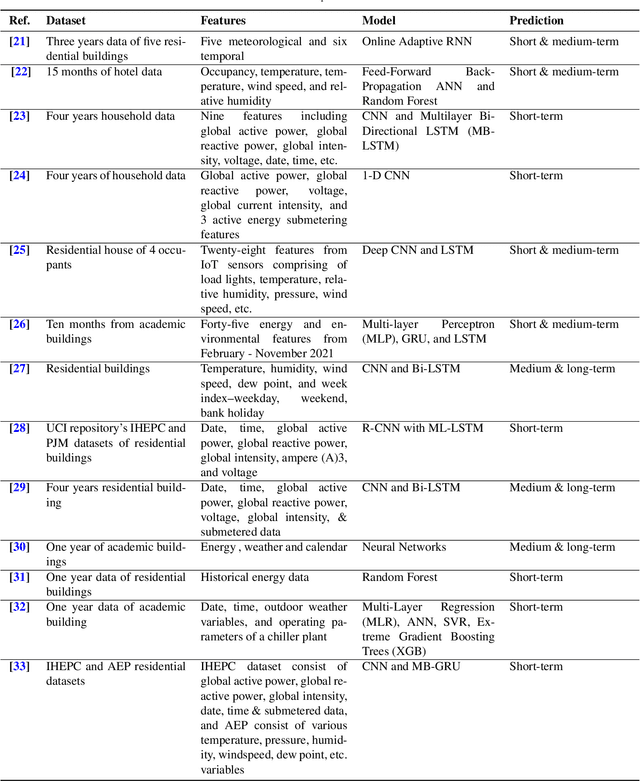
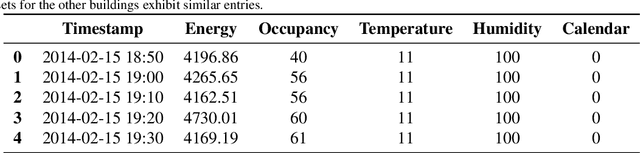
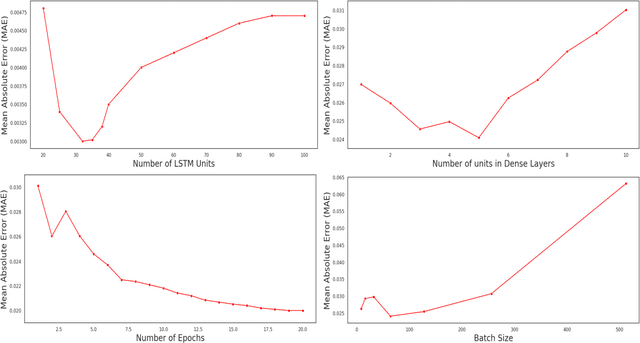
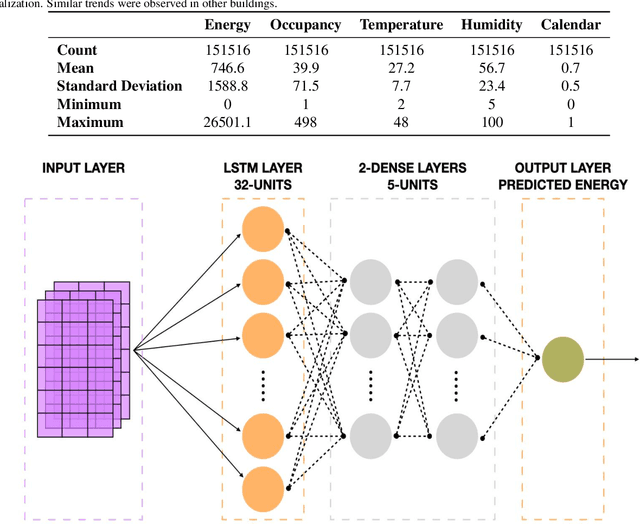
Energy prediction in buildings plays a crucial role in effective energy management. Precise predictions are essential for achieving optimal energy consumption and distribution within the grid. This paper introduces a Long Short-Term Memory (LSTM) model designed to forecast building energy consumption using historical energy data, occupancy patterns, and weather conditions. The LSTM model provides accurate short, medium, and long-term energy predictions for residential and commercial buildings compared to existing prediction models. We compare our LSTM model with established prediction methods, including linear regression, decision trees, and random forest. Encouragingly, the proposed LSTM model emerges as the superior performer across all metrics. It demonstrates exceptional prediction accuracy, boasting the highest R2 score of 0.97 and the most favorable mean absolute error (MAE) of 0.007. An additional advantage of our developed model is its capacity to achieve efficient energy consumption forecasts even when trained on a limited dataset. We address concerns about overfitting (variance) and underfitting (bias) through rigorous training and evaluation on real-world data. In summary, our research contributes to energy prediction by offering a robust LSTM model that outperforms alternative methods and operates with remarkable efficiency, generalizability, and reliability.