 Add to Chrome
 Add to Firefox
 Add to Edge
Fairness-Aware Few-Shot Learning for Audio-Visual Stress Detection
Nov 12, 2025
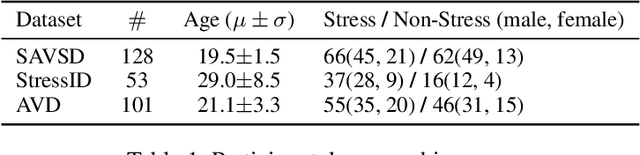
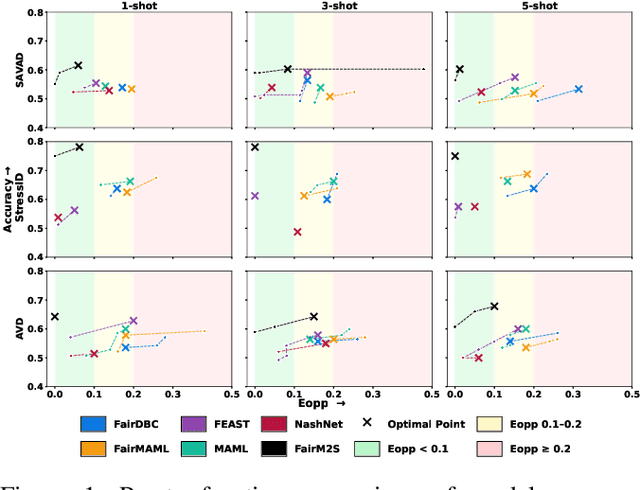
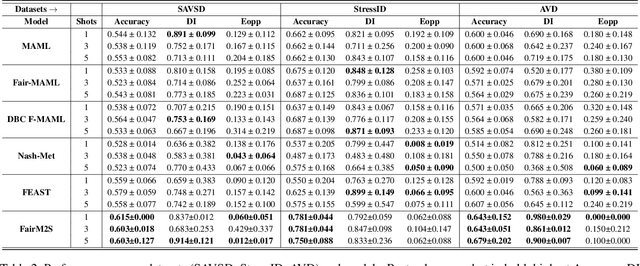

Fairness in AI-driven stress detection is critical for equitable mental healthcare, yet existing models frequently exhibit gender bias, particularly in data-scarce scenarios. To address this, we propose FairM2S, a fairness-aware meta-learning framework for stress detection leveraging audio-visual data. FairM2S integrates Equalized Odds constraints during both meta-training and adaptation phases, employing adversarial gradient masking and fairness-constrained meta-updates to effectively mitigate bias. Evaluated against five state-of-the-art baselines, FairM2S achieves 78.1% accuracy while reducing the Equal Opportunity to 0.06, demonstrating substantial fairness gains. We also release SAVSD, a smartphone-captured dataset with gender annotations, designed to support fairness research in low-resource, real-world contexts. Together, these contributions position FairM2S as a state-of-the-art approach for equitable and scalable few-shot stress detection in mental health AI. We release our dataset and FairM2S publicly with this paper.

HCFSLN: Adaptive Hyperbolic Few-Shot Learning for Multimodal Anxiety Detection
Nov 10, 2025Anxiety disorders impact millions globally, yet traditional diagnosis relies on clinical interviews, while machine learning models struggle with overfitting due to limited data. Large-scale data collection remains costly and time-consuming, restricting accessibility. To address this, we introduce the Hyperbolic Curvature Few-Shot Learning Network (HCFSLN), a novel Few-Shot Learning (FSL) framework for multimodal anxiety detection, integrating speech, physiological signals, and video data. HCFSLN enhances feature separability through hyperbolic embeddings, cross-modal attention, and an adaptive gating network, enabling robust classification with minimal data. We collected a multimodal anxiety dataset from 108 participants and benchmarked HCFSLN against six FSL baselines, achieving 88% accuracy, outperforming the best baseline by 14%. These results highlight the effectiveness of hyperbolic space for modeling anxiety-related speech patterns and demonstrate FSL's potential for anxiety classification.