 Add to Chrome
 Add to Firefox
 Add to Edge
Learning the Graphical Nature of Symmetries
Jul 13, 2026
Finite groups are rigid algebraic objects, whose Cayley graphs expose a rich network geometry through which group-theoretic structure can be measured, compared, and learned. In this paper, a dataset of $131{,}406$ Cayley graphs is constructed, covering all groups of order at most $767$ except order $512$, recording exact algebraic labels for group properties together with a broad collection of graph, cycle, distance, and spectral statistics. This census aims to provide novel benchmarks for studying how finite-group properties are reflected in Cayley graph observables. It also yields new enumerative contributions: alongside recovering known OEIS sequences for standard group classes, new sequences for monolithic groups and for groups generated by at most three, four, and five elements are contributed to the OEIS. The accompanying network analysis identifies several empirical regularities and formulates testable conjectures, including relationships involving square clustering, Cayley graph diameter, average graph disorder, and spectral eigengaps of nilpotent groups. Finally, a comparison between classical models, an MLP, and graph neural network architectures is performed for predicting algebraic group properties directly from Cayley graph data. The results show that engineered graph statistics are highly informative, while GNNs, especially GIN and in some fixed-order settings GCN, can recover substantial structural signal directly from the graph. Such that graph-aware architectures show phases of optimality on these group-theoretic graph representations.

Multiple-View Spectral Clustering for Group-wise Functional Community Detection
Nov 21, 2016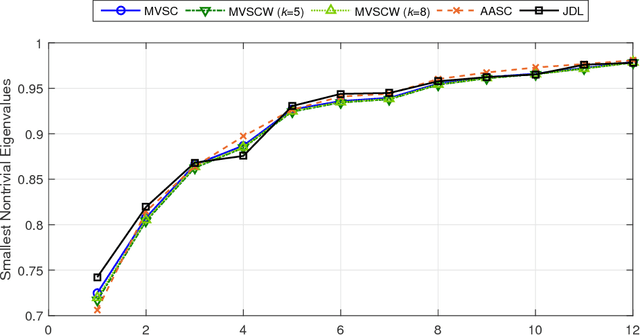
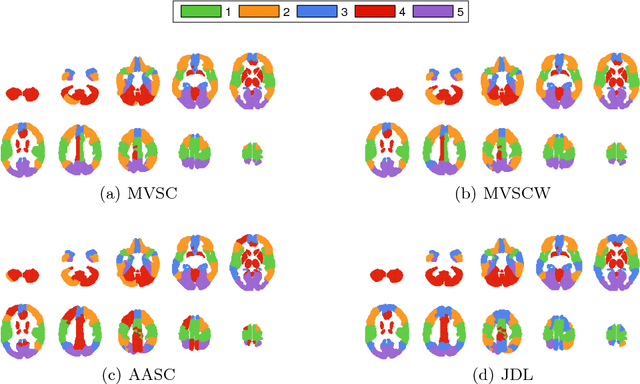
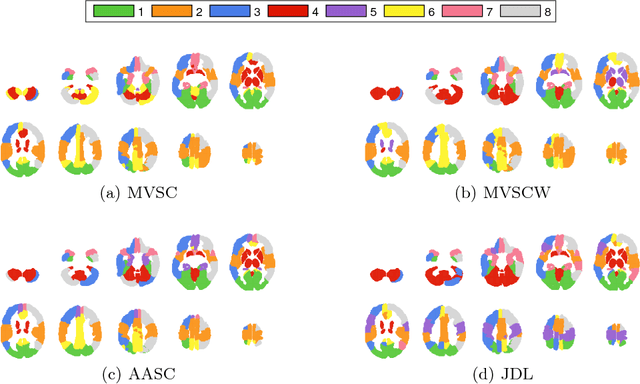
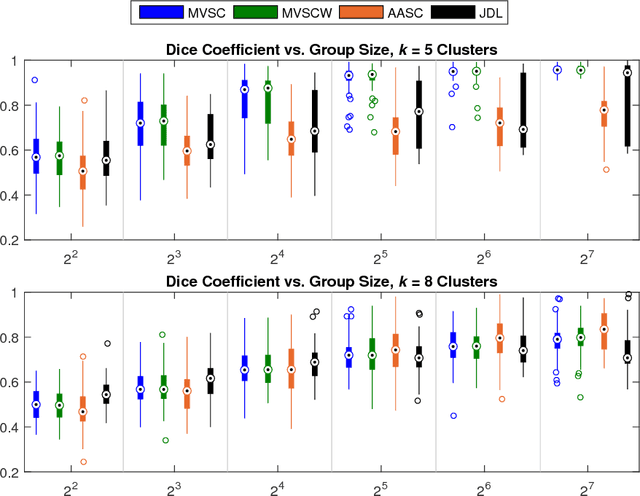
Functional connectivity analysis yields powerful insights into our understanding of the human brain. Group-wise functional community detection aims to partition the brain into clusters, or communities, in which functional activity is inter-regionally correlated in a common manner across a group of subjects. In this article, we show how to use multiple-view spectral clustering to perform group-wise functional community detection. In a series of experiments on 291 subjects from the Human Connectome Project, we compare three versions of multiple-view spectral clustering: MVSC (uniform weights), MVSCW (weights based on subject-specific embedding quality), and AASC (weights optimized along with the embedding) with the competing technique of Joint Diagonalization of Laplacians (JDL). Results show that multiple-view spectral clustering not only yields group-wise functional communities that are more consistent than JDL when using randomly selected subsets of individual brains, but it is several orders of magnitude faster than JDL.
Contravening Esotery: Cryptanalysis of Knapsack Cipher using Genetic Algorithms
Jun 20, 2016Cryptanalysis of knapsack cipher is a fascinating problem which has eluded the computing fraternity for decades. However, in most of the cases either the time complexity of the proposed algorithm is colossal or an insufficient number of samples have been taken for verification. The present work proposes a Genetic Algorithm based technique for cryptanalysis of knapsack cipher. The experiments conducted prove the validity of the technique. The results prove that the technique is better than the existing techniques. An extensive review has been carried out in order to find the gaps in the existing techniques. The work paves the way of the application of computational intelligence techniques to the discipline of cryptanalysis.