 Add to Chrome
 Add to Firefox
 Add to Edge
Sheaf-Based Federated Representation Learning
Aug 08, 2026
Heterogeneous federated systems require agents to learn and exchange informative representations despite differences in data distributions, sensing modalities, model architectures, latent dimensionalities, and local learning objectives. To address this challenge, we propose Sheaf-based Federated Representation Learning (SFRL), a general framework that jointly optimizes local objectives with a manifold-constrained geometric alignment regularizer based on learnable sheaf restriction maps. Unlike most existing approaches, SFRL does not assume a shared global latent space. Instead, global consistency emerges from the alignment of neighboring latent representations through orthogonal transformations and isometric embeddings. This alignment is enforced by a quadratic gluing regularizer induced by the sheaf Laplacian, whose learnable restriction maps adapt the geometry to the observed data. The penalty is evaluated on a small set of shared pilot samples, ensuring scalability and communication efficiency. We develop a decentralized algorithm for solving SFRL, termed Sheaf-FRL, which alternates between gradient updates of the local models and closed-form Procrustes updates of the edge-wise restriction maps. We further establish convergence of Sheaf-FRL to first-order stationary points in both deterministic and stochastic settings. As an application, we consider a cooperative classification task in the context of semantic communication, under model and data heterogeneity. Our results show that Sheaf-FRL outperforms baseline approaches in terms of local and post-communication classification accuracy across different levels of local distribution shift and exhibits greater robustness to latent-space dimensionality compression.

Learning the Graphical Nature of Symmetries
Jul 13, 2026Finite groups are rigid algebraic objects, whose Cayley graphs expose a rich network geometry through which group-theoretic structure can be measured, compared, and learned. In this paper, a dataset of $131{,}406$ Cayley graphs is constructed, covering all groups of order at most $767$ except order $512$, recording exact algebraic labels for group properties together with a broad collection of graph, cycle, distance, and spectral statistics. This census aims to provide novel benchmarks for studying how finite-group properties are reflected in Cayley graph observables. It also yields new enumerative contributions: alongside recovering known OEIS sequences for standard group classes, new sequences for monolithic groups and for groups generated by at most three, four, and five elements are contributed to the OEIS. The accompanying network analysis identifies several empirical regularities and formulates testable conjectures, including relationships involving square clustering, Cayley graph diameter, average graph disorder, and spectral eigengaps of nilpotent groups. Finally, a comparison between classical models, an MLP, and graph neural network architectures is performed for predicting algebraic group properties directly from Cayley graph data. The results show that engineered graph statistics are highly informative, while GNNs, especially GIN and in some fixed-order settings GCN, can recover substantial structural signal directly from the graph. Such that graph-aware architectures show phases of optimality on these group-theoretic graph representations.
A Sheaf-Theoretic Framework for Distributed Multi-Site Channel Charting
Jul 03, 2026Channel charting (CC) enables data-driven user localization in wireless networks by embedding channel state information (CSI) into low-dimensional representations. In multi-cell scenarios, each base station independently learns a local chart via neural encoders, leading to misaligned representation spaces across overlapping coverage areas. This lack of consistency hinders network-level tasks such as user tracking, handover prediction, and resource allocation. To address this issue, we propose a principled framework for multi-site channel charting based on topological signal processing. We model the collection of local charts as a network sheaf, which encodes consistency constraints across the network and enables the coherent integration of locally learned representations into a shared global structure. This formulation introduces an interpretable inductive bias that promotes alignment across base stations while preserving local geometric fidelity. Building on this model, we develop a multi-site channel charting architecture and an alternating optimization algorithm that jointly updates neural encoders and inter-site orthogonal transport maps, with theoretical guarantees on consistency. Experimental results validate the effectiveness of the proposed approach, demonstrating improved cross-site alignment without degrading the quality of local embeddings.
SEMASIA: A Large-Scale Dataset of Semantically Structured Latent Representations
May 10, 2026Latent representations learned by neural networks often exhibit semantic structure, where concept similarity is reflected by geometric proximity in embedding space. However, comparing such spaces across models remains difficult: changes in architecture, pretraining data, objective, or random seed can yield embeddings with similar content but incompatible geometry. This latent space alignment problem is central to interpretability, transfer and multimodal learning, federated systems, and semantic communication; however, progress remains limited by the lack of large-scale, model-diverse, and metadata-rich benchmarks. To address this gap, we introduce SEMASIA, a large-scale collection of latent representations extracted from approximately 1,700 pretrained vision models across eight standard image-classification benchmarks. SEMASIA pairs embeddings with structured metadata describing architectures, training regimes, pretraining sources, and model scale. We demonstrate three applications of the resource. First, we analyze the conceptual organization of individual latent spaces, showing consistent prototype-like clustering and hierarchical semantic neighborhoods across models and datasets. Second, we benchmark supervised alignment mappings between latent spaces using reconstruction error and downstream task performance. Third, we perform a large-scale regression analysis of how pretraining-data complexity, specialization, transfer learning, augmentation, and model scale relate to geometric and probing properties of embeddings. By coupling representational scale with standardized metadata, SEMASIA provides a reproducible foundation for studying latent geometry, evaluating alignment methods, and developing next-generation heterogeneous and interoperable AI systems.
Topological Dictionary Learning
Mar 14, 2025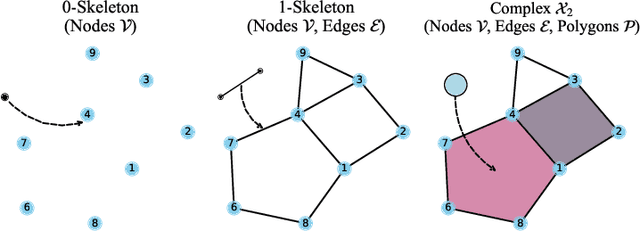
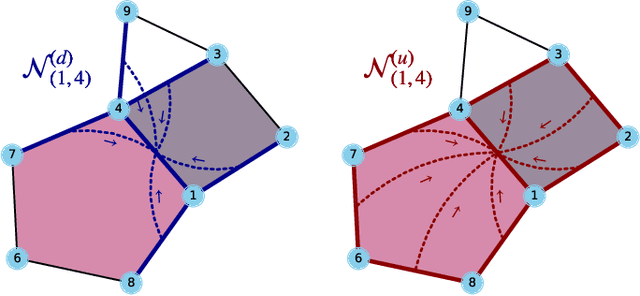
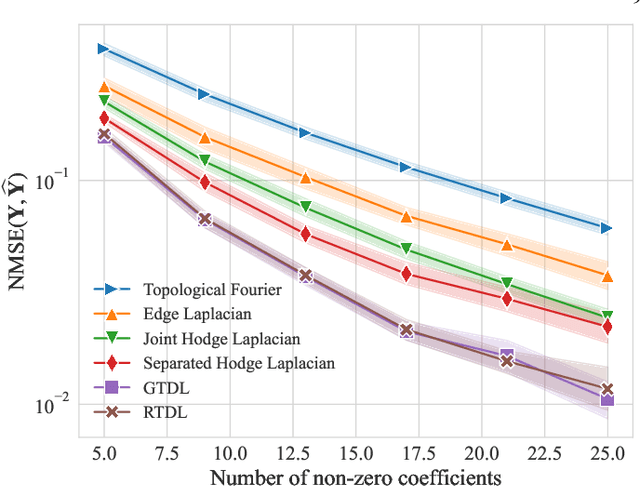
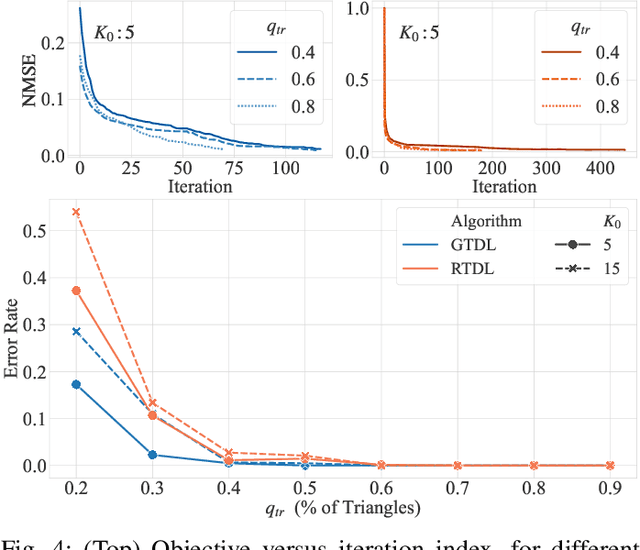
The aim of this paper is to introduce a novel dictionary learning algorithm for sparse representation of signals defined over combinatorial topological spaces, specifically, regular cell complexes. Leveraging Hodge theory, we embed topology into the dictionary structure via concatenated sub-dictionaries, each as a polynomial of Hodge Laplacians, yielding localized spectral topological filter frames. The learning problem is cast to jointly infer the underlying cell complex and optimize the dictionary coefficients and the sparse signal representation. We efficiently solve the problem via iterative alternating algorithms. Numerical results on both synthetic and real data show the effectiveness of the proposed procedure in jointly learning the sparse representations and the underlying relational structure of topological signals.