 Add to Chrome
 Add to Firefox
 Add to Edge
Querit-Reranker: Training Compact Multilingual Rerankers via Efficient Label-Free Distribution Adaptation
Jun 17, 2026
Deployable multilingual rerankers must generalize across languages, domains, and target ranking tasks while remaining efficient enough for second-stage reranking. However, adapting them to new target distributions typically requires extensive task-specific relevance annotations, which are costly to obtain. We present Querit-Reranker, a family of multilingual cross-encoder rerankers trained with a data-centric pipeline for label-efficient adaptation. We instantiate it as Querit-Reranker-A0.4B, initialized from an in-house MoE backbone with 0.4B activated parameters, and Querit-Reranker-4B, initialized from Qwen3-Embedding-4B. Our pipeline first learns general relevance modeling from large-scale ranking-oriented data, then adapts to target distributions through synthetic-query mining with teacher scores as continuous soft labels. To consolidate complementary task-adapted strengths, we further merge checkpoints via spherical linear interpolation, obtaining a single deployable model without runtime ensembling overhead. Using Qwen3-Embedding-0.6B as the shared first-stage retriever, Querit-Reranker-A0.4B improves average nDCG@10 from 54.11 to 59.28 on BEIR and from 59.87 to 67.70 on MIRACL. On MTEB Multilingual v2 Reranking, it also substantially outperforms larger embedding-based baselines, while Querit-Reranker-4B further achieves state-of-the-art performance among publicly available models. We release both models on Hugging Face.

On the Capacity of Citation Generation by Large Language Models
Oct 15, 2024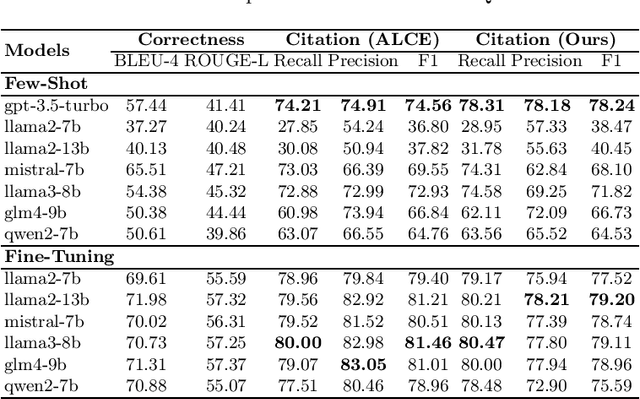
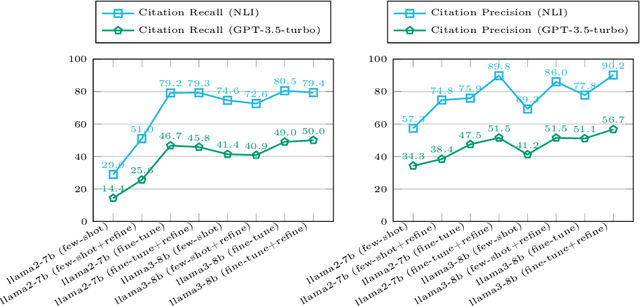
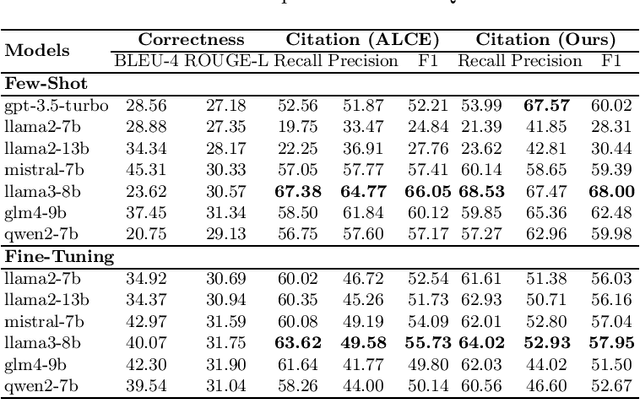
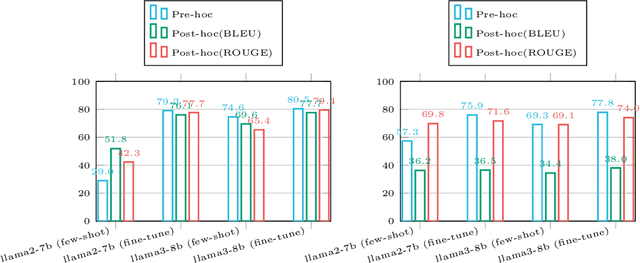
Retrieval-augmented generation (RAG) appears as a promising method to alleviate the "hallucination" problem in large language models (LLMs), since it can incorporate external traceable resources for response generation. The essence of RAG in combating the hallucination issue lies in accurately attributing claims in responses to the corresponding retrieved documents. However, most of existing works focus on improving the quality of generated responses from the LLM, while largely overlooked its ability to attribute sources accurately. In this study, we conduct a systematic analysis about the capabilities of LLMs in generating citations within response generation, and further introduce a novel method to enhance their citation generation abilities. Specifically, we evaluate both the correctness and citation quality for seven widely-used LLMs on two benchmark datasets. Meanwhile, we introduce new citation evaluation metrics to eliminate the over-penalization of unnecessary and excessive citations in existing metrics. Furthermore, we propose a Generate-then-Refine method that completes relevant citations and removes irrelevant ones without altering the response text. The results on WebGLM-QA, ASQA and ELI5 datasets show that our method substantially improves the quality of citations in responses generated by LLMs.