 Add to Chrome
 Add to Firefox
 Add to Edge
From Fuzzy to Exact: The Halo Architecture for Infinite-Depth Reasoning via Rational Arithmetic
Jan 26, 2026
Current paradigms in Deep Learning prioritize computational throughput over numerical precision, relying on the assumption that intelligence emerges from statistical correlation at scale. In this paper, we challenge this orthodoxy. We propose the Exactness Hypothesis: that General Intelligence (AGI), specifically high-order causal inference, requires a computational substrate capable of Arbitrary Precision Arithmetic. We argue that the "hallucinations" and logical incoherence seen in current Large Language Models (LLMs) are artifacts of IEEE 754 floating-point approximation errors accumulating over deep compositional functions. To mitigate this, we introduce the Halo Architecture, a paradigm shift to Rational Arithmetic ($\mathbb{Q}$) supported by a novel Exact Inference Unit (EIU). Empirical validation on the Huginn-0125 prototype demonstrates that while 600B-parameter scale BF16 baselines collapse in chaotic systems, Halo maintains zero numerical divergence indefinitely. This work establishes exact arithmetic as a prerequisite for reducing logical uncertainty in System 2 AGI.

An Anatomy of Graph Neural Networks Going Deep via the Lens of Mutual Information: Exponential Decay vs. Full Preservation
Oct 22, 2019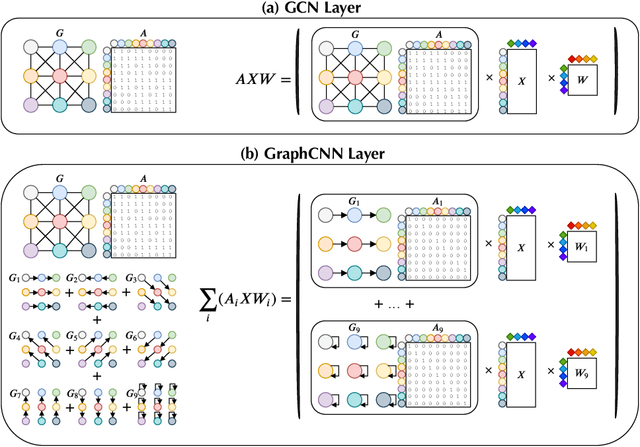

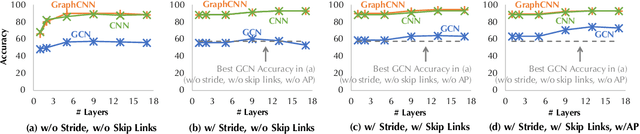
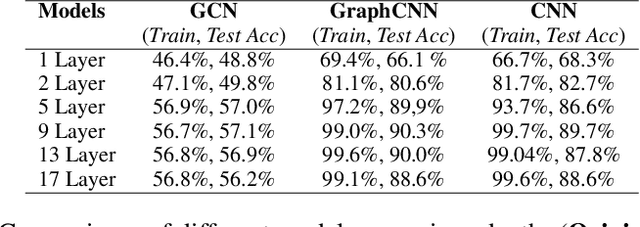
Graph Convolutional Network (GCN) has attracted intensive interests recently. One major limitation of GCN is that it often cannot benefit from using a deep architecture, while traditional CNN and an alternative Graph Neural Network architecture, namely GraphCNN, often achieve better quality with a deeper neural architecture. How can we explain this phenomenon? In this paper, we take the first step towards answering this question. We first conduct a systematic empirical study on the accuracy of GCN, GraphCNN, and ResNet-18 on 2D images and identified relative importance of different factors in architectural design. This inspired a novel theoretical analysis on the mutual information between the input and the output after $l$ GCN and GraphCNN layers. We identified regimes in which GCN suffers exponentially fast information lose and show that GraphCNN requires a much weaker condition for similar behavior to happen.
Time-Series Anomaly Detection Service at Microsoft
Jun 10, 2019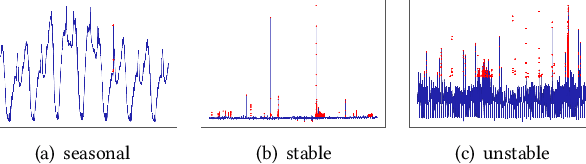
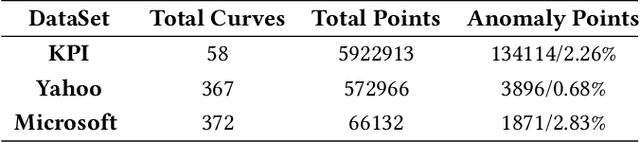
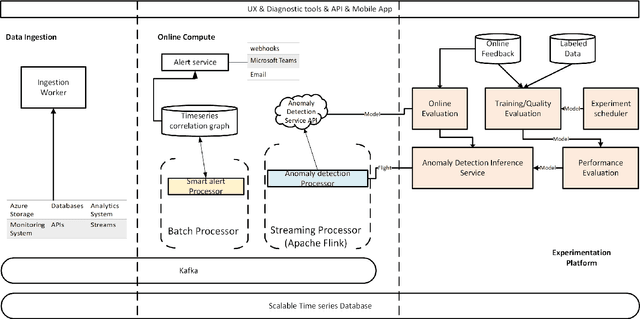

Large companies need to monitor various metrics (for example, Page Views and Revenue) of their applications and services in real time. At Microsoft, we develop a time-series anomaly detection service which helps customers to monitor the time-series continuously and alert for potential incidents on time. In this paper, we introduce the pipeline and algorithm of our anomaly detection service, which is designed to be accurate, efficient and general. The pipeline consists of three major modules, including data ingestion, experimentation platform and online compute. To tackle the problem of time-series anomaly detection, we propose a novel algorithm based on Spectral Residual (SR) and Convolutional Neural Network (CNN). Our work is the first attempt to borrow the SR model from visual saliency detection domain to time-series anomaly detection. Moreover, we innovatively combine SR and CNN together to improve the performance of SR model. Our approach achieves superior experimental results compared with state-of-the-art baselines on both public datasets and Microsoft production data.