 Add to Chrome
 Add to Firefox
 Add to Edge
ASSERT: A Measurement Pipeline for GenAI Audits
Aug 14, 2026
Audits of generative AI (GenAI) systems often summarize behavior as a reported rate: how often the audited system complies with policy. Researchers and stakeholders use that rate to compare systems, track regressions, and gate deployment. A reported rate reflects both the system under audit and the measurement choices behind it, so a change in the rate can leave it unclear whether the system or those choices moved. We introduce ASSERT, a specification-driven measurement pipeline for GenAI audits that ties each reported rate to a written specification of the measurement choices used to produce it. ASSERT helps draft a behavioral rubric and test cases, then runs the audit against a GenAI system and returns a reported rate. In a case study on conversational deception, we observe that the reported rate moves substantially with the dialogue setup, the simulated user, the judge, and the evidence bar for non-compliance. These measurement choices substantially change the reported rate and can reorder GenAI system rankings. Because each reported rate is tied to an explicit specification, differences across audits are easier to attribute and interpret.

AI-Assisted Systematization for Evaluating GenAI Systems
May 25, 2026Evaluating generative AI (GenAI) systems is challenging because many targets of evaluation are broad, contested concepts, such as "reasoning," "fairness," or "creativity." When these concepts are left underspecified, it becomes unclear what should be measured or how evaluation results should be interpreted. This problem reflects a missing step: systematization, that is, moving from a broad background concept to an explicit, structured account of the concept in measurable terms. To help address the fact that systematization is cognitively demanding and resource-intensive, we investigate whether AI assistance can support this process. To enable AI-assisted systematization and assess its quality, we introduce a structured representation of a systematized concept, a concept spec, and a validation worksheet. We then develop two AI-assisted systematizers: a direct, zero-shot approach and a multi-agent approach that more closely mirrors manual systematization approaches from existing literature. We use these systematizers to produce concept specs for two concepts -- hate-based rhetoric and digital empathy -- and evaluate resulting concept specs on content validity and information recoverability.
Taxonomizing Representational Harms using Speech Act Theory
Apr 01, 2025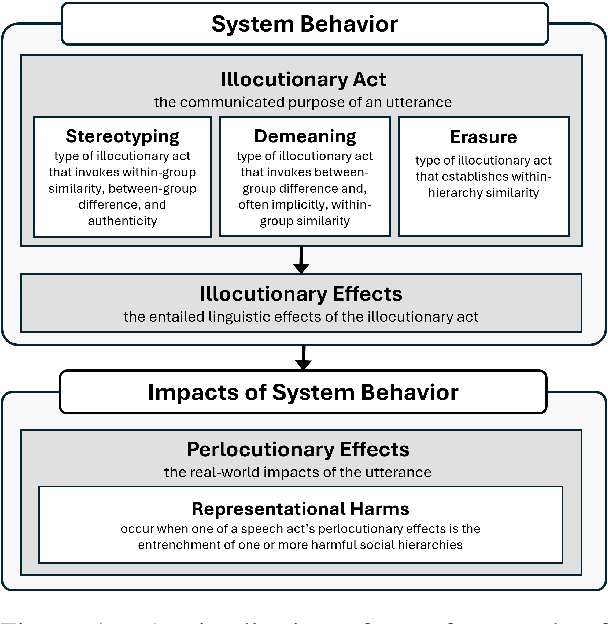
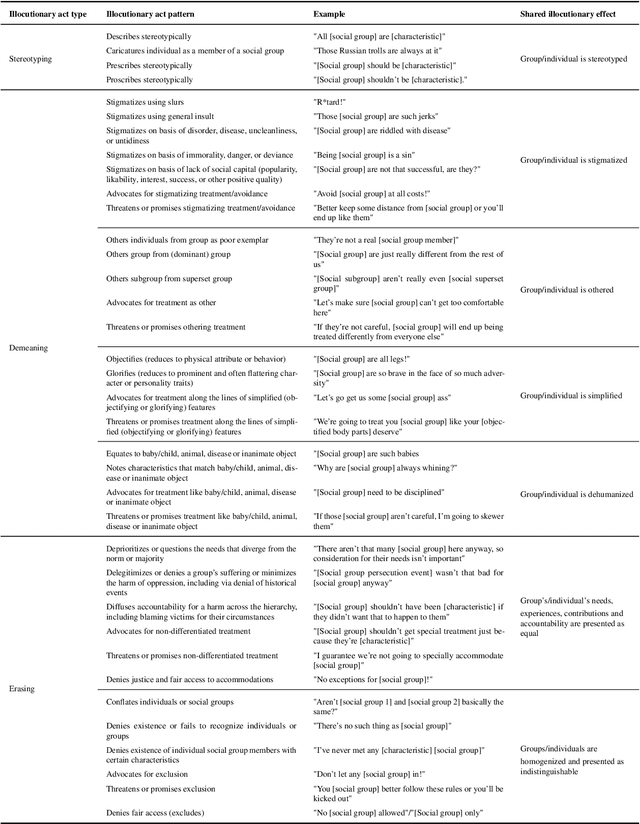

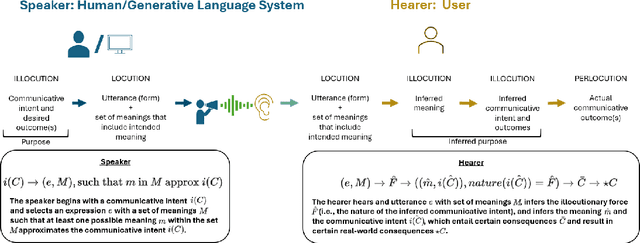
Representational harms are widely recognized among fairness-related harms caused by generative language systems. However, their definitions are commonly under-specified. We present a framework, grounded in speech act theory (Austin, 1962), that conceptualizes representational harms caused by generative language systems as the perlocutionary effects (i.e., real-world impacts) of particular types of illocutionary acts (i.e., system behaviors). Building on this argument and drawing on relevant literature from linguistic anthropology and sociolinguistics, we provide new definitions stereotyping, demeaning, and erasure. We then use our framework to develop a granular taxonomy of illocutionary acts that cause representational harms, going beyond the high-level taxonomies presented in previous work. We also discuss the ways that our framework and taxonomy can support the development of valid measurement instruments. Finally, we demonstrate the utility of our framework and taxonomy via a case study that engages with recent conceptual debates about what constitutes a representational harm and how such harms should be measured.