 Add to Chrome
 Add to Firefox
 Add to Edge
ASSERT: A Measurement Pipeline for GenAI Audits
Aug 14, 2026
Audits of generative AI (GenAI) systems often summarize behavior as a reported rate: how often the audited system complies with policy. Researchers and stakeholders use that rate to compare systems, track regressions, and gate deployment. A reported rate reflects both the system under audit and the measurement choices behind it, so a change in the rate can leave it unclear whether the system or those choices moved. We introduce ASSERT, a specification-driven measurement pipeline for GenAI audits that ties each reported rate to a written specification of the measurement choices used to produce it. ASSERT helps draft a behavioral rubric and test cases, then runs the audit against a GenAI system and returns a reported rate. In a case study on conversational deception, we observe that the reported rate moves substantially with the dialogue setup, the simulated user, the judge, and the evidence bar for non-compliance. These measurement choices substantially change the reported rate and can reorder GenAI system rankings. Because each reported rate is tied to an explicit specification, differences across audits are easier to attribute and interpret.

Comparison requires valid measurement: Rethinking attack success rate comparisons in AI red teaming
Jan 26, 2026We argue that conclusions drawn about relative system safety or attack method efficacy via AI red teaming are often not supported by evidence provided by attack success rate (ASR) comparisons. We show, through conceptual, theoretical, and empirical contributions, that many conclusions are founded on apples-to-oranges comparisons or low-validity measurements. Our arguments are grounded in asking a simple question: When can attack success rates be meaningfully compared? To answer this question, we draw on ideas from social science measurement theory and inferential statistics, which, taken together, provide a conceptual grounding for understanding when numerical values obtained through the quantification of system attributes can be meaningfully compared. Through this lens, we articulate conditions under which ASRs can and cannot be meaningfully compared. Using jailbreaking as a running example, we provide examples and extensive discussion of apples-to-oranges ASR comparisons and measurement validity challenges.
Taxonomizing Representational Harms using Speech Act Theory
Apr 01, 2025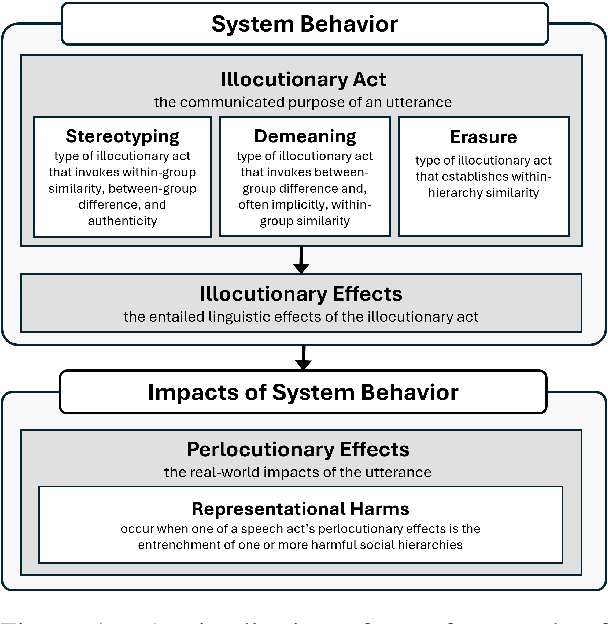
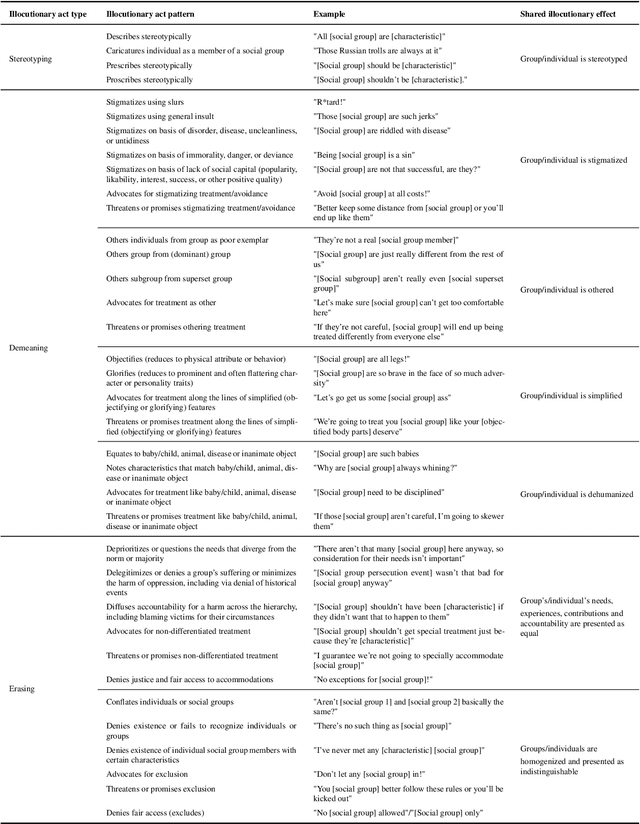

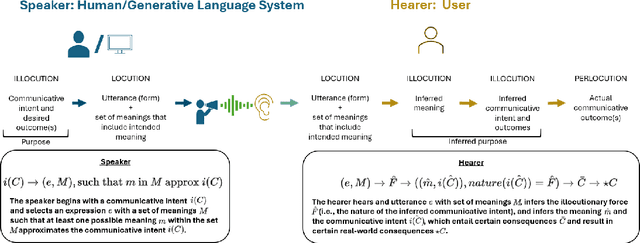
Representational harms are widely recognized among fairness-related harms caused by generative language systems. However, their definitions are commonly under-specified. We present a framework, grounded in speech act theory (Austin, 1962), that conceptualizes representational harms caused by generative language systems as the perlocutionary effects (i.e., real-world impacts) of particular types of illocutionary acts (i.e., system behaviors). Building on this argument and drawing on relevant literature from linguistic anthropology and sociolinguistics, we provide new definitions stereotyping, demeaning, and erasure. We then use our framework to develop a granular taxonomy of illocutionary acts that cause representational harms, going beyond the high-level taxonomies presented in previous work. We also discuss the ways that our framework and taxonomy can support the development of valid measurement instruments. Finally, we demonstrate the utility of our framework and taxonomy via a case study that engages with recent conceptual debates about what constitutes a representational harm and how such harms should be measured.
A Framework for Automated Measurement of Responsible AI Harms in Generative AI Applications
Oct 26, 2023
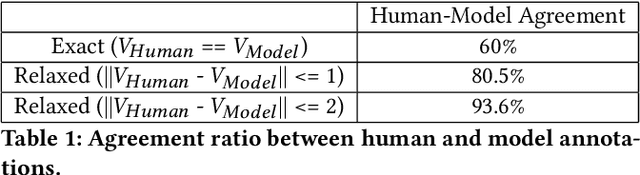

We present a framework for the automated measurement of responsible AI (RAI) metrics for large language models (LLMs) and associated products and services. Our framework for automatically measuring harms from LLMs builds on existing technical and sociotechnical expertise and leverages the capabilities of state-of-the-art LLMs, such as GPT-4. We use this framework to run through several case studies investigating how different LLMs may violate a range of RAI-related principles. The framework may be employed alongside domain-specific sociotechnical expertise to create measurements for new harm areas in the future. By implementing this framework, we aim to enable more advanced harm measurement efforts and further the responsible use of LLMs.