 Add to Chrome
 Add to Firefox
 Add to Edge
Computational and Effective Degrees of Freedom for Spatially Stationary HMIMO Channel Modeling
Jul 26, 2026
This paper establishes a comprehensive theoretical framework for the continuous-to-discrete modeling of spatially stationary holographic MIMO (HMIMO) channels utilizing the Nystrom method with Gauss-Legendre quadrature (NGLQ). Starting with an operator-theoretic analysis of the NGLQ method, we prove that its quadrature error exhibits a super-exponential decay. Furthermore, we derive a spatial sampling threshold, termed computational degrees of freedom (cDoF), which reveals a π/2 oversampling penalty over the physical DoF for 1D arrays, compounding to a 68% computational redundancy for 2D separable grids. To address the ill-conditioning of the eigenvalue decomposition (EVD) problem inherent to the Nystrom discretization, we invoke the multidimensional Szego-Widom asymptotic expansion. This analysis yields a physically grounded semi-analytical expression for the effective DoF (eDoF) of 2D rectangular apertures, capturing the anisotropic boundary truncation effects to guide partial EVD and reduce computational complexity. Numerical evaluations confirm the tightness of the cDoF threshold under worst-case end-fire conditions. Moreover, simulations utilizing closed-form kernels for isotropic scattering verify that the derived eDoF acts as an accurate asymptotic approximation. Finally, by deploying the exact non-uniform discrete Fourier transform to eliminate interpolation error floors, we demonstrate spectral convergence down to the machine-precision level for non-isotropic scattering environments.

Robust Multi-Stream Massive MIMO Satellite Systems Based on Statistical CSI
Apr 10, 2026This paper investigates multi-stream downlink precoding for massive multiple-input multiple-output low-Earthorbit satellite (SAT) communication systems. We adopt a delay and Doppler precompensation approach to achieve coherent transmission. Under this setting, we formulate a signal transmission model that incorporates the near-independent properties of inter-SAT interference and compensation errors. We then demonstrate that moving beyond single-stream transmission requires both multi-SAT cooperation and multi-antenna UTs. Based on this configuration and the established signal transmission model, we derive the first- and second-order statistical channel characteristics and utilize them to design locally optimal precoding algorithms for both total power constraint (TPC) and per-antenna power constraint (PAPC) conditions, which rely only on statistical channel state information (sCSI). In particular, the designed PAPC algorithm achieves linear complexity with respect to the number of antennas on the cooperative SATs. To reduce the computational complexity of the locally optimal precoder under TPC, we propose a low-complexity and robust precoding scheme optimized for both minimum mean squared error and sum-rate maximization objectives. Using majorization theory, we also provide a rigorous theoretical analysis of the optimal precoding structure under TPC. Moreover, the Lanczos algorithm is adopted to further reduce the complexity of the proposed robust designs. Simulation results show that when each SAT is equipped with a sufficiently large number of antennas, the proposed sCSI-based designs achieve performance comparable to that of instantaneous CSI-based designs.
Channel Knowledge Maps for 6G Wireless Networks: Construction, Applications, and Future Challenges
May 30, 2025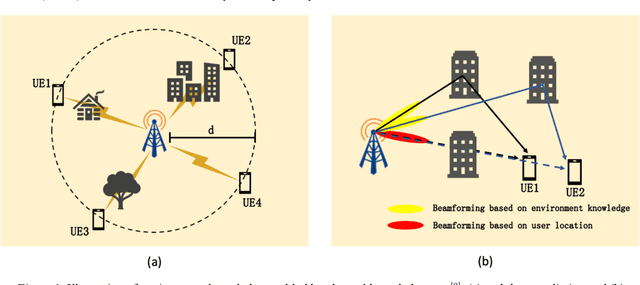
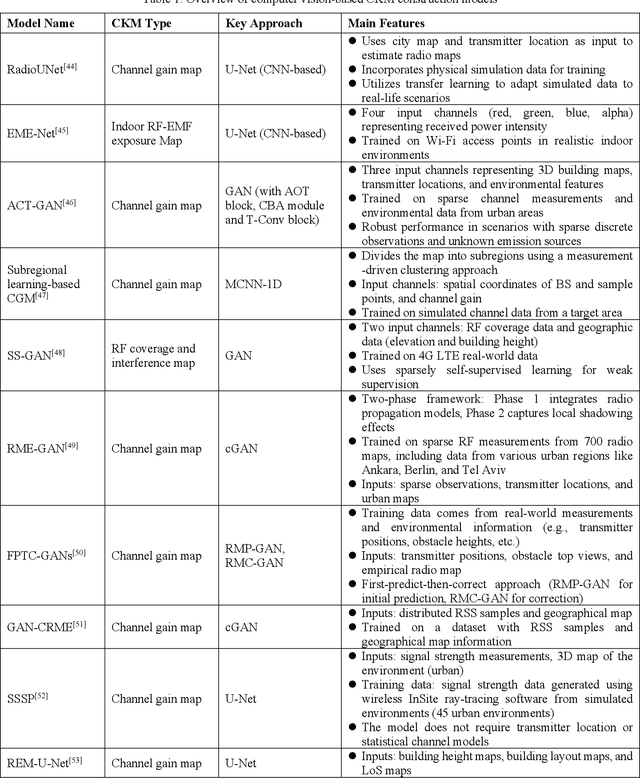
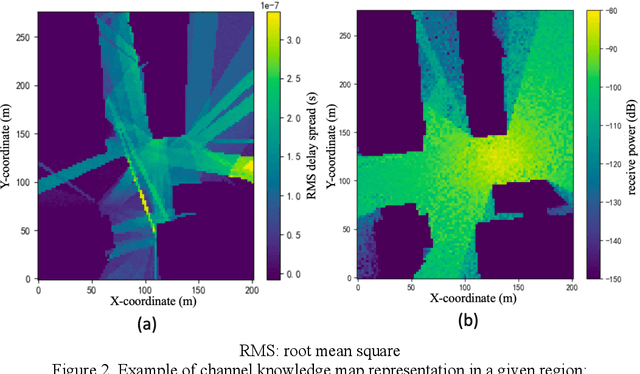
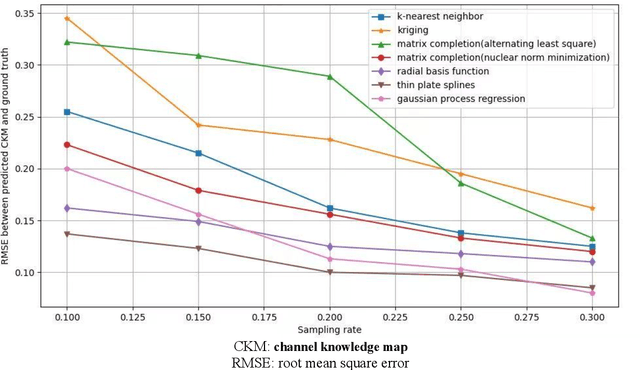
The advent of 6G wireless networks promises unprecedented connectivity, supporting ultra-high data rates, low latency, and massive device connectivity. However, these ambitious goals introduce significant challenges, particularly in channel estimation due to complex and dynamic propagation environments. This paper explores the concept of channel knowledge maps (CKMs) as a solution to these challenges. CKMs enable environment-aware communications by providing location-specific channel information, reducing reliance on real-time pilot measurements. We categorize CKM construction techniques into measurement-based, model-based, and hybrid methods, and examine their key applications in integrated sensing and communication systems, beamforming, trajectory optimization of unmanned aerial vehicles, base station placement, and resource allocation. Furthermore, we discuss open challenges and propose future research directions to enhance the robustness, accuracy, and scalability of CKM-based systems in the evolving 6G landscape.
Can Massive MIMO Support URLLC?
Feb 23, 2021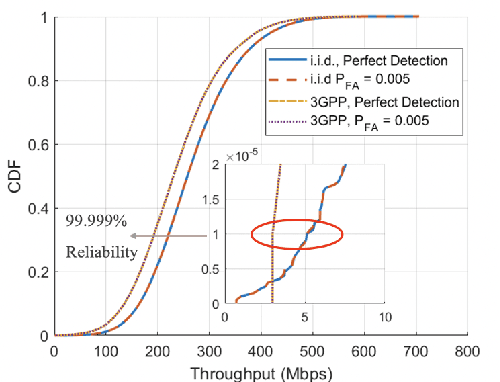
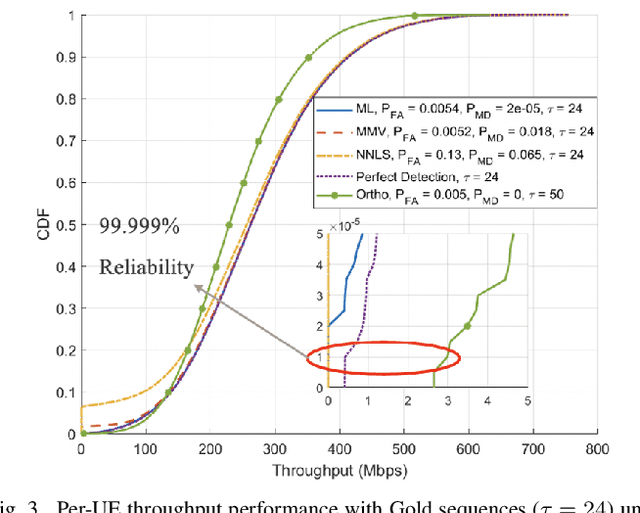
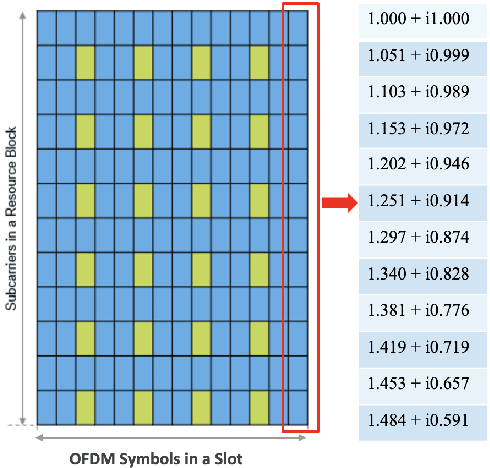
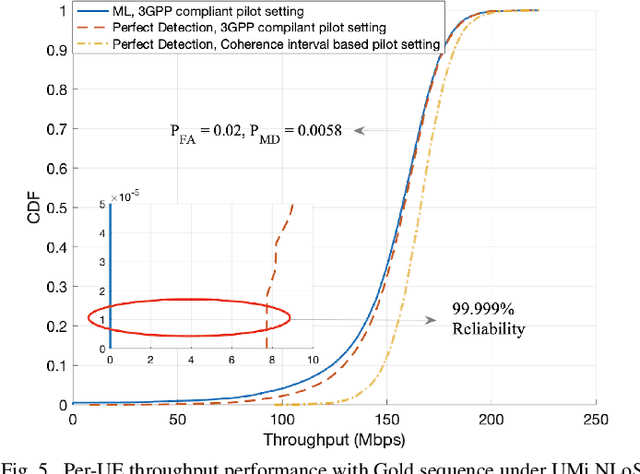
We investigate the feasibility of using Massive MIMO to support URLLC in both coherence interval based and 3GPP compliant pilot settings. We consider grant-free uplink transmission with MMSE receiver and adopt 3GPP channel models. In the coherence interval based pilot setting, by extensive system level simulations, we find that using a Massive MIMO base station with 128 antennas and MMSE receiver, URLLC requirements can be achieved in Urban Macro (UMa) Non-Line of Sight (NLoS) with orthogonal pilots and Neyman-Pearson detector. However, in the 3GPP compliant pilot setting, even by using the covariance matrix of Physical Resource Block (PRB) subcarriers for active UE detection and channel estimation as well as open-loop power control, we find that URLLC requirements are still challenging to achieve due to the insufficient pilot length and pilot symbol location regulations in a PRB.