 Add to Chrome
 Add to Firefox
 Add to Edge
SADe: Sparse-Atom Support Decontamination for Few-Shot Segmentation with Weak Support Annotations
Jul 27, 2026
Few-shot segmentation (FSS) commonly assumes clean pixel-level support masks, yet practical support supervision often uses boxes, scribbles, coarse masks, or pseudo-masks. These weak annotations may include texture-similar distractors and background context alongside the target, contaminating class prototypes or visual prompts before query prediction. We introduce SADe, a predictor-agnostic support decontamination layer that estimates the reliability of selected support patches without query information. Central to SADe is sparse autoencoder (SAE) atom evidence: dense similarity may respond to both target and texture-similar context, whereas contrasting atom activations inside and outside the weak-support region provides factor-level reliability cues. A lightweight router combines atom evidence with dense similarity and episode statistics to predict patch reliability and generate a cleaned support mask. Trained once on synthetic weak-support episodes from FSS-1000, the router is frozen for all target evaluations. The resulting mask supports standalone prediction or can be supplied to heterogeneous FSS models through native support interfaces without altering query-side inference. Under a matched weak-support protocol, SADe achieves the highest query mIoU in six of nine standalone prompt-shot combinations. With the same ProMi query head, it is within 0.03 mIoU of SAM3-derived masks under tight boxes and surpasses them by 11.17 and 19.49 points under box-r2 and box-r4, respectively. As a plug-in, SADe improves over raw support in 70 of 72 matched box-family comparisons across four frozen downstream models and two datasets. On point and scribble prompts, its average performance remains close to the corresponding raw-support baseline. Ablations and atom-removal controls show that atom evidence contributes reliability information beyond dense similarity.

Face-MakeUp: Multimodal Facial Prompts for Text-to-Image Generation
Jan 05, 2025Facial images have extensive practical applications. Although the current large-scale text-image diffusion models exhibit strong generation capabilities, it is challenging to generate the desired facial images using only text prompt. Image prompts are a logical choice. However, current methods of this type generally focus on general domain. In this paper, we aim to optimize image makeup techniques to generate the desired facial images. Specifically, (1) we built a dataset of 4 million high-quality face image-text pairs (FaceCaptionHQ-4M) based on LAION-Face to train our Face-MakeUp model; (2) to maintain consistency with the reference facial image, we extract/learn multi-scale content features and pose features for the facial image, integrating these into the diffusion model to enhance the preservation of facial identity features for diffusion models. Validation on two face-related test datasets demonstrates that our Face-MakeUp can achieve the best comprehensive performance.All codes are available at:https://github.com/ddw2AIGROUP2CQUPT/Face-MakeUp
Reversible Upper Confidence Bound Algorithm to Generate Diverse Optimized Candidates
Dec 30, 2021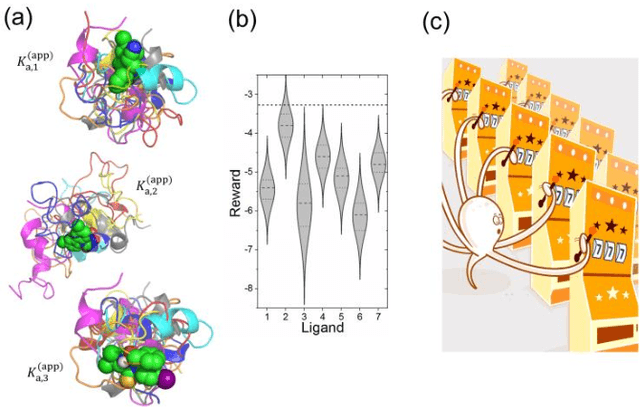
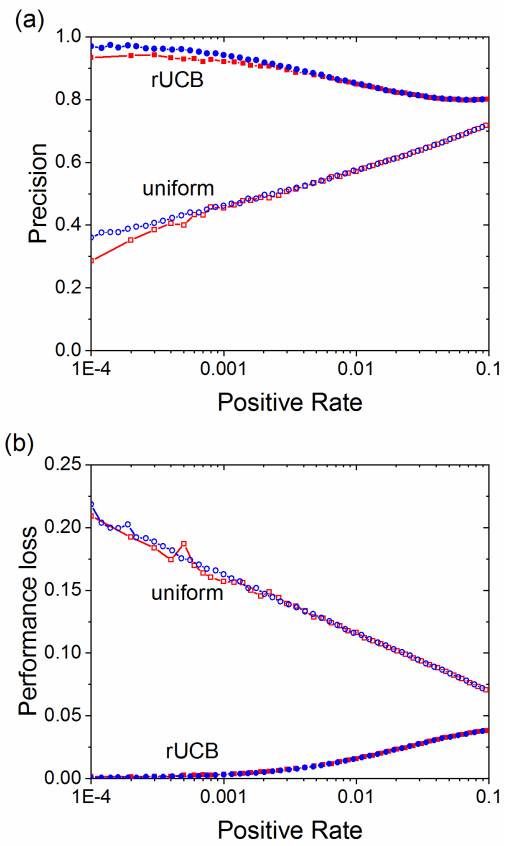
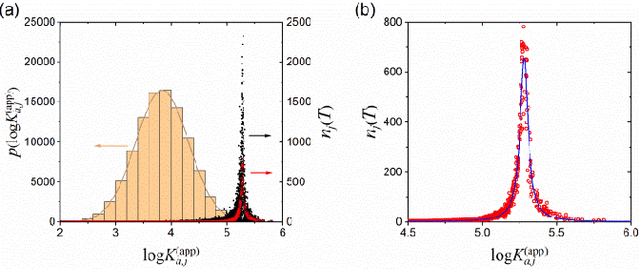
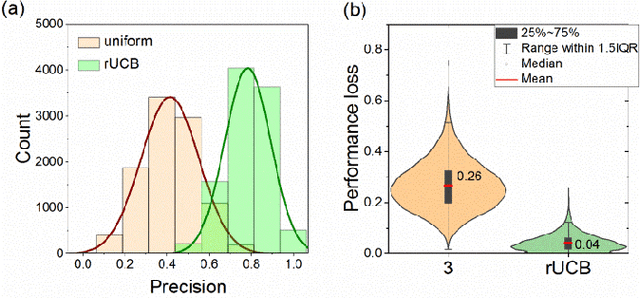
Most algorithms for the multi-armed bandit problem in reinforcement learning aimed to maximize the expected reward, which are thus useful in searching the optimized candidate with the highest reward (function value) for diverse applications (e.g., AlphaGo). However, in some typical application scenaios such as drug discovery, the aim is to search a diverse set of candidates with high reward. Here we propose a reversible upper confidence bound (rUCB) algorithm for such a purpose, and demonstrate its application in virtual screening upon intrinsically disordered proteins (IDPs). It is shown that rUCB greatly reduces the query times while achieving both high accuracy and low performance loss.The rUCB may have potential application in multipoint optimization and other reinforcement-learning cases.
* 10 pages, 10 figures