 Add to Chrome
 Add to Firefox
 Add to Edge
VLBM: Variational Latent Basis Modeling for OOD Robust Multivariate Time Series Forecasting
Jun 01, 2026
Out of distribution (OOD) events in multivariate time series forecasting are rare but often dominate real world risk, making average case forecasting insufficient for reliable deployment. Under standard average risk training on mixed ID/OOD distributions, optimization signals from rare OOD events can be overwhelmed by frequent in distribution (ID) patterns, so strong benchmark accuracy may not translate into reliability under high impact shifts. To address this issue, we propose VLBM (Variational Latent Basis Model), a theory guided latent forecasting framework that separates stable dynamics from OOD induced deviations. VLBM learns a shared latent basis that defines a low rank subspace for stable ID dynamics, explicitly decomposes inputs into basis subspace components and orthogonal residual components, and aligns a future aware posterior with a future blind prior so that test time latent inference depends only on historical input. Across 12 benchmark tasks spanning transportation, weather, power systems, and other real world domains, including newly constructed real world OOD traffic datasets, VLBM achieves state of the art OOD robustness and ID accuracy, with average MAE and MSE gains of 15.08\% and 7.74\% over the strongest baseline. On a synthetic simulation dataset, VLBM also consistently achieves the best performance and better tracks OOD pulse recovery. These results support latent structured forecasting as a principled route to robust prediction under mixed ID and OOD conditions. The code is available at https://github.com/leijieruilq/VLBM_OOD_forecast.

System States Forecasting of Microservices with Dynamic Spatio-Temporal Data
Aug 15, 2024

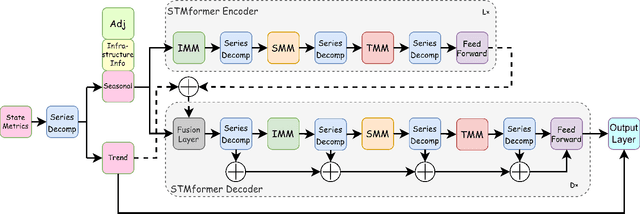

In the AIOps (Artificial Intelligence for IT Operations) era, accurately forecasting system states is crucial. In microservices systems, this task encounters the challenge of dynamic and complex spatio-temporal relationships among microservice instances, primarily due to dynamic deployments, diverse call paths, and cascading effects among instances. Current time-series forecasting methods, which focus mainly on intrinsic patterns, are insufficient in environments where spatial relationships are critical. Similarly, spatio-temporal graph approaches often neglect the nature of temporal trend, concentrating mostly on message passing between nodes. Moreover, current research in microservices domain frequently underestimates the importance of network metrics and topological structures in capturing the evolving dynamics of systems. This paper introduces STMformer, a model tailored for forecasting system states in microservices environments, capable of handling multi-node and multivariate time series. Our method leverages dynamic network connection data and topological information to assist in modeling the intricate spatio-temporal relationships within the system. Additionally, we integrate the PatchCrossAttention module to compute the impact of cascading effects globally. We have developed a dataset based on a microservices system and conducted comprehensive experiments with STMformer against leading methods. In both short-term and long-term forecasting tasks, our model consistently achieved a 8.6% reduction in MAE(Mean Absolute Error) and a 2.2% reduction in MSE (Mean Squared Error). The source code is available at https://github.com/xuyifeiiie/STMformer.