 Add to Chrome
 Add to Firefox
 Add to Edge
Learning Constituent Headedness
Mar 16, 2026
Headedness is widely used as an organizing device in syntactic analysis, yet constituency treebanks rarely encode it explicitly and most processing pipelines recover it procedurally via percolation rules. We treat this notion of constituent headedness as an explicit representational layer and learn it as a supervised prediction task over aligned constituency and dependency annotations, inducing supervision by defining each constituent head as the dependency span head. On aligned English and Chinese data, the resulting models achieve near-ceiling intrinsic accuracy and substantially outperform Collins-style rule-based percolation. Predicted heads yield comparable parsing accuracy under head-driven binarization, consistent with the induced binary training targets being largely equivalent across head choices, while increasing the fidelity of deterministic constituency-to-dependency conversion and transferring across resources and languages under simple label-mapping interfaces.

Parsing Through Boundaries in Chinese Word Segmentation
Mar 29, 2025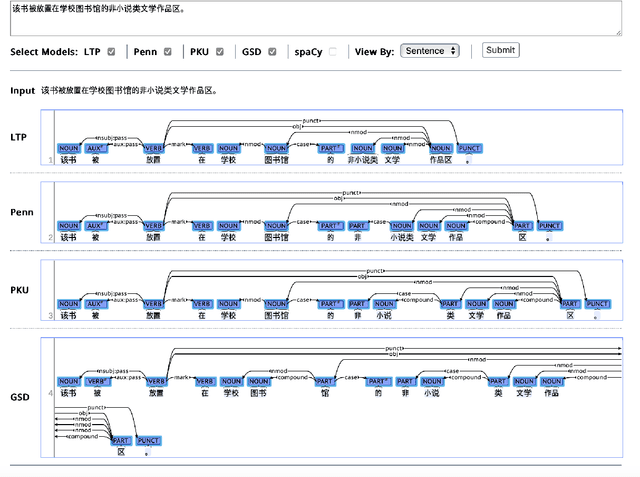

Chinese word segmentation is a foundational task in natural language processing (NLP), with far-reaching effects on syntactic analysis. Unlike alphabetic languages like English, Chinese lacks explicit word boundaries, making segmentation both necessary and inherently ambiguous. This study highlights the intricate relationship between word segmentation and syntactic parsing, providing a clearer understanding of how different segmentation strategies shape dependency structures in Chinese. Focusing on the Chinese GSD treebank, we analyze multiple word boundary schemes, each reflecting distinct linguistic and computational assumptions, and examine how they influence the resulting syntactic structures. To support detailed comparison, we introduce an interactive web-based visualization tool that displays parsing outcomes across segmentation methods.