 Add to Chrome
 Add to Firefox
 Add to Edge
A tree interpretation of arc standard dependency derivation
Mar 29, 2026
We show that arc-standard derivations for projective dependency trees determine a unique ordered tree representation with surface-contiguous yields and stable lexical anchoring. Each \textsc{shift}, \textsc{leftarc}, and \textsc{rightarc} transition corresponds to a deterministic tree update, and the resulting hierarchical object uniquely determines the original dependency arcs. We further show that this representation characterizes projectivity: a single-headed dependency tree admits such a contiguous ordered representation if and only if it is projective. The proposal is derivational rather than convertive. It interprets arc-standard transition sequences directly as ordered tree construction, rather than transforming a completed dependency graph into a phrase-structure output. For non-projective inputs, the same interpretation can be used in practice via pseudo-projective lifting before derivation and inverse decoding after recovery. A proof-of-concept implementation in a standard neural transition-based parser shows that the mapped derivations are executable and support stable dependency recovery.

Parsing Through Boundaries in Chinese Word Segmentation
Mar 29, 2025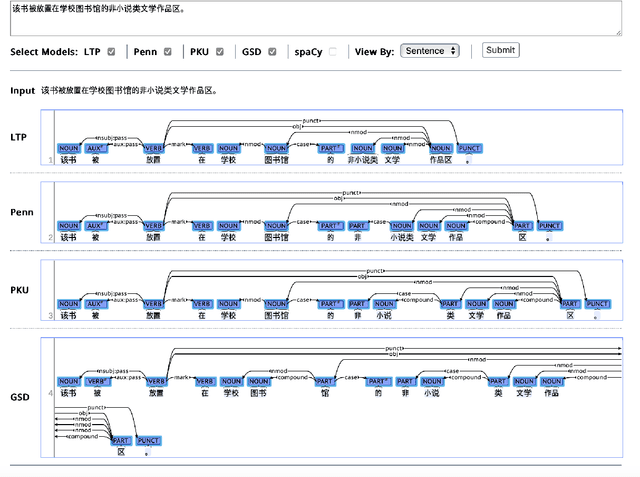

Chinese word segmentation is a foundational task in natural language processing (NLP), with far-reaching effects on syntactic analysis. Unlike alphabetic languages like English, Chinese lacks explicit word boundaries, making segmentation both necessary and inherently ambiguous. This study highlights the intricate relationship between word segmentation and syntactic parsing, providing a clearer understanding of how different segmentation strategies shape dependency structures in Chinese. Focusing on the Chinese GSD treebank, we analyze multiple word boundary schemes, each reflecting distinct linguistic and computational assumptions, and examine how they influence the resulting syntactic structures. To support detailed comparison, we introduce an interactive web-based visualization tool that displays parsing outcomes across segmentation methods.