 Add to Chrome
 Add to Firefox
 Add to Edge
CV-Arena: An Open Benchmark for Instructional Computer Vision Problem Solving with Human-AI Collaborative Preferences
May 30, 2026
Instruction-guided image editing is becoming a general interface for visual work, yet existing benchmarks still focus largely on narrow appearance edits and do not fully capture the diversity of real-image tasks in professional workflows. Here, we define instructional computer vision problem solving as a broader formulation of image editing: given a real input image and a natural-language instruction, a system must produce an edited output that realizes the requested transformation while satisfying explicit preservation, geometric, physical, and usability constraints. We introduce CV-Arena, an open benchmark designed to evaluate this capability at professional scales. CV-Arena contains 12K high-resolution real-image instruction pairs spanning 16 instruction-based visual task types, constructed using CogRetriever, a dual-track retrieval-and-curation pipeline that combines targeted web search, agentic query refinement, verification, and traceability. To evaluate models at scale while preserving human fidelity, we propose Active Elo, a human-AI collaborative preference protocol that leverages CV-Judge, a logic-gated, multi-dimensional VLM evaluator, to reject clear failures and resolve high-confidence comparisons; and to route close, high-quality comparisons to expert raters. Mixed human and AI supervision is then aggregated through reliability-weighted Elo updates. Our comprehensive evaluation of 21 systems, including proprietary, open-source, and agentic models, on CV-Arena reveals persistent gaps in instruction adherence, physical reasoning, structural control, and fine-grained detail preservation. We further develop CV-Agent, a lightweight agentic model that combines planning, editing, and verification, and demonstrate that closed-loop reasoning is a promising direction for professional-grade instruction-following visual editing.

AdaptFuse: Training-Free Sequential Preference Learning via Externalized Bayesian Inference
Apr 05, 2026Large language models struggle to accumulate evidence across multiple rounds of user interaction, failing to update their beliefs in a manner consistent with Bayesian inference. Existing solutions require fine-tuning on sensitive user interaction data, limiting their applicability in privacy-conscious settings. We propose AdaptFuse, a training-free framework that externalizes probabilistic computation entirely from the LLM: a symbolic module maintains a Bayesian posterior over a discrete hypothesis set, while a frozen LLM contributes semantic reasoning via multi-sample Dirichlet aggregation. The two signals are combined through entropy-adaptive fusion, which automatically weights each source by its predictive confidence, shifting reliance from the LLM to the symbolic posterior as evidence accumulates. We evaluate across three domains: flight recommendation, hotel recommendation, and web shopping; on Gemma 2 9B, Llama 3 8B, and Qwen 2.5 7B. AdaptFuse consistently outperforms both prompting baselines and fine-tuned Bayesian Teaching models on all tasks, with accuracy improving monotonically over interaction rounds. These results demonstrate that principled inference-time algorithms can substitute for fine-tuning in personalized recommendation, without storing or training on sensitive user data. All the code and materials will be open-sourced.
Towards Autonomous Robotic Kidney Ultrasound: Spatial-Efficient Volumetric Imaging via Template Guided Optimal Pivoting
Feb 18, 2026Medical ultrasound (US) imaging is a frontline tool for the diagnosis of kidney diseases. However, traditional freehand imaging procedure suffers from inconsistent, operator-dependent outcomes, lack of 3D localization information, and risks of work-related musculoskeletal disorders. While robotic ultrasound (RUS) systems offer the potential for standardized, operator-independent 3D kidney data acquisition, the existing scanning methods lack the ability to determine the optimal imaging window for efficient imaging. As a result, the scan is often blindly performed with excessive probe footprint, which frequently leads to acoustic shadowing and incomplete organ coverage. Consequently, there is a critical need for a spatially efficient imaging technique that can maximize the kidney coverage through minimum probe footprint. Here, we propose an autonomous workflow to achieve efficient kidney imaging via template-guided optimal pivoting. The system first performs an explorative imaging to generate partial observations of the kidney. This data is then registered to a kidney template to estimate the organ pose. With the kidney localized, the robot executes a fixed-point pivoting sweep where the imaging plane is aligned with the kidney long axis to minimize the probe translation. The proposed method was validated in simulation and in-vivo. Simulation results indicate that a 60% exploration ratio provides optimal balance between kidney localization accuracy and scanning efficiency. In-vivo evaluation on two male subjects demonstrates a kidney localization accuracy up to 7.36 mm and 13.84 degrees. Moreover, the optimal pivoting approach shortened the probe footprint by around 75 mm when compared with the baselines. These results valid our approach of leveraging anatomical templates to align the probe optimally for volumetric sweep.
Position: Human-Centric AI Requires a Minimum Viable Level of Human Understanding
Jan 31, 2026AI systems increasingly produce fluent, correct, end-to-end outcomes. Over time, this erodes users' ability to explain, verify, or intervene. We define this divergence as the Capability-Comprehension Gap: a decoupling where assisted performance improves while users' internal models deteriorate. This paper argues that prevailing approaches to transparency, user control, literacy, and governance do not define the foundational understanding humans must retain for oversight under sustained AI delegation. To formalize this, we define the Cognitive Integrity Threshold (CIT) as the minimum comprehension required to preserve oversight, autonomy, and accountable participation under AI assistance. CIT does not require full reasoning reconstruction, nor does it constrain automation. It identifies the threshold beyond which oversight becomes procedural and contestability fails. We operatinalize CIT through three functional dimensions: (i) verification capacity, (ii) comprehension-preserving interaction, and (iii) institutional scaffolds for governance. This motivates a design and governance agenda that aligns human-AI interaction with cognitive sustainability in responsibility-critical settings.
Deep Loss Convexification for Learning Iterative Models
Nov 16, 2024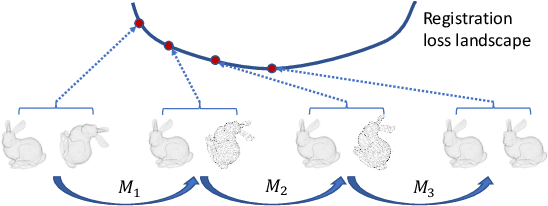

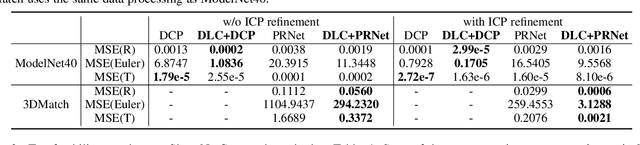
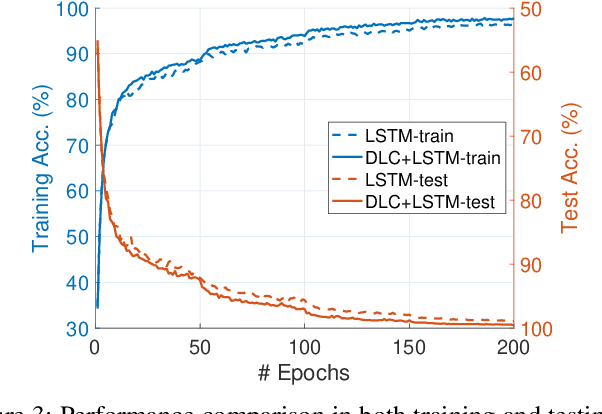
Iterative methods such as iterative closest point (ICP) for point cloud registration often suffer from bad local optimality (e.g. saddle points), due to the nature of nonconvex optimization. To address this fundamental challenge, in this paper we propose learning to form the loss landscape of a deep iterative method w.r.t. predictions at test time into a convex-like shape locally around each ground truth given data, namely Deep Loss Convexification (DLC), thanks to the overparametrization in neural networks. To this end, we formulate our learning objective based on adversarial training by manipulating the ground-truth predictions, rather than input data. In particular, we propose using star-convexity, a family of structured nonconvex functions that are unimodal on all lines that pass through a global minimizer, as our geometric constraint for reshaping loss landscapes, leading to (1) extra novel hinge losses appended to the original loss and (2) near-optimal predictions. We demonstrate the state-of-the-art performance using DLC with existing network architectures for the tasks of training recurrent neural networks (RNNs), 3D point cloud registration, and multimodel image alignment.