 Add to Chrome
 Add to Firefox
 Add to Edge
DW-DGAT: Dynamically Weighted Dual Graph Attention Network for Neurodegenerative Disease Diagnosis
Jan 15, 2026
Parkinson's disease (PD) and Alzheimer's disease (AD) are the two most prevalent and incurable neurodegenerative diseases (NDs) worldwide, for which early diagnosis is critical to delay their progression. However, the high dimensionality of multi-metric data with diverse structural forms, the heterogeneity of neuroimaging and phenotypic data, and class imbalance collectively pose significant challenges to early ND diagnosis. To address these challenges, we propose a dynamically weighted dual graph attention network (DW-DGAT) that integrates: (1) a general-purpose data fusion strategy to merge three structural forms of multi-metric data; (2) a dual graph attention architecture based on brain regions and inter-sample relationships to extract both micro- and macro-level features; and (3) a class weight generation mechanism combined with two stable and effective loss functions to mitigate class imbalance. Rigorous experiments, based on the Parkinson Progression Marker Initiative (PPMI) and Alzhermer's Disease Neuroimaging Initiative (ADNI) studies, demonstrate the state-of-the-art performance of our approach.

ADAM Challenge: Detecting Age-related Macular Degeneration from Fundus Images
Feb 18, 2022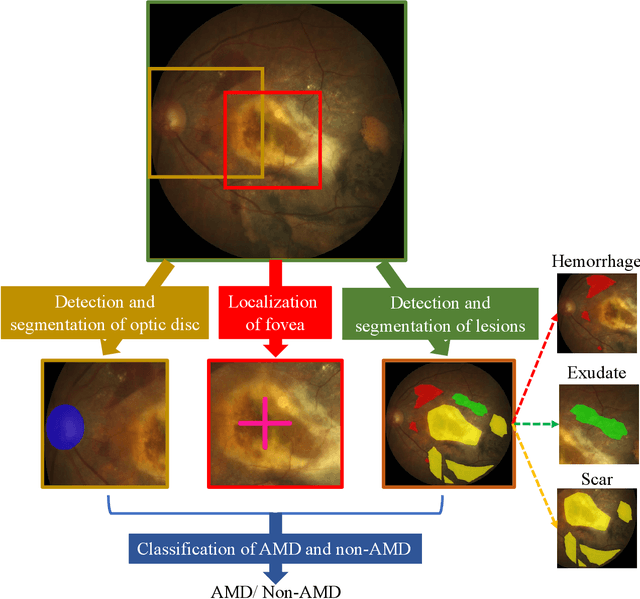

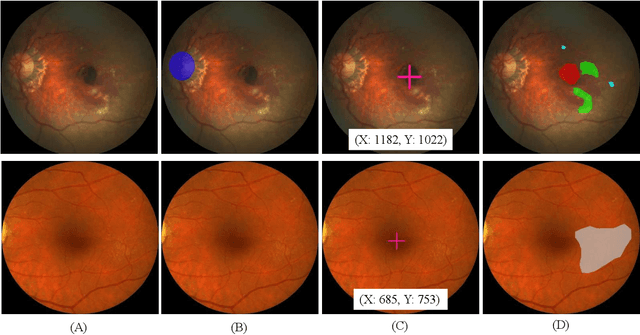
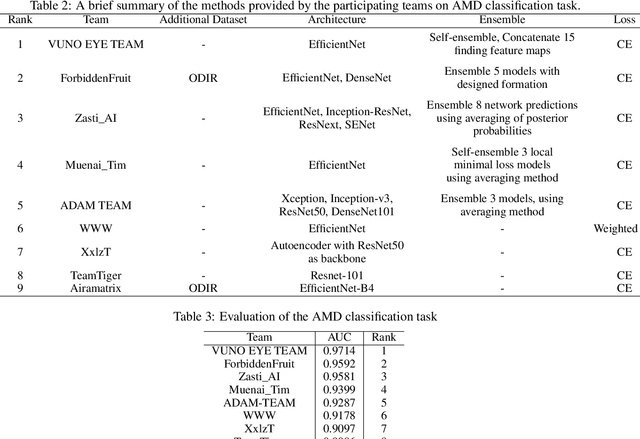
Age-related macular degeneration (AMD) is the leading cause of visual impairment among elderly in the world. Early detection of AMD is of great importance as the vision loss caused by AMD is irreversible and permanent. Color fundus photography is the most cost-effective imaging modality to screen for retinal disorders. \textcolor{red}{Recently, some algorithms based on deep learning had been developed for fundus image analysis and automatic AMD detection. However, a comprehensive annotated dataset and a standard evaluation benchmark are still missing.} To deal with this issue, we set up the Automatic Detection challenge on Age-related Macular degeneration (ADAM) for the first time, held as a satellite event of the ISBI 2020 conference. The ADAM challenge consisted of four tasks which cover the main topics in detecting AMD from fundus images, including classification of AMD, detection and segmentation of optic disc, localization of fovea, and detection and segmentation of lesions. The ADAM challenge has released a comprehensive dataset of 1200 fundus images with the category labels of AMD, the pixel-wise segmentation masks of the full optic disc and lesions (drusen, exudate, hemorrhage, scar, and other), as well as the location coordinates of the macular fovea. A uniform evaluation framework has been built to make a fair comparison of different models. During the ADAM challenge, 610 results were submitted for online evaluation, and finally, 11 teams participated in the onsite challenge. This paper introduces the challenge, dataset, and evaluation methods, as well as summarizes the methods and analyzes the results of the participating teams of each task. In particular, we observed that ensembling strategy and clinical prior knowledge can better improve the performances of the deep learning models.