 Add to Chrome
 Add to Firefox
 Add to Edge
From Operational Design Domain to Action: A Systematic Behavioral Taxonomy for Autonomous Driving
Aug 09, 2026
Operational Design Domain (ODD) specifications describe where an automated driving system (ADS) is permitted to operate, but they do not prescribe what the ADS must demonstrably do once deployed within that domain. This gap between operating condition specification and behavioral validation represents a critical unresolved challenge in ADS safety assurance. This paper presents a structured, standards-grounded taxonomy of 21 behavioral competencies organized across three operational domains-Highway (HWY), Urban (URB), and Hub (HUB)-derived systematically from the PEGASUS six-layer model-based ODD. Each behavior is decomposed along longitudinal and lateral control axes and characterized against a four-property framework: Safety (gap maintenance, conflict avoidance, kinematic stability), Compliance (legal rules and behavioral norms), Comfort (rider dynamics and trust), and Efficiency (mission completion and product-level metrics). We further demonstrate that the crossing of ODD layer parameterizations with behavioral competency specifications yields concrete scenario families suitable for systematic behavioral testing and SOTIF coverage evidence. The taxonomy is grounded in AVSC00008202111, SAE J3237, and SAE J3016, and is validated as an operational specification layer through its deployment in a rule-enforced trajectory optimization system. The Hub domain is identified as a structurally distinct, underspecified domain warranting dedicated research attention.

Real-Time Rulebook-Aware Nonlinear MPC for Autonomous Driving with Priority-Biased Tiered Slacks
Jul 13, 2026Autonomous-vehicle motion planners must resolve conflicts among safety, regulation, comfort, and efficiency in real time while exposing those decisions for audit. We present W-SQP, a weighted tiered-slack nonlinear model predictive controller (NMPC) that compiles nine driving-rule families into a four-tier shared-slack nonlinear program solved online with CasADi and IPOPT; the name denotes the weighted quadratic slack penalty, not a sequential-quadratic-programming solver. Strongly separated tier penalties bias residual violations toward lower-priority rules while leaving actuation bounds hard. The controller replans from its executed state at $10$\,Hz and records per-rule residuals on every cycle. A $90$\,ms solver-time limit returns an anytime iterate that is projected through the vehicle dynamics before execution; median and maximum observed wall-clock solve times were $28$ and $104$\,ms. We evaluate W-SQP in closed loop on 150 Waymo Open Motion Dataset scenarios in Waymax against reactive and proposal-and-select baselines, and introduce a log-independent protocol that separates safety and regulatory compliance from resemblance to the recorded human trajectory. Under this protocol, W-SQP shows no systematic group-level deficit relative to expert replay on the log-independent safety and regulatory rules, with several localized regressions in the hardest, highest-divergence scenarios. The results characterize W-SQP as an auditable, priority-biased, anytime-capable NMPC prototype rather than a hard-real-time or formally safe controller.
Decentralized Geometric Control for Cable-Suspended Payload Transport with Adaptive Mass Estimation
Jun 20, 2026Cooperative aerial transport requires controllers that respect nonlinear manifold geometry, operate without centralized coordination, and respect operational safety constraints. To address these demands, we present GPAC, a four-layer hierarchical architecture that enables $N$ quadrotors to transport a cable-suspended payload without a central coordinator or by exchanging cable states or adaptive parameters. The key insight is implicit coordination: each quadrotor independently estimates its effective load share from local cable measurements, so combined forces converge to the correct total, even without knowledge of $N$ or the payload mass; the payload position is reconstructed locally from each agent's own cable geometry, and the only inter-agent communication is a low-rate neighbor-position broadcast for collision avoidance. GPAC operates directly on the full nonlinear configuration manifold and integrates geometric position and attitude control, anti-swing regulation, an extended-state observer for wind rejection, concurrent learning-based mass estimation without persistent excitation, and a priority-ordered control barrier function (CBF)-inspired safety filter that reduces operational risk, with input-to-state safety (ISSf) margins that hold exactly under single-constraint activation. A compatibility result shows that the filter's force modifications keep the desired attitude within the almost-global stability region of the $\mathrm{SO}(3)$ attitude controller. Finally, high-fidelity simulation with flexible cables, onboard sensor fusion, and wind turbulence -- with all control and estimation loops closed through the estimator -- yields a mean payload-tracking RMSE of 33.8 cm (2.8\% coefficient of variation over 13 seeds) at a low per-agent computational cost.
Re-imagining ISO 26262 in the Age of Autonomous Vehicles: Enhancing Controllability through Transferability and Predictability
Jun 05, 2026The ISO 26262 standard defines functional safety for road vehicles through risk assessments based on Severity, Exposure, and Controllability, grounded in a human-driven vehicle paradigm. In the context of autonomous vehicles (AVs), the absence of a human driver necessitates revisiting these principles. This paper decomposes the Controllability placeholder into two auditable evidence dimensions of ISO 26262 by introducing two measurable sub-concepts: Transferability and Predictability. Transferability extends Controllability to capture AV systems' ability to hand off control to dedicated fallback safety mechanisms, while Predictability captures how easily external agents can anticipate AV behavior. Predictability is formally defined from human-robot interaction-inspired principles, and a mathematical framework is provided to quantify it. A designed-versus-achievable gap is introduced to distinguish architectural fallback claims from scene-conditioned achievable fallback capability. The proposed metrics align with ISO 26262 and ISO/PAS 21448 (SOTIF), rendering fallback and interaction claims falsifiable and traceable across ODD slices. These dimensions complement rather than replace existing standards, and the enhancements preserve the structure of ISO 26262 while extending its applicability to driverless automated systems operating at SAE Levels 4 and 5.
RECTOR: Priority-Aware Rule-Based Reranking for Compliance-Aware Autonomous Driving Trajectory Selection
May 24, 2026Autonomous driving stacks must pick one trajectory from a multi-modal candidate set; choosing by model confidence ignores safety, traffic-law, and comfort constraints. We present \textsc{RECTOR} (Rule-Enforced Constrained Trajectory Orchestrator), a post-generation reranking layer that scores candidates against a tiered rulebook (Safety~$\succ$~Legal~$\succ$~Road~$\succ$~Comfort) via differentiable proxies and a scene-conditioned applicability mechanism, then selects with a deterministic $\varepsilon$-lexicographic rule that preserves cross-tier priority by construction -- without retraining the predictor. On the Waymo Open Motion Dataset \texttt{validation\_interactive} split (43{,}219 augmented instances, $K{=}6$), under Protocol~B (28-rule proxy catalog, oracle applicability) rule-aware selection cuts Safety+Legal violations from 28.58\% to 20.42\% and Total from 40.32\% to 32.41\% versus confidence-only on the same candidates. A uniform-weight weighted-sum baseline matches binary compliance on this benchmark -- the empirical lift comes from rule-aware ranking, while the lexicographic guarantee is the structural differentiator no weight calibration can replicate. Under adversarial confidence corruption, confidence-only selection fails in 100\% of scenarios while both rule-aware selectors reject the injected mode in $\sim$96\%. All figures are proxy-evaluator results (not a safety certificate), open-loop, 5\,s horizon, U.S.\ rules, validation split.
Benchmarking local motion planners for navigation of mobile manipulators
Nov 03, 2022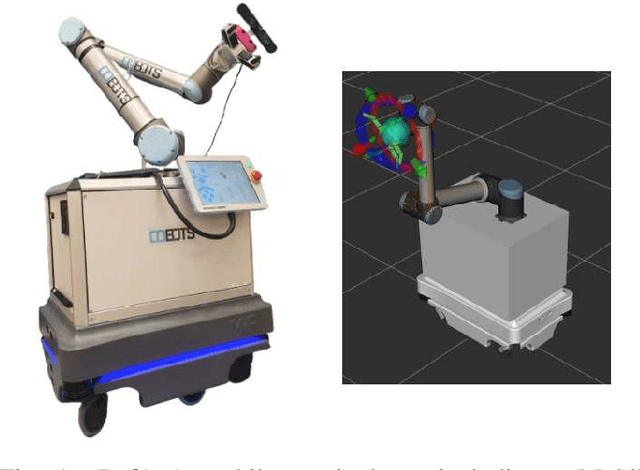
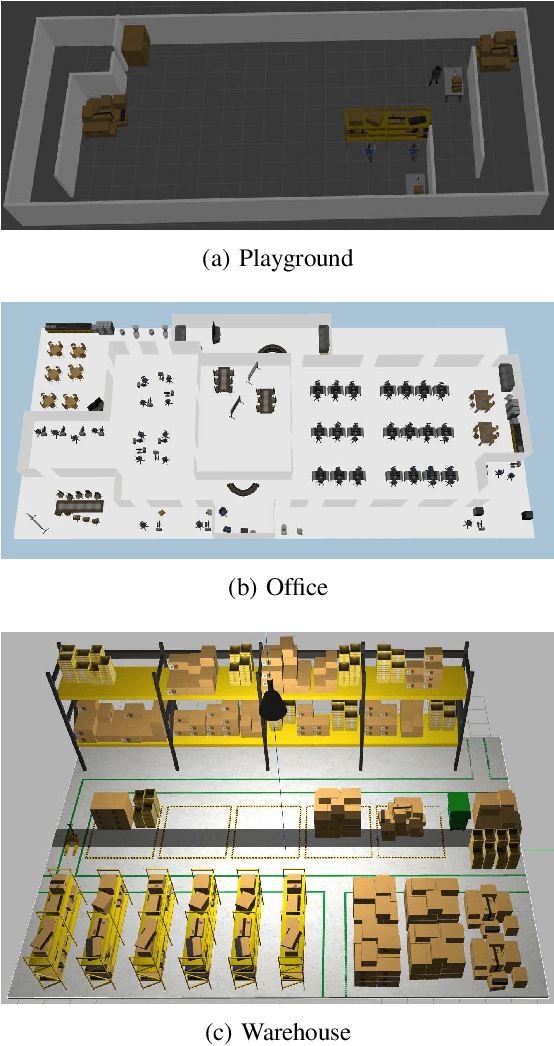
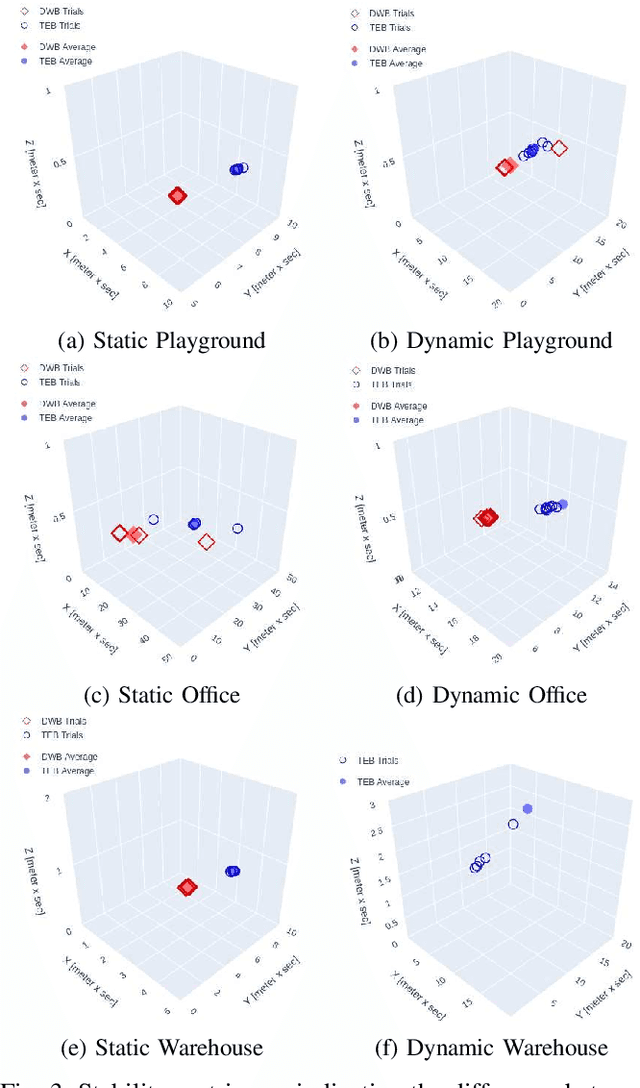
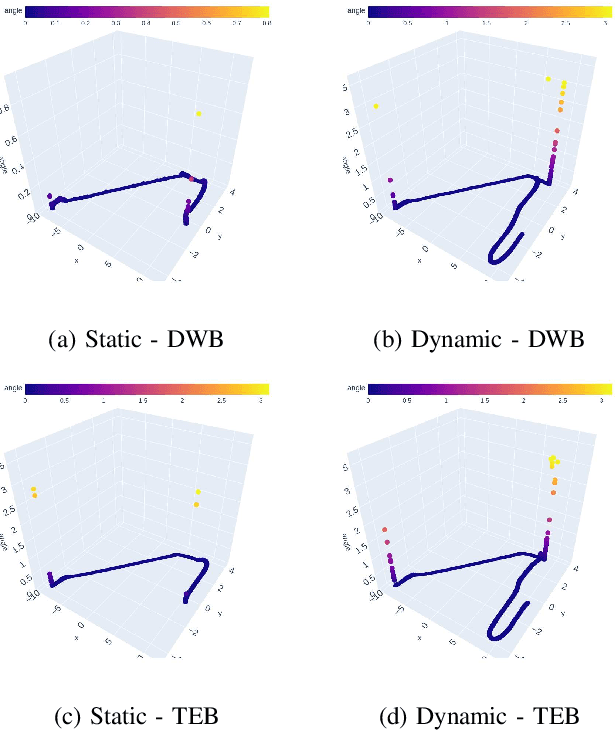
There are various trajectory planners for mobile manipulators. It is often challenging to compare their performance under similar circumstances due to differences in hardware, dissimilarity of tasks and objectives, as well as uncertainties in measurements and operating environments. In this paper, we propose a simulation framework to evaluate the performance of the local trajectory planners to generate smooth, and dynamically and kinematically feasible trajectories for mobile manipulators in the same environment. We focus on local planners as they are key components that provide smooth trajectories while carrying a load, react to dynamic obstacles, and avoid collisions. We evaluate two prominent local trajectory planners, Dynamic-Window Approach (DWA) and Time Elastic Band (TEB) using the metrics that we introduce. Moreover, our software solution is applicable to any other local planners used in the Robot Operating System (ROS) framework, without additional programming effort.
Bayesian Optimization-based Nonlinear Adaptive PID Controller Design for Robust Mobile Manipulation
Jul 04, 2022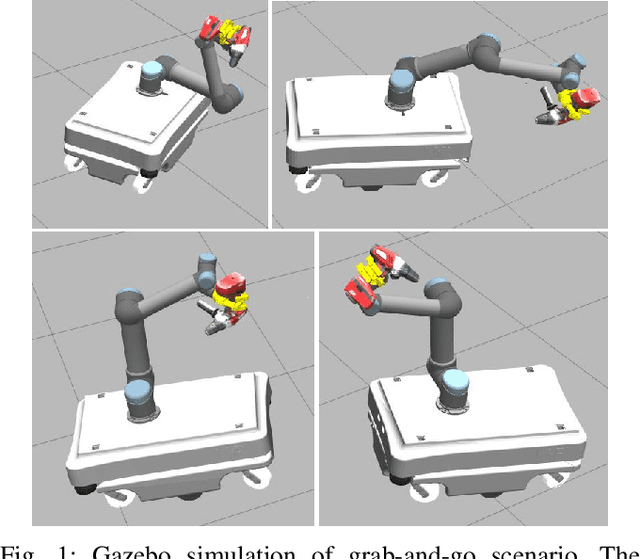
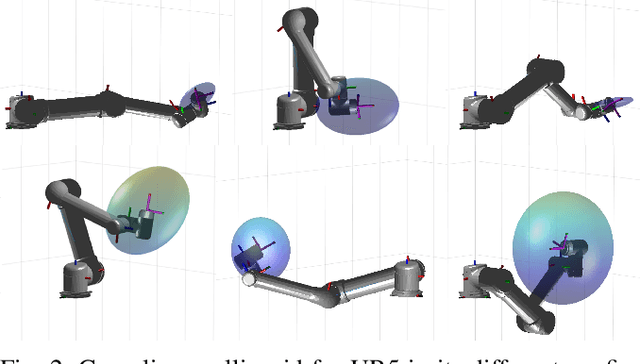
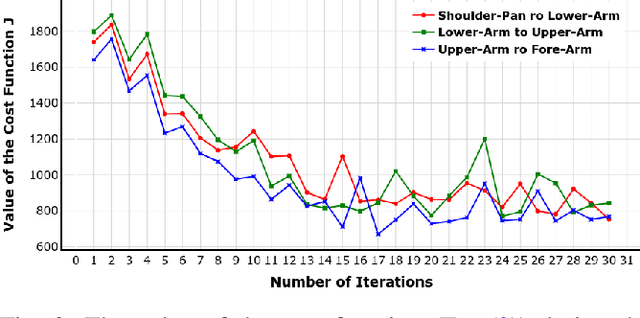
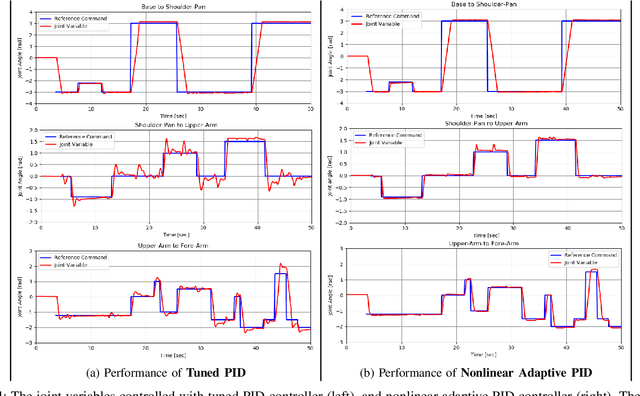
In this paper, we propose to use a nonlinear adaptive PID controller to regulate the joint variables of a mobile manipulator. The motion of the mobile base forces undue disturbances on the joint controllers of the manipulator. In designing a conventional PID controller, one should make a trade-off between the performance and agility of the closed-loop system and its stability margins. The proposed nonlinear adaptive PID controller provides a mechanism to relax the need for such a compromise by adapting the gains according to the magnitude of the error without expert tuning. Therefore, we can achieve agile performance for the system while seeing damped overshoot in the output and track the reference as close as possible, even in the presence of external disturbances and uncertainties in the modeling of the system. We have employed a Bayesian optimization approach to choose the parameters of a nonlinear adaptive PID controller to achieve the best performance in tracking the reference input and rejecting disturbances. The results demonstrate that a well-designed nonlinear adaptive PID controller can effectively regulate a mobile manipulator's joint variables while carrying an unspecified heavy load and an abrupt base movement occurs.