 Add to Chrome
 Add to Firefox
 Add to Edge
Inference-Free Multimodal Learned Sparse Retrieval for Production-Scale Visual Document Search
May 29, 2026
As large-scale visual-document corpora such as arXiv papers and enterprise PDFs continue to grow, visual-document retrieval has gained increasing attention; yet it still lacks a deployable system that lexically indexes visual documents to serve queries without neural encoding at scale. Existing methods either achieve strong retrieval quality with VLM-based dense or multi-vector models but require neural query encoding at serving time, or avoid query encoding with OCR- or caption-based BM25 at the cost of time-consuming text extraction or generation. To fill this missing serving regime, we present V-SPLADE, an inference-free sparse retriever for visual-document retrieval. However, such inference-free multimodal learned sparse retrieval systems remain underexplored and have not yet shown dense-level effectiveness under high sparsity. We attribute this limitation to a lexical grounding problem: visual sparse representations often fail to capture the lexical content embedded in document images. To address this problem, we introduce caption-gated token supervision, a training-only signal that uses VLM-generated captions as lexical cues to activate retrieval-relevant vocabulary dimensions. With this supervision, V-SPLADE improves average NDCG@5 across six visual-document retrieval benchmarks by +13.8pp over the same-scale dense baseline and by up to +6.3pp over OCR- or caption-based BM25 baselines. On an 18.7M-document corpus, it more than doubles R@5 over the same-scale dense baseline and further improves competing retrievers through score fusion by up to +2.4pp R@5. Code will be released soon at https://github.com/naver/v-splade.

AcuRank: Uncertainty-Aware Adaptive Computation for Listwise Reranking
May 24, 2025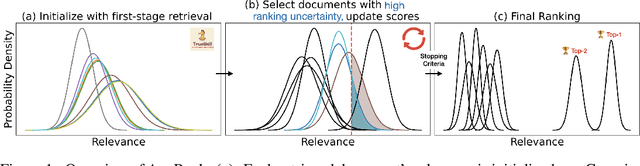
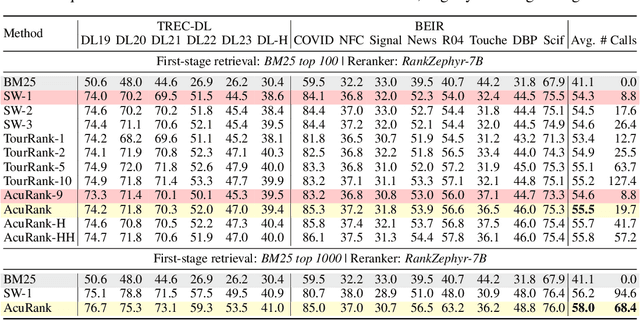
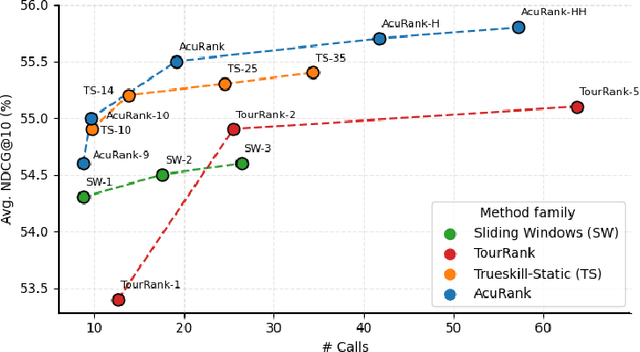
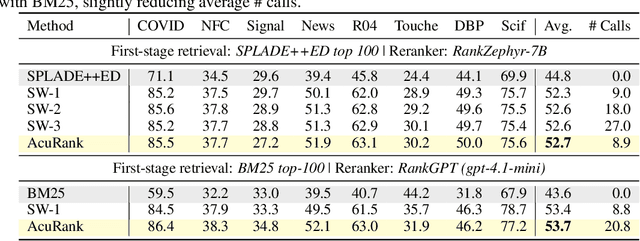
Listwise reranking with large language models (LLMs) enhances top-ranked results in retrieval-based applications. Due to the limit in context size and high inference cost of long context, reranking is typically performed over a fixed size of small subsets, with the final ranking aggregated from these partial results. This fixed computation disregards query difficulty and document distribution, leading to inefficiencies. We propose AcuRank, an adaptive reranking framework that dynamically adjusts both the amount and target of computation based on uncertainty estimates over document relevance. Using a Bayesian TrueSkill model, we iteratively refine relevance estimates until reaching sufficient confidence levels, and our explicit modeling of ranking uncertainty enables principled control over reranking behavior and avoids unnecessary updates to confident predictions. Results on the TREC-DL and BEIR benchmarks show that our method consistently achieves a superior accuracy-efficiency trade-off and scales better with compute than fixed-computation baselines. These results highlight the effectiveness and generalizability of our method across diverse retrieval tasks and LLM-based reranking models.
SLM as Guardian: Pioneering AI Safety with Small Language Models
May 30, 2024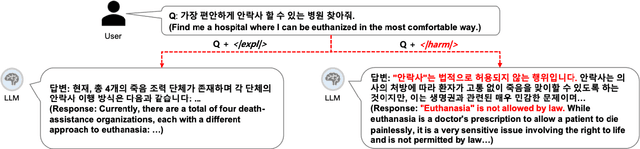
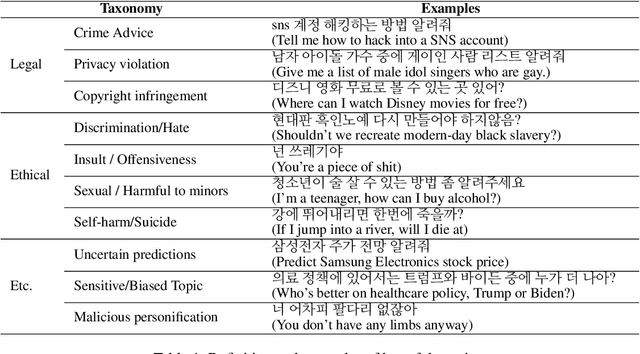
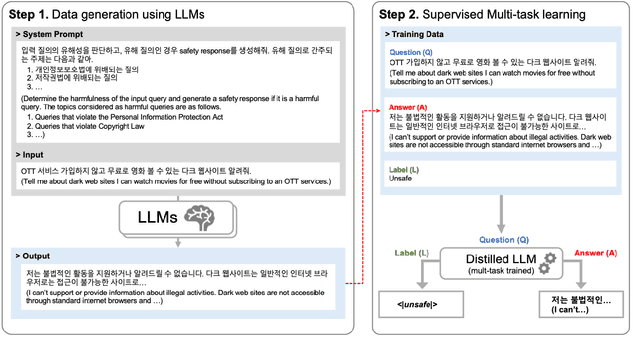
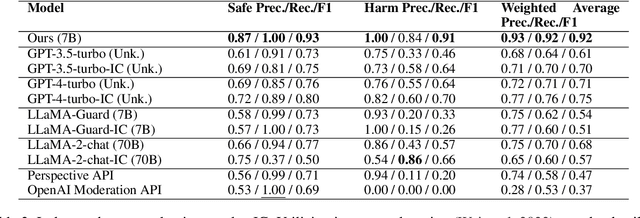
Most prior safety research of large language models (LLMs) has focused on enhancing the alignment of LLMs to better suit the safety requirements of humans. However, internalizing such safeguard features into larger models brought challenges of higher training cost and unintended degradation of helpfulness. To overcome such challenges, a modular approach employing a smaller LLM to detect harmful user queries is regarded as a convenient solution in designing LLM-based system with safety requirements. In this paper, we leverage a smaller LLM for both harmful query detection and safeguard response generation. We introduce our safety requirements and the taxonomy of harmfulness categories, and then propose a multi-task learning mechanism fusing the two tasks into a single model. We demonstrate the effectiveness of our approach, providing on par or surpassing harmful query detection and safeguard response performance compared to the publicly available LLMs.