 Add to Chrome
 Add to Firefox
 Add to Edge
KnowU-Bench: Towards Interactive, Proactive, and Personalized Mobile Agent Evaluation
Apr 09, 2026
Personalized mobile agents that infer user preferences and calibrate proactive assistance hold great promise as everyday digital assistants, yet existing benchmarks fail to capture what this requires. Prior work evaluates preference recovery from static histories or intent prediction from fixed contexts. Neither tests whether an agent can elicit missing preferences through interaction, nor whether it can decide when to intervene, seek consent, or remain silent in a live GUI environment. We introduce KnowU-Bench, an online benchmark for personalized mobile agents built on a reproducible Android emulation environment, covering 42 general GUI tasks, 86 personalized tasks, and 64 proactive tasks. Unlike prior work that treats user preferences as static context, KnowU-Bench hides the user profile from the agent and exposes only behavioral logs, forcing genuine preference inference rather than context lookup. To support multi-turn preference elicitation, it instantiates an LLM-driven user simulator grounded in structured profiles, enabling realistic clarification dialogues and proactive consent handling. Beyond personalization, KnowU-Bench provides comprehensive evaluation of the complete proactive decision chain, including grounded GUI execution, consent negotiation, and post-rejection restraint, evaluated through a hybrid protocol combining rule-based verification with LLM-as-a-Judge scoring. Our experiments reveal a striking degradation: agents that excel at explicit task execution fall below 50% under vague instructions requiring user preference inference or intervention calibration, even for frontier models like Claude Sonnet 4.6. The core bottlenecks are not GUI navigation but preference acquisition and intervention calibration, exposing a fundamental gap between competent interface operation and trustworthy personal assistance.

Advances in 3D Neural Stylization: A Survey
Nov 30, 2023
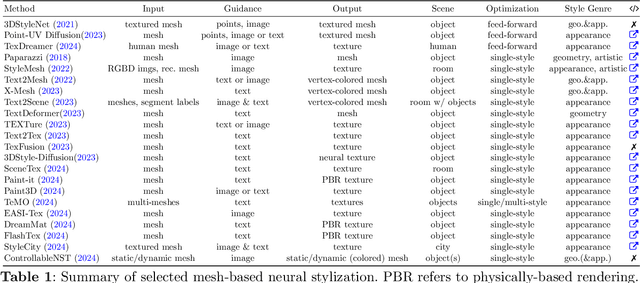

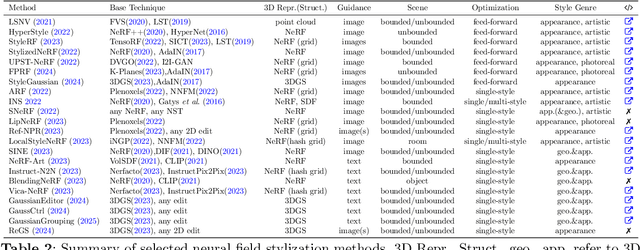
Modern artificial intelligence provides a novel way of producing digital art in styles. The expressive power of neural networks enables the realm of visual style transfer methods, which can be used to edit images, videos, and 3D data to make them more artistic and diverse. This paper reports on recent advances in neural stylization for 3D data. We provide a taxonomy for neural stylization by considering several important design choices, including scene representation, guidance data, optimization strategies, and output styles. Building on such taxonomy, our survey first revisits the background of neural stylization on 2D images, and then provides in-depth discussions on recent neural stylization methods for 3D data, where we also provide a mini-benchmark on artistic stylization methods. Based on the insights gained from the survey, we then discuss open challenges, future research, and potential applications and impacts of neural stylization.