 Add to Chrome
 Add to Firefox
 Add to Edge
Beyond Static Snapshots: Dynamic Modeling and Forecasting of Group-Level Value Evolution with Large Language Models
Feb 15, 2026
Social simulation is critical for mining complex social dynamics and supporting data-driven decision making. LLM-based methods have emerged as powerful tools for this task by leveraging human-like social questionnaire responses to model group behaviors. Existing LLM-based approaches predominantly focus on group-level values at discrete time points, treating them as static snapshots rather than dynamic processes. However, group-level values are not fixed but shaped by long-term social changes. Modeling their dynamics is thus crucial for accurate social evolution prediction--a key challenge in both data mining and social science. This problem remains underexplored due to limited longitudinal data, group heterogeneity, and intricate historical event impacts. To bridge this gap, we propose a novel framework for group-level dynamic social simulation by integrating historical value trajectories into LLM-based human response modeling. We select China and the U.S. as representative contexts, conducting stratified simulations across four core sociodemographic dimensions (gender, age, education, income). Using the World Values Survey, we construct a multi-wave, group-level longitudinal dataset to capture historical value evolution, and then propose the first event-based prediction method for this task, unifying social events, current value states, and group attributes into a single framework. Evaluations across five LLM families show substantial gains: a maximum 30.88\% improvement on seen questions and 33.97\% on unseen questions over the Vanilla baseline. We further find notable cross-group heterogeneity: U.S. groups are more volatile than Chinese groups, and younger groups in both countries are more sensitive to external changes. These findings advance LLM-based social simulation and provide new insights for social scientists to understand and predict social value changes.

RCLMuFN: Relational Context Learning and Multiplex Fusion Network for Multimodal Sarcasm Detection
Dec 17, 2024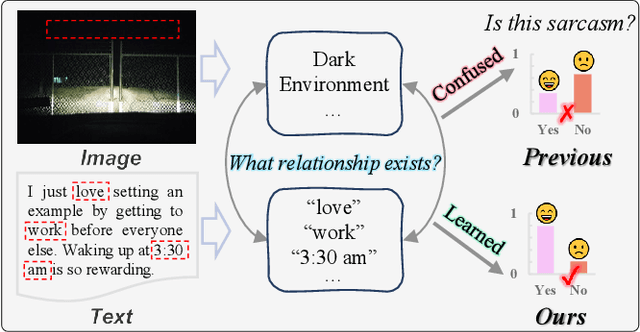
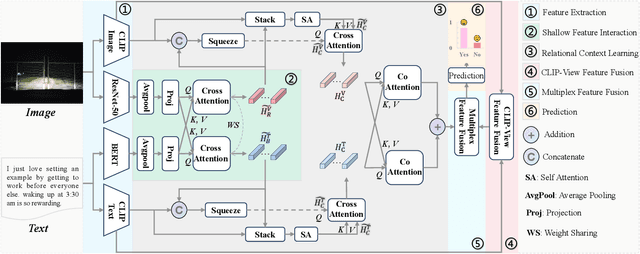
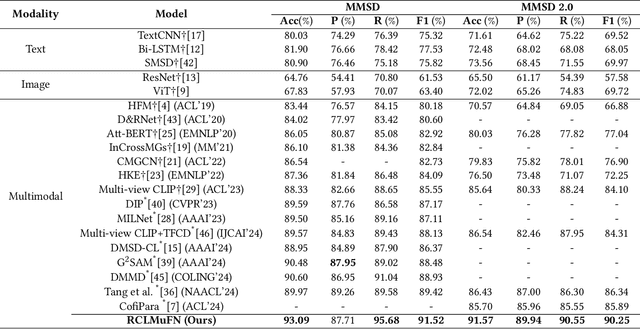
Sarcasm typically conveys emotions of contempt or criticism by expressing a meaning that is contrary to the speaker's true intent. Accurate detection of sarcasm aids in identifying and filtering undesirable information on the Internet, thereby reducing malicious defamation and rumor-mongering. Nonetheless, the task of automatic sarcasm detection remains highly challenging for machines, as it critically depends on intricate factors such as relational context. Most existing multimodal sarcasm detection methods focus on introducing graph structures to establish entity relationships between text and images while neglecting to learn the relational context between text and images, which is crucial evidence for understanding the meaning of sarcasm. In addition, the meaning of sarcasm changes with the evolution of different contexts, but existing methods may not be accurate in modeling such dynamic changes, limiting the generalization ability of the models. To address the above issues, we propose a relational context learning and multiplex fusion network (RCLMuFN) for multimodal sarcasm detection. Firstly, we employ four feature extractors to comprehensively extract features from raw text and images, aiming to excavate potential features that may have been previously overlooked. Secondly, we utilize the relational context learning module to learn the contextual information of text and images and capture the dynamic properties through shallow and deep interactions. Finally, we employ a multiplex feature fusion module to enhance the generalization of the model by penetratingly integrating multimodal features derived from various interaction contexts. Extensive experiments on two multimodal sarcasm detection datasets show that our proposed method achieves state-of-the-art performance.