 Add to Chrome
 Add to Firefox
 Add to Edge
Generative Adversarial Reconstruction with Adaptive Thresholding for Obstructed Targets in Computational Microwave Imaging
Aug 02, 2026
In this work, an end-to-end generative adversarial framework for computational microwave imaging (CMI) is proposed to reconstruct the targets of interest directly from the measurements of targets obstructed by undesired objects. It integrates a conditional generative adversarial network (cGAN) with a learnable soft-threshold module (STM) to adaptively suppress non-target related information. The proposed framework is evaluated on a diverse dataset comprising MNIST digits obstructed by E-MNIST letters for training and testing, as well as on measurements acquired with an experimental CMI system. In addition, further studies involving objects with different geometries are conducted, demonstrating that the proposed approach can be adapted to other types of objects. Numerical experiments show that the proposed cGAN-STM achieves a normalized mean square error (NMSE) of 0.066 and a structural similarity index (SSIM) of 0.876 under ideal conditions. Comprehensive analyses, including benchmarking, analysis of the STM mechanism, and evaluation under different obstruction sizes, are also conducted. The performance of the model under different signal-to-noise ratio (SNR) scenarios is also evaluated, achieving reasonable reconstruction quality at 15 dB SNR with an NMSE of 0.168 and an SSIM of 0.700. Even at low SNR levels, recognizable target outlines are preserved. These results highlight the effectiveness and adaptability of the proposed method.

Holographic Metasurfaces Enabling Wave Computing for 6G: Status Overview, Challenges, and Future Research Trends
Jan 09, 2025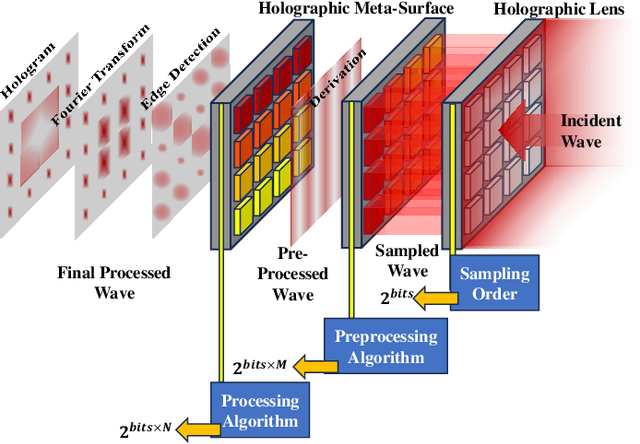
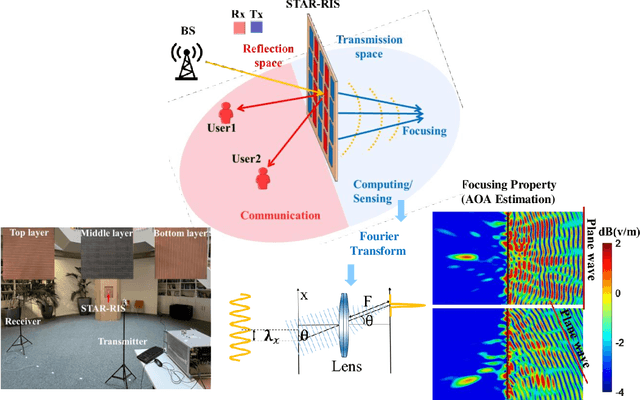
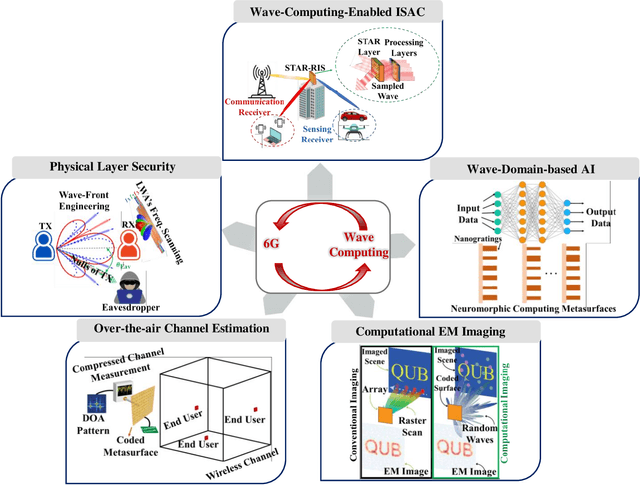
Recent advancements in wave computing using metasurfaces are poised to transform wireless communications by enabling high-speed, energy-efficient, and highly parallelized signal processing. These capabilities are essential to meet the ultra-high data rates of up to 1 terabit per second and minimal latency as low as 1 millisecond required by next-generation wireless networks. Diverging from traditional digital processing, wave computing adopts continuous analog signals to foster innovative functions such as over-the-air computation, integrated sensing and communications, computational electromagnetic imaging, and physical-layer security. This article explores the potential of reconfigurable multi-functional metasurfaces in wave computing, emphasizing their pivotal role in facilitating seamless communications and addressing the escalating computational demands for sixth generation (6G) networks. As artificial intelligence has become one of the most prominent and rapidly advancing fields of research over the last decade, we also introduce a wave-domain-based machine learning approach aimed at achieving power-efficient, fast training and computation. Future research directions are discussed, underscoring how metasurface-based systems can merge computation with communication to innovate components of 6G networks, thus creating smarter, faster, and more adaptable wireless infrastructures.