 Add to Chrome
 Add to Firefox
 Add to Edge
Workflow-GYM: Towards Long-Horizon Evaluation of Computer-use Agentic tasks in Real-World Professional Fields
Jun 09, 2026
Recent years have witnessed the rapid evolution of AI agents toward handling increasingly complex, real-world tasks. However, existing benchmarks rarely evaluate whether agents can operate graphical user interfaces to complete long-horizon, high-value professional workflows across diverse domains. Current GUI benchmarks still predominantly focus on general-purpose software, relatively simple applications, and short-horizon tasks, leaving it largely unknown whether modern agents can follow user instructions to autonomously operate domain-specific professional software and accomplish economically valuable work in an end-to-end manner. To bridge this gap, we introduce Workflow-GYM, a benchmark for long-horizon GUI tasks centered on professional domains and specialized software environments. Through extensive experiments on state-of-the-art models, we find that even the strongest models achieve only slightly above 30% success rates, highlighting that professional long-horizon GUI workflows remain highly challenging for current GUI agents. Further analysis reveals that current agents struggle to maintain long-horizon workflow consistency, frequently exhibiting workflow stage omission, error propagation, objective drift, and insufficient understanding of professional software environments. Our findings provide important insights into the limitations of current agent systems and suggest key directions for the next generation of GUI-agent research.

A Comprehensive Study on Learning-Based PE Malware Family Classification Methods
Oct 29, 2021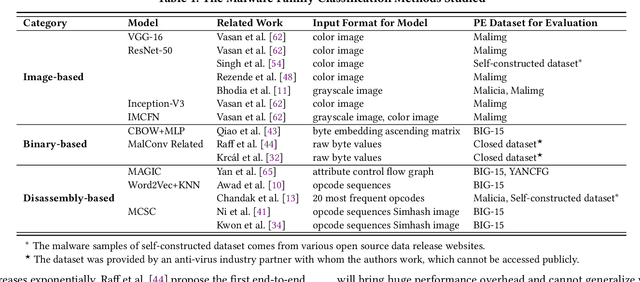
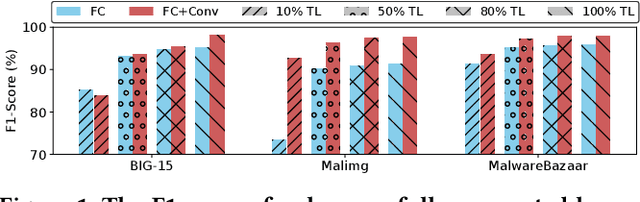
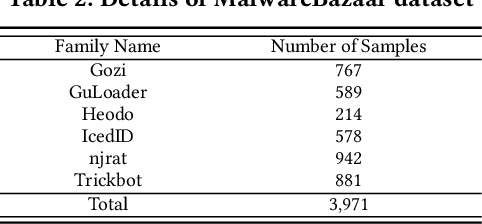
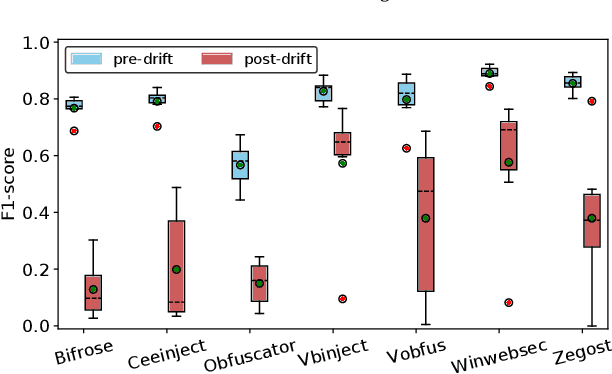
Driven by the high profit, Portable Executable (PE) malware has been consistently evolving in terms of both volume and sophistication. PE malware family classification has gained great attention and a large number of approaches have been proposed. With the rapid development of machine learning techniques and the exciting results they achieved on various tasks, machine learning algorithms have also gained popularity in the PE malware family classification task. Three mainstream approaches that use learning based algorithms, as categorized by the input format the methods take, are image-based, binary-based and disassembly-based approaches. Although a large number of approaches are published, there is no consistent comparisons on those approaches, especially from the practical industry adoption perspective. Moreover, there is no comparison in the scenario of concept drift, which is a fact for the malware classification task due to the fast evolving nature of malware. In this work, we conduct a thorough empirical study on learning-based PE malware classification approaches on 4 different datasets and consistent experiment settings. Based on the experiment results and an interview with our industry partners, we find that (1) there is no individual class of methods that significantly outperforms the others; (2) All classes of methods show performance degradation on concept drift (by an average F1-score of 32.23%); and (3) the prediction time and high memory consumption hinder existing approaches from being adopted for industry usage.