 Add to Chrome
 Add to Firefox
 Add to Edge
Self-Supervised Topologically Invariant Manifold Learning for Railway Image Quality Assessment
Aug 15, 2026
Existing blind image quality assessment (BIQA) methods typically rely on synthetic distortions and subjective annotations, limiting generalization in real-world domains. To address this, we propose a fully self-supervised BIQA framework based on topologically invariant manifold learning under boundary constraints, which constructs a stable quality reference without manual labels. The framework generates progressive background dilution scales via repeated random cropping around each target; exploiting the monotonic degradation of target information density across these scales, it establishes a self-constrained quality manifold. A linearized spatial moment projection eliminates geometric distortions from random cropping; then a monotonicity divergence filter prunes background-sensitive evaluators, isolating an elite pool \(\mathcal{M}_{\text{elite}}\). A robust M-estimator with a principal component stabilizer fuses the metrics into an asymptotically efficient pseudo-ground truth \(q_{\text{PGT}}\), contracting variance toward the Cramér-Rao lower bound. Extensive evaluations demonstrate that the elite evaluator pool, distilled from 11 baseline metrics, secures superior zero-shot transferability across standard synthetic and wild benchmarks (CSIQ, LIVEC, LIVE-2). Concurrently, deployments on the CQU Railway Rolling Stock Surveillance Dataset (2,797 images) yield a manifold cosine similarity \(>0.999\) and a 100.0\% survival rate under industrial extreme stresses, robustly validating its cross-paradigm decoupling and topological resilience.

A hybrid evolutionary algorithm with importance sampling for multi-dimensional optimization
Aug 23, 2013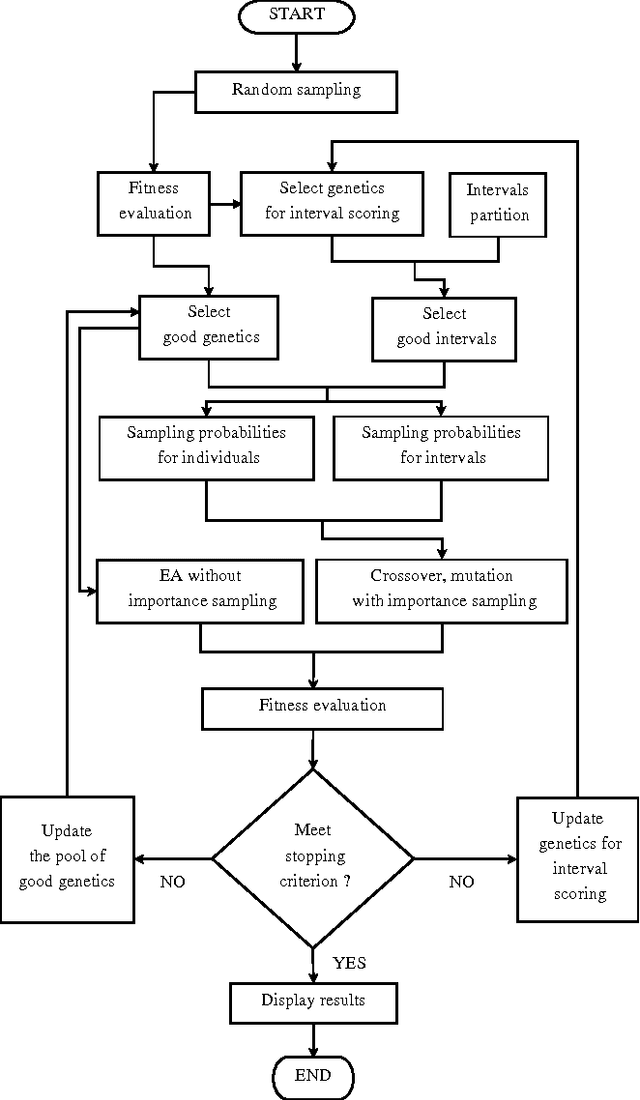
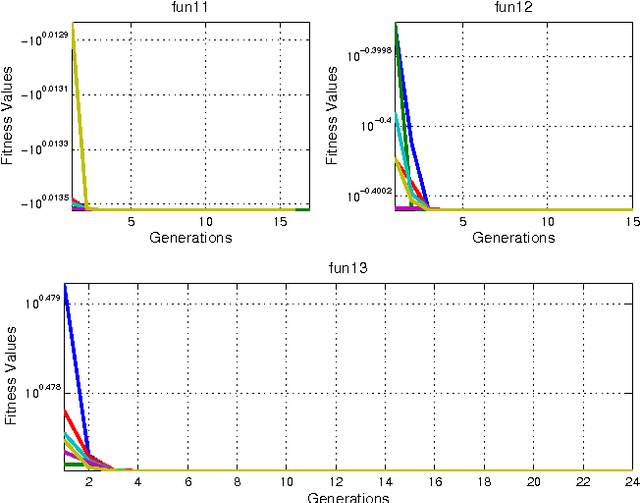
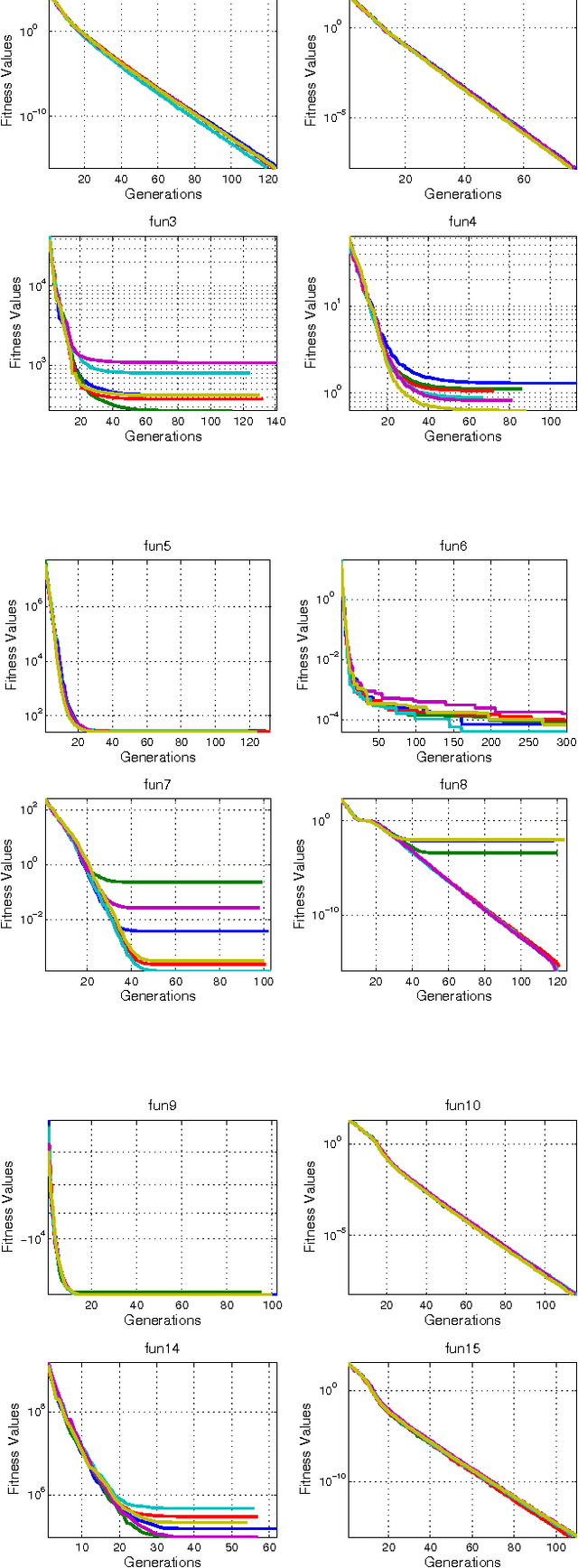
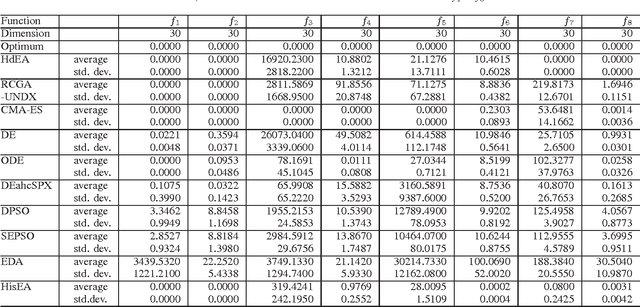
A hybrid evolutionary algorithm with importance sampling method is proposed for multi-dimensional optimization problems in this paper. In order to make use of the information provided in the search process, a set of visited solutions is selected to give scores for intervals in each dimension, and they are updated as algorithm proceeds. Those intervals with higher scores are regarded as good intervals, which are used to estimate the joint distribution of optimal solutions through an interaction between the pool of good genetics, which are the individuals with smaller fitness values. And the sampling probabilities for good genetics are determined through an interaction between those estimated good intervals. It is a cross validation mechanism which determines the sampling probabilities for good intervals and genetics, and the resulted probabilities are used to design crossover, mutation and other stochastic operators with importance sampling method. As the selection of genetics and intervals is not directly dependent on the values of fitness, the resulted offsprings may avoid the trap of local optima. And a purely random EA is also combined into the proposed algorithm to maintain the diversity of population. 30 benchmark test functions are used to evaluate the performance of the proposed algorithm, and it is found that the proposed hybrid algorithm is an efficient algorithm for multi-dimensional optimization problems considered in this paper.