 Add to Chrome
 Add to Firefox
 Add to Edge
Compiled AI: Deterministic Code Generation for LLM-Based Workflow Automation
Apr 06, 2026
We study compiled AI, a paradigm in which large language models generate executable code artifacts during a compilation phase, after which workflows execute deterministically without further model invocation. This paradigm has antecedents in prior work on declarative pipeline optimization (DSPy) and hybrid neural-symbolic planning (LLM+P); our contribution is a systems-oriented study of its application to high-stakes enterprise workflows, with particular emphasis on healthcare settings where reliability and auditability are critical. By constraining generation to narrow business-logic functions embedded in validated templates, compiled AI trades runtime flexibility for predictability, auditability, cost efficiency, and reduced security exposure. We introduce (i) a system architecture for constrained LLM-based code generation, (ii) a four-stage generation-and-validation pipeline that converts probabilistic model output into production-ready code artifacts, and (iii) an evaluation framework measuring operational metrics including token amortization, determinism, reliability, security, and cost. We evaluate on two task types: function-calling (BFCL, n=400) and document intelligence (DocILE, n=5,680 invoices). On function-calling, compiled AI achieves 96% task completion with zero execution tokens, breaking even with runtime inference at approximately 17 transactions and reducing token consumption by 57x at 1,000 transactions. On document intelligence, our Code Factory variant matches Direct LLM on key field extraction (KILE: 80.0%) while achieving the highest line item recognition accuracy (LIR: 80.4%). Security evaluation across 135 test cases demonstrates 96.7% accuracy on prompt injection detection and 87.5% on static code safety analysis with zero false positives.

A General-purpose AI Avatar in Healthcare
Jan 10, 2024Recent advancements in machine learning and natural language processing have led to the rapid development of artificial intelligence (AI) as a valuable tool in the healthcare industry. Using large language models (LLMs) as conversational agents or chatbots has the potential to assist doctors in diagnosing patients, detecting early symptoms of diseases, and providing health advice to patients. This paper focuses on the role of chatbots in healthcare and explores the use of avatars to make AI interactions more appealing to patients. A framework of a general-purpose AI avatar application is demonstrated by using a three-category prompt dictionary and prompt improvement mechanism. A two-phase approach is suggested to fine-tune a general-purpose AI language model and create different AI avatars to discuss medical issues with users. Prompt engineering enhances the chatbot's conversational abilities and personality traits, fostering a more human-like interaction with patients. Ultimately, the injection of personality into the chatbot could potentially increase patient engagement. Future directions for research include investigating ways to improve chatbots' understanding of context and ensuring the accuracy of their outputs through fine-tuning with specialized medical data sets.
Transfer Learning Based Multi-Objective Genetic Algorithm for Dynamic Community Detection
Oct 09, 2021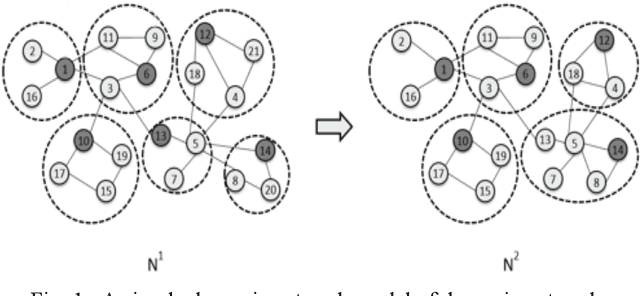

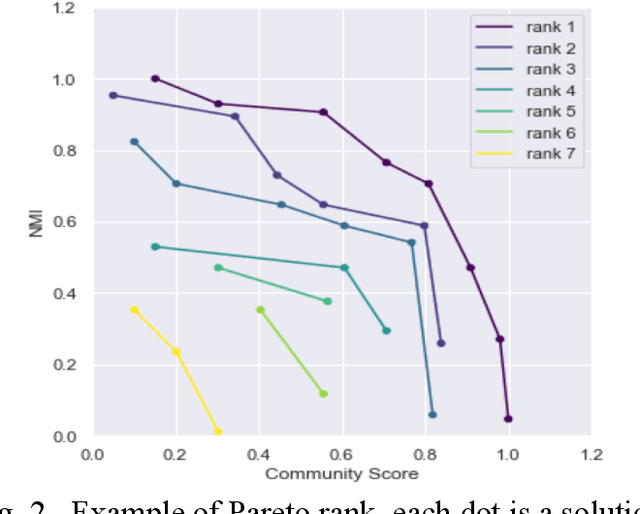
Dynamic community detection is the hotspot and basic problem of complex network and artificial intelligence research in recent years. It is necessary to maximize the accuracy of clustering as the network structure changes, but also to minimize the two consecutive clustering differences between the two results. There is a trade-off relationship between these two objectives. In this paper, we propose a Feature Transfer Based Multi-Objective Optimization Genetic Algorithm (TMOGA) based on transfer learning and traditional multi-objective evolutionary algorithm framework. The main idea is to extract stable features from past community structures, retain valuable feature information, and integrate this feature information into current optimization processes to improve the evolutionary algorithms. Additionally, a new theoretical framework is proposed in this paper to analyze community detection problem based on information theory. Then, we exploit this framework to prove the rationality of TMOGA. Finally, the experimental results show that our algorithm can achieve better clustering effects compared with the state-of-the-art dynamic network community detection algorithms in diverse test problems.