 Add to Chrome
 Add to Firefox
 Add to Edge
Motif 3: Technical Report
Aug 10, 2026
We introduce Motif 3, a decoder-only Mixture-of-Experts language model with 314 billion total parameters and 13.2 billion activated per token. Each sparse MoE layer contains 384 routed experts, with eight selected per token. This fine-grained sparsity provides substantial expert capacity while limiting computation. Motif 3 is built around Grouped Differential Latent Attention (GDLA), which integrates grouped differential attention with the compressed key-value representation of Multi-head Latent Attention. The architecture further incorporates modified manifold-constrained hyper-connections, Expert Specific PolyNorm activations, and multi-token prediction to improve optimization stability, expert specialization, and inference efficiency. We pretrain Motif 3 on approximately 12.5 trillion tokens spanning web documents, STEM, code, mathematics, multilingual content, and domain-specialized corpora. Expert-balancing and numerical-stabilization techniques support stable training at scale, while selective MXFP8 computation and communication, memory-efficient fused kernels, and window-aware context parallelism enable training with context lengths up to 256K tokens. Our post-training pipeline combines general supervised fine-tuning, six specialist teachers trained with reinforcement learning, a software-engineering teacher trained with supervised fine-tuning, and Multi-teacher On-Policy Distillation. The resulting unified model consolidates complementary capabilities in reasoning, coding, tool use, professional work, long-context understanding, calibrated abstention, and instruction following. Across a broad evaluation suite, Motif 3 demonstrates competitive performance against leading open weight models, including strong results on long-horizon agentic tasks, mathematical reasoning, scientific knowledge, and hallucination-sensitive evaluation.

Exploring the Capabilities of LLM Encoders for Image-Text Retrieval in Chest X-rays
Sep 17, 2025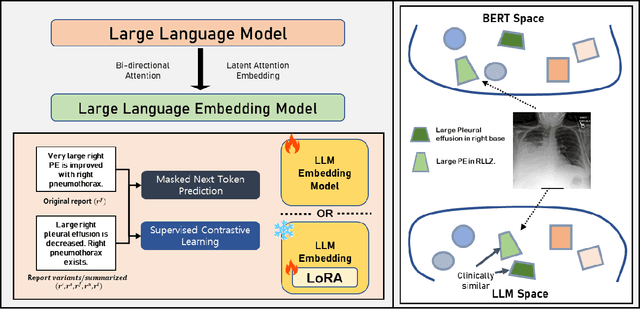
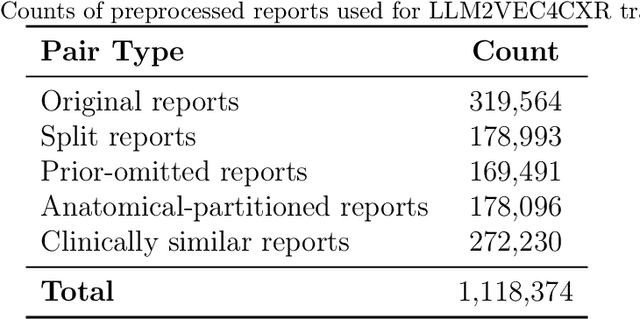
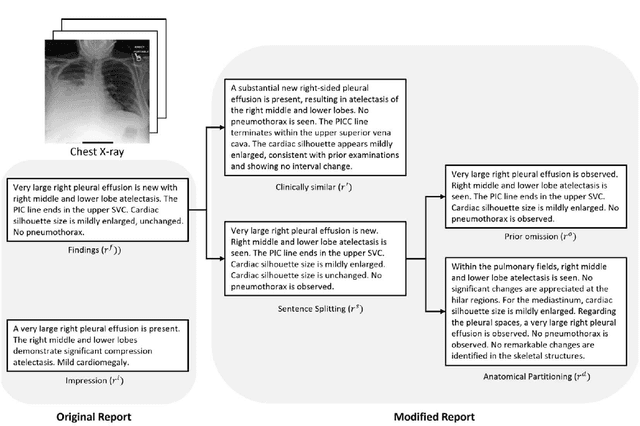
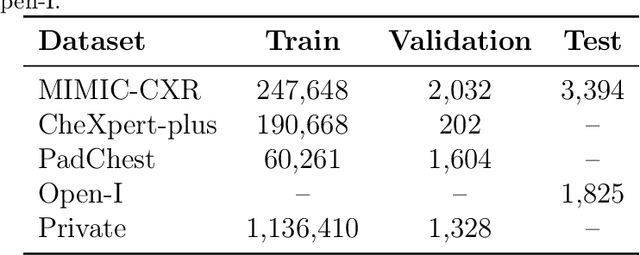
Vision-language pretraining has advanced image-text alignment, yet progress in radiology remains constrained by the heterogeneity of clinical reports, including abbreviations, impression-only notes, and stylistic variability. Unlike general-domain settings where more data often leads to better performance, naively scaling to large collections of noisy reports can plateau or even degrade model learning. We ask whether large language model (LLM) encoders can provide robust clinical representations that transfer across diverse styles and better guide image-text alignment. We introduce LLM2VEC4CXR, a domain-adapted LLM encoder for chest X-ray reports, and LLM2CLIP4CXR, a dual-tower framework that couples this encoder with a vision backbone. LLM2VEC4CXR improves clinical text understanding over BERT-based baselines, handles abbreviations and style variation, and achieves strong clinical alignment on report-level metrics. LLM2CLIP4CXR leverages these embeddings to boost retrieval accuracy and clinically oriented scores, with stronger cross-dataset generalization than prior medical CLIP variants. Trained on 1.6M CXR studies from public and private sources with heterogeneous and noisy reports, our models demonstrate that robustness -- not scale alone -- is the key to effective multimodal learning. We release models to support further research in medical image-text representation learning.