 Add to Chrome
 Add to Firefox
 Add to Edge
Temporal Inversion for Learning Interval Change in Chest X-Rays
Apr 06, 2026
Recent advances in vision--language pretraining have enabled strong medical foundation models, yet most analyze radiographs in isolation, overlooking the key clinical task of comparing prior and current images to assess interval change. For chest radiographs (CXRs), capturing interval change is essential, as radiologists must evaluate not only the static appearance of findings but also how they evolve over time. We introduce TILA (Temporal Inversion-aware Learning and Alignment), a simple yet effective framework that uses temporal inversion, reversing image pairs, as a supervisory signal to enhance the sensitivity of existing temporal vision-language models to directional change. TILA integrates inversion-aware objectives across pretraining, fine-tuning, and inference, complementing conventional appearance modeling with explicit learning of temporal order. We also propose a unified evaluation protocol to assess order sensitivity and consistency under temporal inversion, and introduce MS-CXR-Tretrieval, a retrieval evaluation set constructed through a general protocol that can be applied to any temporal CXR dataset. Experiments on public datasets and real-world hospital cohorts demonstrate that TILA consistently improves progression classification and temporal embedding alignment when applied to multiple existing architectures.

Exploring the Capabilities of LLM Encoders for Image-Text Retrieval in Chest X-rays
Sep 17, 2025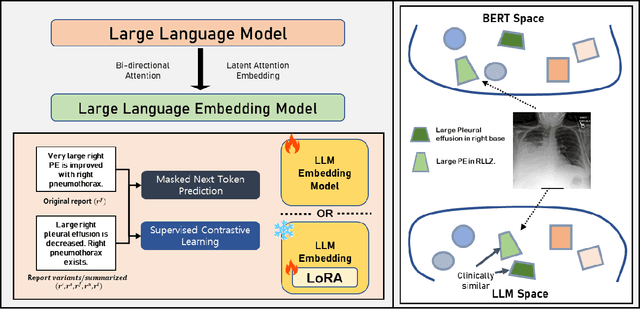
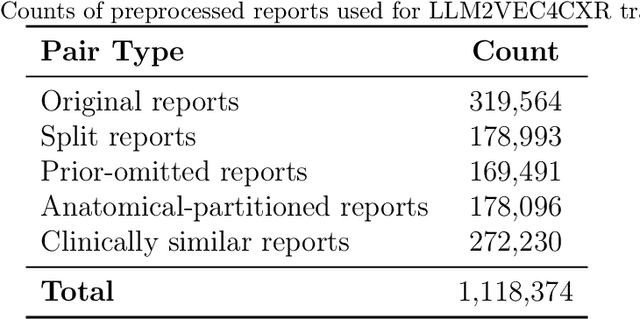
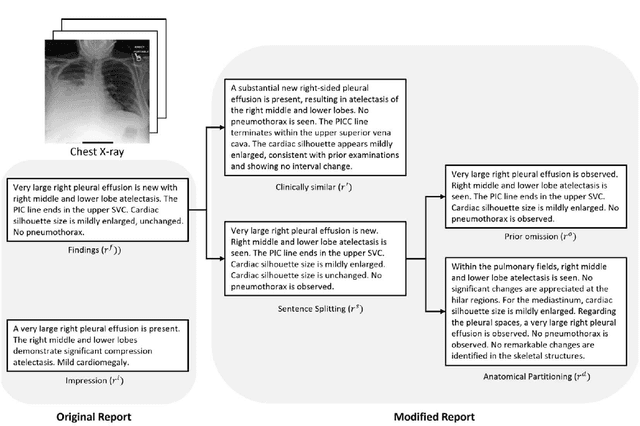
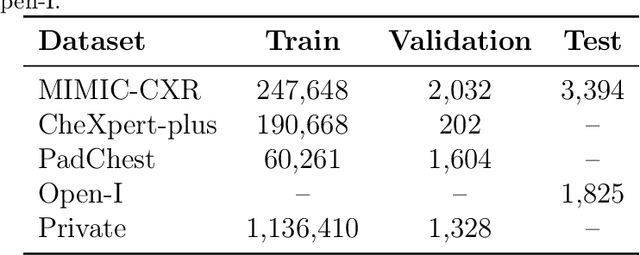
Vision-language pretraining has advanced image-text alignment, yet progress in radiology remains constrained by the heterogeneity of clinical reports, including abbreviations, impression-only notes, and stylistic variability. Unlike general-domain settings where more data often leads to better performance, naively scaling to large collections of noisy reports can plateau or even degrade model learning. We ask whether large language model (LLM) encoders can provide robust clinical representations that transfer across diverse styles and better guide image-text alignment. We introduce LLM2VEC4CXR, a domain-adapted LLM encoder for chest X-ray reports, and LLM2CLIP4CXR, a dual-tower framework that couples this encoder with a vision backbone. LLM2VEC4CXR improves clinical text understanding over BERT-based baselines, handles abbreviations and style variation, and achieves strong clinical alignment on report-level metrics. LLM2CLIP4CXR leverages these embeddings to boost retrieval accuracy and clinically oriented scores, with stronger cross-dataset generalization than prior medical CLIP variants. Trained on 1.6M CXR studies from public and private sources with heterogeneous and noisy reports, our models demonstrate that robustness -- not scale alone -- is the key to effective multimodal learning. We release models to support further research in medical image-text representation learning.
Bringing CLIP to the Clinic: Dynamic Soft Labels and Negation-Aware Learning for Medical Analysis
May 28, 2025The development of large-scale image-text pair datasets has significantly advanced self-supervised learning in Vision-Language Processing (VLP). However, directly applying general-domain architectures such as CLIP to medical data presents challenges, particularly in handling negations and addressing the inherent data imbalance of medical datasets. To address these issues, we propose a novel approach that integrates clinically-enhanced dynamic soft labels and medical graphical alignment, thereby improving clinical comprehension and the applicability of contrastive loss in medical contexts. Furthermore, we introduce negation-based hard negatives to deepen the model's understanding of the complexities of clinical language. Our approach is easily integrated into the medical CLIP training pipeline and achieves state-of-the-art performance across multiple tasks, including zero-shot, fine-tuned classification, and report retrieval. To comprehensively evaluate our model's capacity for understanding clinical language, we introduce CXR-Align, a benchmark uniquely designed to evaluate the understanding of negation and clinical information within chest X-ray (CXR) datasets. Experimental results demonstrate that our proposed methods are straightforward to implement and generalize effectively across contrastive learning frameworks, enhancing medical VLP capabilities and advancing clinical language understanding in medical imaging.