 Add to Chrome
 Add to Firefox
 Add to Edge
ANCHOR-RE: An Agentic Neuro-Symbolic Framework for Grounded Biomedical Relation Extraction
Aug 04, 2026
Biomedical relation extraction (BioRE) extracts structured knowledge from biomedical literature for applications such as knowledge base construction and hypothesis generation. Traditional symbolic systems such as SemRep provide high precision but limited recall, while large language models (LLMs) offer stronger contextual reasoning but remain prone to false-positive predictions. We developed ANCHOR-RE, a framework that integrates ontology-guided reasoning, external knowledge grounding, and data-driven verification rules into LLM inference. We evaluated it on three BioRE benchmarks (SemRepGS, DDI, and ChemProt) using both proprietary and open-weight LLMs. To assess generalizability beyond benchmark datasets while reducing potential evaluation bias from LLM pretraining contamination, we conducted a temporal evaluation using 100 biomedical articles published in 2026. With the proprietary backbone, ANCHOR-RE outperformed direct LLM prompting, improving micro-F1 from 0.654 to 0.676 on SemRepGS, from 0.769 to 0.872 on DDI, and from 0.939 to 0.941 on ChemProt. On DDI and ChemProt, it also outperformed previously reported inference-only methods and approached fine-tuned or instruction-tuned systems without parameter updates. Similar performance gains observed with open-weight LLMs indicate that the benefits were not limited to the proprietary backbone. On the post-cutoff set, manual assessment of 500 randomly sampled predictions yielded a precision of 69%, maintaining consistent precision on previously unseen biomedical literature. Neuro-symbolic reasoning can improve the reliability of LLM-based BioRE without fine-tuning. Results across multiple benchmarks, model families, and post-cutoff literature support ANCHOR-RE as a practical training-free approach to biomedical literature mining.

DiMB-RE: Mining the Scientific Literature for Diet-Microbiome Associations
Sep 29, 2024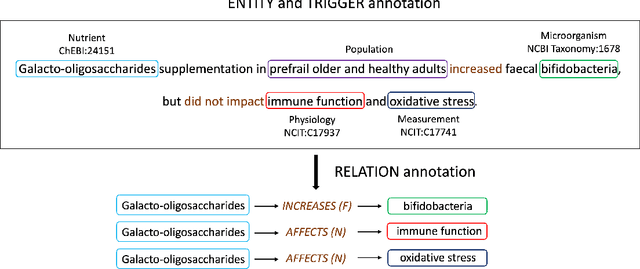
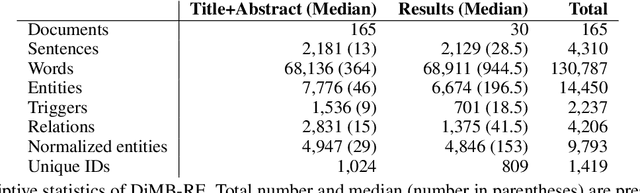
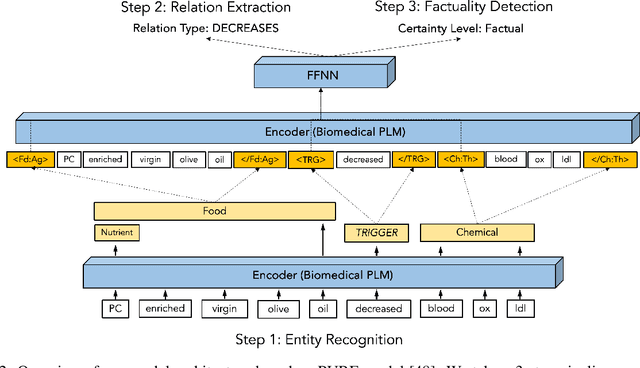
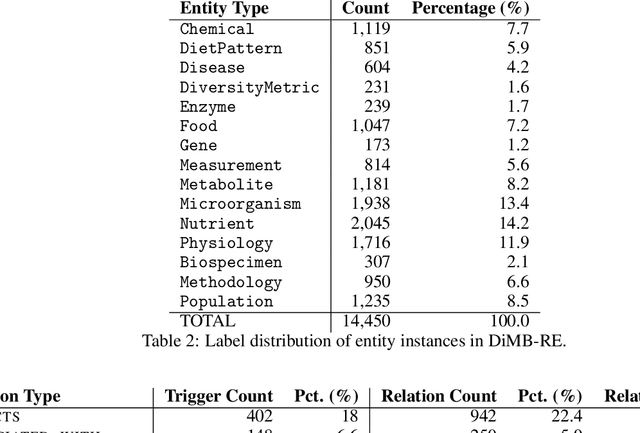
Motivation: The gut microbiota has recently emerged as a key factor that underpins certain connections between diet and human health. A tremendous amount of knowledge has been amassed from experimental studies on diet, human metabolism and microbiome. However, this evidence remains mostly buried in scientific publications, and biomedical literature mining in this domain remains scarce. We developed DiMB-RE, a comprehensive corpus annotated with 15 entity types (e.g., Nutrient, Microorganism) and 13 relation types (e.g., increases, improves) capturing diet-microbiome associations. We also trained and evaluated state-of-the-art natural language processing (NLP) models for named entity, trigger, and relation extraction as well as factuality detection using DiMB-RE. Results: DiMB-RE consists of 14,450 entities and 4,206 relationships from 165 articles. While NLP models performed reasonably well for named entity recognition (0.760 F$_{1}$), end-to-end relation extraction performance was modest (0.356 F$_{1}$), partly due to missed entities and triggers as well as cross-sentence relations. Conclusions: To our knowledge, DiMB-RE is largest and most diverse dataset focusing on diet-microbiome interactions. It can serve as a benchmark corpus for biomedical literature mining. Availability: DiMB-RE and the NLP models are available at https://github.com/ScienceNLP-Lab/DiMB-RE.