 Add to Chrome
 Add to Firefox
 Add to Edge
NEST3D: A High-Resolution Multimodal Dataset of Sociable Weaver Tree Nests
Jun 12, 2026
Sociable weaver nests function as complex ecological structures offering thermoregulatory microhabitats and sustaining diverse species; however, datasets used in prior studies lack fine-grained 3D structural detail. Producing usable and accurate 3D weaver nest data is challenging due to their irregular geometry and integration with complex host vegetation. We bridge this gap with an open-access, 1.4 TB multimodal drone dataset of 104 nest-bearing trees, comprising 27,945 RGB images, 111,780 multispectral images, approximately 781 million 3D points, and expert-annotated semantic segmentation labels. We benchmark semantic segmentation using KPConv, RandLA-Net, and Point Transformer V3, with PT-v3 achieving an mIoU of 86.35% on the test set. While the results demonstrate strong performance for transformer-based and point-wise methods, they also highlight architecture-dependent challenges, particularly for convolution-based approaches such as KPConv. By uniquely combining spectral, spatial, and structural information, the presented dataset advances 3D reconstruction, segmentation, and classification algorithms, enabling ecological applications from nest volume estimation to species conservation, and serves as a demanding benchmark that exposes architecture-dependent performance under extreme class imbalance.

POLO -- Point-based, multi-class animal detection
Oct 15, 2024

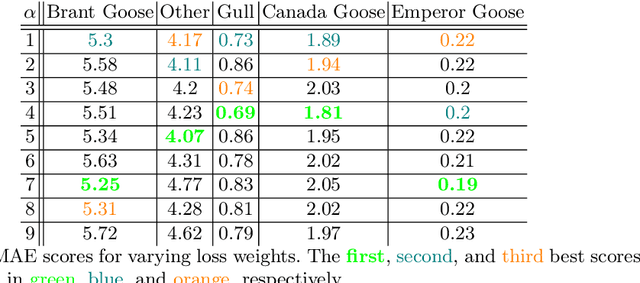

Automated wildlife surveys based on drone imagery and object detection technology are a powerful and increasingly popular tool in conservation biology. Most detectors require training images with annotated bounding boxes, which are tedious, expensive, and not always unambiguous to create. To reduce the annotation load associated with this practice, we develop POLO, a multi-class object detection model that can be trained entirely on point labels. POLO is based on simple, yet effective modifications to the YOLOv8 architecture, including alterations to the prediction process, training losses, and post-processing. We test POLO on drone recordings of waterfowl containing up to multiple thousands of individual birds in one image and compare it to a regular YOLOv8. Our experiments show that at the same annotation cost, POLO achieves improved accuracy in counting animals in aerial imagery.