 Add to Chrome
 Add to Firefox
 Add to Edge
EmeraldMind: A Knowledge Graph-Augmented Framework for Greenwashing Detection
Dec 15, 2025
As AI and web agents become pervasive in decision-making, it is critical to design intelligent systems that not only support sustainability efforts but also guard against misinformation. Greenwashing, i.e., misleading corporate sustainability claims, poses a major challenge to environmental progress. To address this challenge, we introduce EmeraldMind, a fact-centric framework integrating a domain-specific knowledge graph with retrieval-augmented generation to automate greenwashing detection. EmeraldMind builds the EmeraldGraph from diverse corporate ESG (environmental, social, and governance) reports, surfacing verifiable evidence, often missing in generic knowledge bases, and supporting large language models in claim assessment. The framework delivers justification-centric classifications, presenting transparent, evidence-backed verdicts and abstaining responsibly when claims cannot be verified. Experiments on a new greenwashing claims dataset demonstrate that EmeraldMind achieves competitive accuracy, greater coverage, and superior explanation quality compared to generic LLMs, without the need for fine-tuning or retraining.

Auditing for Spatial Fairness
Feb 23, 2023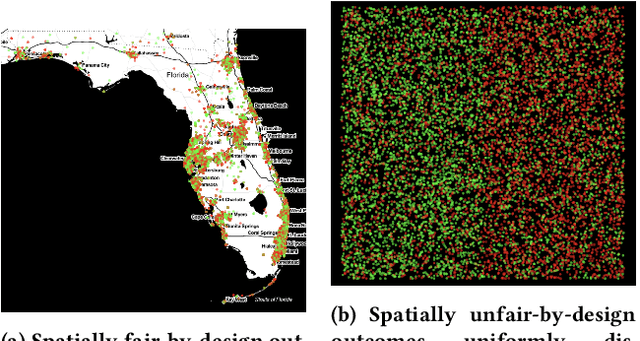
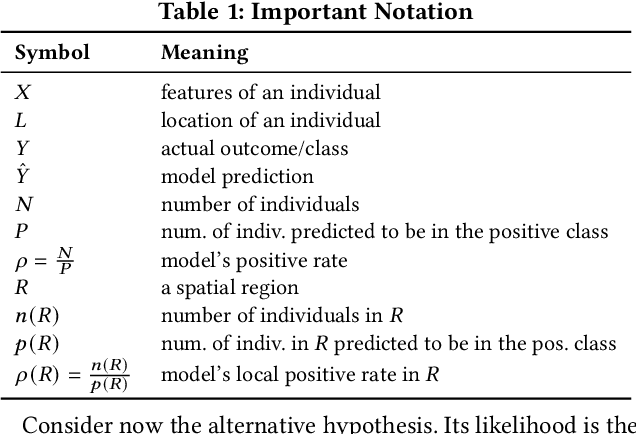
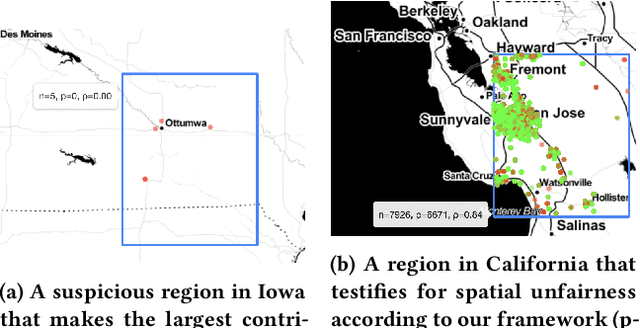

This paper studies algorithmic fairness when the protected attribute is location. To handle protected attributes that are continuous, such as age or income, the standard approach is to discretize the domain into predefined groups, and compare algorithmic outcomes across groups. However, applying this idea to location raises concerns of gerrymandering and may introduce statistical bias. Prior work addresses these concerns but only for regularly spaced locations, while raising other issues, most notably its inability to discern regions that are likely to exhibit spatial unfairness. Similar to established notions of algorithmic fairness, we define spatial fairness as the statistical independence of outcomes from location. This translates into requiring that for each region of space, the distribution of outcomes is identical inside and outside the region. To allow for localized discrepancies in the distribution of outcomes, we compare how well two competing hypotheses explain the observed outcomes. The null hypothesis assumes spatial fairness, while the alternate allows different distributions inside and outside regions. Their goodness of fit is then assessed by a likelihood ratio test. If there is no significant difference in how well the two hypotheses explain the observed outcomes, we conclude that the algorithm is spatially fair.
Data-driven soiling detection in PV modules
Jan 30, 2023

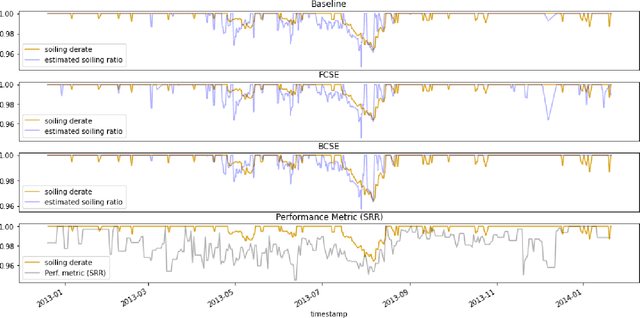

Soiling is the accumulation of dirt in solar panels which leads to a decreasing trend in solar energy yield and may be the cause of vast revenue losses. The effect of soiling can be reduced by washing the panels, which is, however, a procedure of non-negligible cost. Moreover, soiling monitoring systems are often unreliable or very costly. We study the problem of estimating the soiling ratio in photo-voltaic (PV) modules, i.e., the ratio of the real power output to the power output that would be produced if solar panels were clean. A key advantage of our algorithms is that they estimate soiling, without needing to train on labelled data, i.e., periods of explicitly monitoring the soiling in each park, and without relying on generic analytical formulas which do not take into account the peculiarities of each installation. We consider as input a time series comprising a minimum set of measurements, that are available to most PV park operators. Our experimental evaluation shows that we significantly outperform current state-of-the-art methods for estimating soiling ratio.