 Add to Chrome
 Add to Firefox
 Add to Edge
Like a Hammer, It Can Build, It Can Break: Large Language Model Uses, Perceptions, and Adoption in Cybersecurity Operations on Reddit
Apr 11, 2026
Large language models (LLMs) have recently emerged as promising tools for augmenting Security Operations Center (SOC) workflows, with vendors increasingly marketing autonomous AI solutions for SOCs. However, there remains a limited empirical understanding of how such tools are used, perceived, and adopted by real-world security practitioners. To address this gap, we conduct a mixed-methods analysis of discussions in cybersecurity-focused forums to learn how a diverse group of practitioners use and perceive modern LLM tools for security operations. More specifically, we analyzed 892 posts between December 2022 and September 2025 from three cybersecurity-focused forums on Reddit, and, using a combination of qualitative coding and statistical analysis, examined how security practitioners discuss LLM tools across three dimensions: (1) their stated tools and use cases, (2) the perceived pros and cons of each tool across a set of critical factors, and (3) their adoption of such tools and the expected impacts on the cybersecurity industry and individual analysts. Overall, our findings reveal nuanced patterns in LLM tools adoption, highlighting independent use of LLMs for low-risk, productivity-oriented tasks, alongside active interest around enterprise-grade, security-focused LLM platforms. Although practitioners report meaningful gains in efficiency and effectiveness in LLM-assisted workflows, persistent issues with reliability, verification overheads, and security risks sharply constrain the autonomy granted to LLM tools. Based on these results, we also provide recommendations for developing and adopting LLM tools to ensure the security of organizations and the safety of cybersecurity practitioners.

Moving Target Defense for Web Applications using Bayesian Stackelberg Games
Nov 17, 2016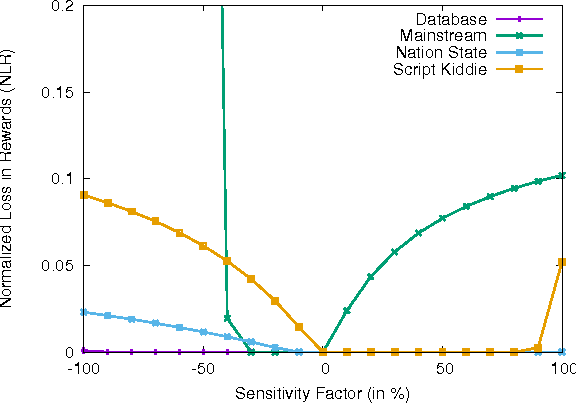
The present complexity in designing web applications makes software security a difficult goal to achieve. An attacker can explore a deployed service on the web and attack at his/her own leisure. Moving Target Defense (MTD) in web applications is an effective mechanism to nullify this advantage of their reconnaissance but the framework demands a good switching strategy when switching between multiple configurations for its web-stack. To address this issue, we propose modeling of a real-world MTD web application as a repeated Bayesian game. We then formulate an optimization problem that generates an effective switching strategy while considering the cost of switching between different web-stack configurations. To incorporate this model into a developed MTD system, we develop an automated system for generating attack sets of Common Vulnerabilities and Exposures (CVEs) for input attacker types with predefined capabilities. Our framework obtains realistic reward values for the players (defenders and attackers) in this game by using security domain expertise on CVEs obtained from the National Vulnerability Database (NVD). We also address the issue of prioritizing vulnerabilities that when fixed, improves the security of the MTD system. Lastly, we demonstrate the robustness of our proposed model by evaluating its performance when there is uncertainty about input attacker information.