 Add to Chrome
 Add to Firefox
 Add to Edge
Like a Hammer, It Can Build, It Can Break: Large Language Model Uses, Perceptions, and Adoption in Cybersecurity Operations on Reddit
Apr 11, 2026
Large language models (LLMs) have recently emerged as promising tools for augmenting Security Operations Center (SOC) workflows, with vendors increasingly marketing autonomous AI solutions for SOCs. However, there remains a limited empirical understanding of how such tools are used, perceived, and adopted by real-world security practitioners. To address this gap, we conduct a mixed-methods analysis of discussions in cybersecurity-focused forums to learn how a diverse group of practitioners use and perceive modern LLM tools for security operations. More specifically, we analyzed 892 posts between December 2022 and September 2025 from three cybersecurity-focused forums on Reddit, and, using a combination of qualitative coding and statistical analysis, examined how security practitioners discuss LLM tools across three dimensions: (1) their stated tools and use cases, (2) the perceived pros and cons of each tool across a set of critical factors, and (3) their adoption of such tools and the expected impacts on the cybersecurity industry and individual analysts. Overall, our findings reveal nuanced patterns in LLM tools adoption, highlighting independent use of LLMs for low-risk, productivity-oriented tasks, alongside active interest around enterprise-grade, security-focused LLM platforms. Although practitioners report meaningful gains in efficiency and effectiveness in LLM-assisted workflows, persistent issues with reliability, verification overheads, and security risks sharply constrain the autonomy granted to LLM tools. Based on these results, we also provide recommendations for developing and adopting LLM tools to ensure the security of organizations and the safety of cybersecurity practitioners.

"Unlimited Realm of Exploration and Experimentation": Methods and Motivations of AI-Generated Sexual Content Creators
Jan 28, 2026AI-generated media is radically changing the way content is both consumed and produced on the internet, and in no place is this potentially more visible than in sexual content. AI-generated sexual content (AIG-SC) is increasingly enabled by an ecosystem of individual AI developers, specialized third-party applications, and foundation model providers. AIG-SC raises a number of concerns from old debates about the line between pornography and obscenity, to newer debates about fair use and labor displacement (in this case, of sex workers), and spurred new regulations to curb the spread of non-consensual intimate imagery (NCII) created using the same technology used to create AIG-SC. However, despite the growing prevalence of AIG-SC, little is known about its creators, their motivations, and what types of content they produce. To inform effective governance in this space, we perform an in-depth study to understand what AIG-SC creators make, along with how and why they make it. Interviews of 28 AIG-SC creators, ranging from hobbyists to entrepreneurs to those who moderate communities of hundreds of thousands of other creators, reveal a wide spectrum of motivations, including sexual exploration, creative expression, technical experimentation, and in a handful of cases, the creation of NCII.
Signals of Provenance: Practices & Challenges of Navigating Indicators in AI-Generated Media for Sighted and Blind Individuals
May 21, 2025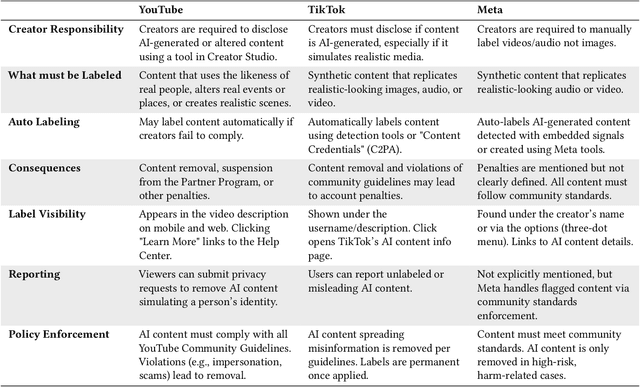
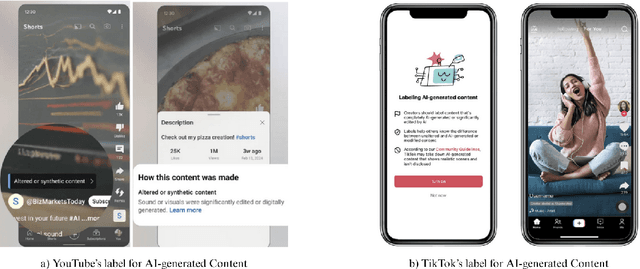
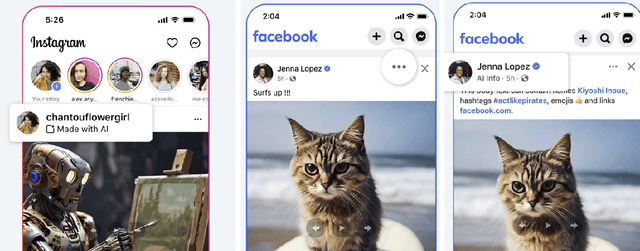

AI-Generated (AIG) content has become increasingly widespread by recent advances in generative models and the easy-to-use tools that have significantly lowered the technical barriers for producing highly realistic audio, images, and videos through simple natural language prompts. In response, platforms are adopting provable provenance with platforms recommending AIG to be self-disclosed and signaled to users. However, these indicators may be often missed, especially when they rely solely on visual cues and make them ineffective to users with different sensory abilities. To address the gap, we conducted semi-structured interviews (N=28) with 15 sighted and 13 BLV participants to examine their interaction with AIG content through self-disclosed AI indicators. Our findings reveal diverse mental models and practices, highlighting different strengths and weaknesses of content-based (e.g., title, description) and menu-aided (e.g., AI labels) indicators. While sighted participants leveraged visual and audio cues, BLV participants primarily relied on audio and existing assistive tools, limiting their ability to identify AIG. Across both groups, they frequently overlooked menu-aided indicators deployed by platforms and rather interacted with content-based indicators such as title and comments. We uncovered usability challenges stemming from inconsistent indicator placement, unclear metadata, and cognitive overload. These issues were especially critical for BLV individuals due to the insufficient accessibility of interface elements. We provide practical recommendations and design implications for future AIG indicators across several dimensions.